

As rooftop solar installations and commercial PV arrays continue to expand across industrial parks, shopping centers, warehouses, and office buildings, maintenance efficiency has become a decisive factor in long-term return on investment. While panel technology keeps improving, dust accumulation, bird droppings, industrial pollutants, and seasonal debris still reduce system performance year after year.
An automatic solar panel cleaning robot offers a scalable and cost-effective solution for photovoltaic system owners seeking consistent output, lower operational expenses, and safer maintenance practices. In this blog post, WANLV SUNNY, as high performance photovoltaic cleaning equipment manufacturer, will share the role of automatic solar panel cleaning robot for rooftop solar systems and commercial PV arrays.
Why Rooftop Solar Systems Require Automatic Solar Panel Cleaning
Rooftop solar systems face unique environmental challenges compared to ground-mounted utility plants. Commercial and industrial rooftops are often exposed to:
• Urban dust and particulate matter
• Exhaust emissions from nearby traffic or factories
• Pollen accumulation during seasonal changes
• Bird nesting and droppings
• Construction debris in developing areas
Even a thin layer of dust can reduce photovoltaic conversion efficiency. Studies consistently show that soiling losses may range from 5% to over 20%, depending on location and climate. For commercial PV arrays operating on tight performance margins, this loss directly impacts electricity generation revenue and financial forecasting.
Manual cleaning methods are labor-intensive, inconsistent, and potentially hazardous when performed on elevated rooftops. An automatic solar panel cleaning robot eliminates these limitations by delivering standardized, repeatable cleaning performance without relying heavily on manual labor.
How an Automatic Solar Panel Cleaning Robot Improves PV Performance
The core purpose of photovoltaic cleaning equipment is simple: maintain maximum light transmittance across the panel surface. However, execution matters.
A high-efficiency robotic solar panel cleaning system typically offers:
• Fast cleaning coverage suitable for large rooftop installations
• Consistent brush pressure for uniform dirt removal
• 360-degree mobility for full panel coverage
• Remote control operation for flexible management
• Anti-drop safety protection for elevated surfaces
By integrating dry brushing and water washing modes, modern solar panel cleaning robots adapt to different levels of contamination. Dry cleaning is ideal for light dust in arid climates, while water-assisted cleaning helps remove sticky residues and industrial grime.
Maintaining clean modules ensures that rooftop solar systems consistently operate closer to their rated capacity, supporting predictable energy output and improved ROI.
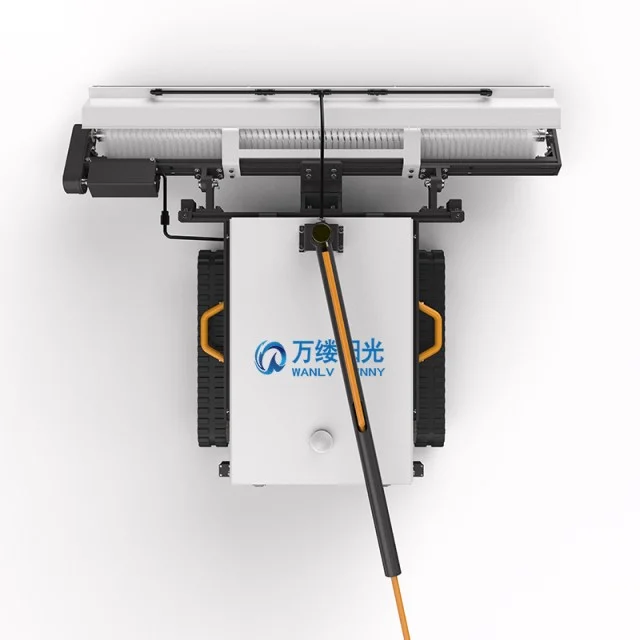
Key Capabilities of Solar Panel Cleaning Equipment for Commercial PV Arrays
When evaluating an automatic solar panel cleaning robot for commercial PV arrays, decision-makers should focus on operational capability rather than marketing claims. The following functional attributes are critical:
High Daily Cleaning Capacity
For medium to large rooftop solar projects, cleaning speed determines economic feasibility. Robotic systems capable of covering megawatt-scale installations per day significantly outperform manual crews in both efficiency and consistency.
Faster coverage reduces downtime and enables regular maintenance cycles, especially in high-dust environments.
Wireless Remote Operation
A wireless remote control system allows operators to manage the photovoltaic panel cleaning robot from a safe distance. Extended control range supports flexible operation across large commercial rooftops without requiring physical repositioning after every cleaning cycle.
This feature also reduces worker exposure to height-related risks.
All-Directional Movement on PV Modules
An effective automatic solar panel cleaning robot must move seamlessly across panel rows, adjusting direction without manual lifting. Omnidirectional mobility ensures complete surface coverage and eliminates blind spots that often remain with traditional tools.
This is especially important for tightly arranged commercial PV arrays where access space is limited.
Integrated Safety Protection
Rooftop solar maintenance carries inherent risks. Anti-drop ultrasonic sensors or edge-detection mechanisms prevent the robot from falling at panel edges. Overload protection systems safeguard both equipment and PV modules during operation.
These smart safety functions make robotic cleaning suitable for high-rise commercial buildings and industrial facilities.
Cost Reduction Through Robotic Solar Panel Cleaning
One of the most compelling reasons commercial system owners adopt automatic solar panel cleaning robots is operational cost control.
Labor Savings
Manual cleaning requires trained workers, safety harnesses, lifting equipment, and coordination. Over time, labor expenses accumulate significantly. Robotic automation reduces manpower requirements while increasing cleaning frequency.
Reduced Downtime
Because photovoltaic cleaning robots operate efficiently and systematically, cleaning cycles can be scheduled with minimal disruption to business operations. This is critical for facilities relying on stable energy supply from rooftop solar installations.
Long-Term Asset Protection
Consistent cleaning prevents the buildup of corrosive residues and hardened deposits that may degrade panel surfaces. Protecting module integrity extends system lifespan and preserves warranty conditions.
Automatic Solar Panel Cleaning Robot in Different Climate Conditions
Rooftop solar systems are deployed globally, from desert industrial zones to humid coastal cities. A versatile photovoltaic cleaning solution must operate reliably across diverse environments.
• In desert regions, dry brushing modes reduce water consumption while removing sand and fine dust.
• In humid or polluted urban areas, water-assisted cleaning removes sticky residues effectively.
• In cold climates, equipment designed for wide operating temperature ranges maintains functionality during seasonal transitions.
The adaptability of modern solar panel cleaning equipment makes it suitable for international solar markets with varying environmental challenges.
Supporting Sustainable Solar Operations
Environmental responsibility is a growing priority for commercial energy users. An automatic solar panel cleaning robot supports sustainability in multiple ways:
• Efficient water usage compared to manual hose-based cleaning
• Reduced chemical dependency
• Lower carbon footprint through automation
• Durable brush materials designed for extended lifecycle
By combining energy production with intelligent maintenance, commercial PV system owners reinforce their sustainability commitments while maintaining peak performance.
Application Scenarios for Rooftop and Commercial Installations
The demand for automatic solar panel cleaning robots is expanding across several commercial sectors:
• Warehouses with large flat rooftop solar systems
• Manufacturing plants with heavy dust exposure
• Shopping malls and commercial complexes
• Logistics centers with distributed PV arrays
• Remote photovoltaic stations with limited maintenance staff
In each scenario, robotic cleaning solutions provide consistent maintenance without disrupting core business activities.
Integration into Solar O&M Strategies
Solar EPC contractors and O&M service providers increasingly incorporate photovoltaic cleaning robots into maintenance contracts. Instead of reactive cleaning schedules, operators now implement preventive cleaning strategies supported by automation.
Routine robotic cleaning improves system monitoring accuracy, as performance data becomes less influenced by soiling variability. This enhances long-term performance analysis and energy yield forecasting.
For commercial solar asset managers, integrating an automatic solar panel cleaning robot into the broader operation and maintenance framework ensures structured, data-driven upkeep rather than occasional manual intervention.
Evaluating Return on Investment for Commercial PV Owners
Investment decisions for commercial PV arrays depend on measurable financial outcomes. Key ROI considerations include:
• Reduction in annual labor expenses
• Increased energy generation due to reduced soiling losses
• Lower safety liability risks
• Extended panel lifespan
When these factors are analyzed collectively, automated photovoltaic cleaning systems often demonstrate strong payback potential, particularly in regions with frequent dust exposure.
The Future of Rooftop Solar Maintenance
As commercial solar adoption accelerates worldwide, maintenance practices must evolve alongside capacity growth. Automatic solar panel cleaning robots are no longer niche tools but strategic assets for commercial PV system management.
Future developments may include AI-based route planning, integration with smart monitoring systems, and predictive maintenance algorithms. However, the core objective remains consistent: ensure rooftop solar systems operate at maximum efficiency with minimal operational risk.
For commercial PV array owners seeking performance stability, cost control, and operational safety, robotic solar panel cleaning equipment represents a forward-looking solution aligned with modern energy infrastructure.
www.wlsolarcleaning.com
WANLV SUNNY