

Buying containerised mobile charging equipment from China is straightforward on the technical side and less so on the commercial side. Product certification, battery transport documentation, warranty structure and the service route all need settling before the order, because they are difficult to renegotiate afterwards.
MPMC POWERTECH CORP. manufactures containerised and trailer-mounted mobile charging equipment as its BCH Series, documented at 80 kW to 600 kW DC output with 70 kWh to 1,075 kWh of onboard storage. This article sets out what an import-focused evaluation should cover.
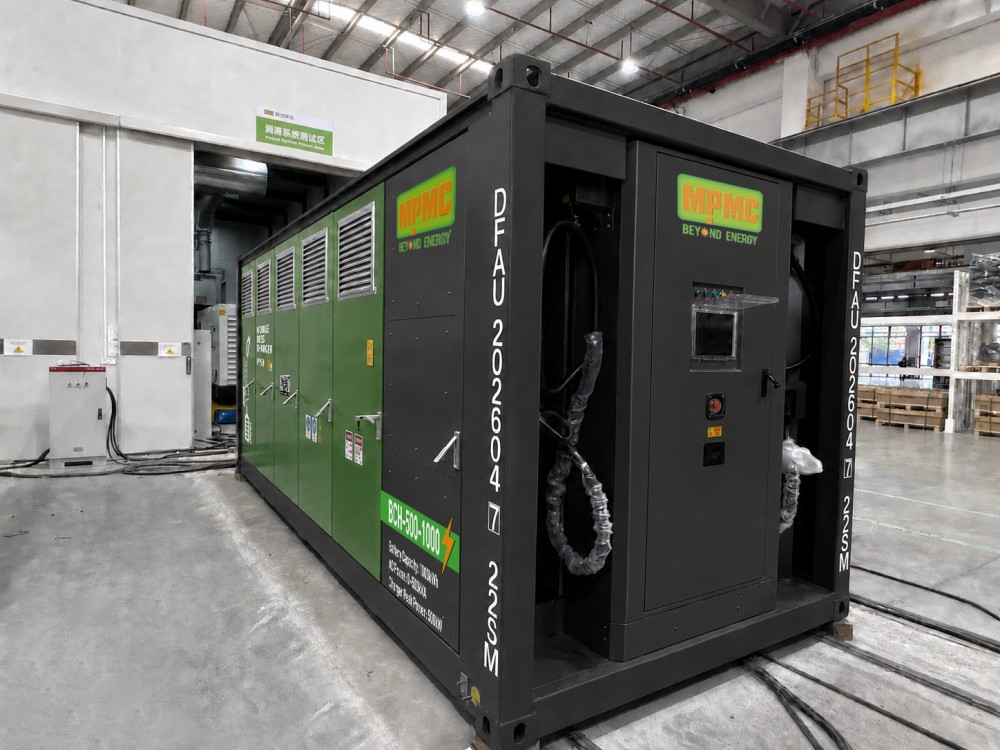
MPMC BCH-500-1000 mobile BESS charger, 20 ft container format with IP54 system protection.
Certification Is Model-Specific and Market-Specific
The most common misunderstanding in this segment is treating certification as a supplier attribute. It is not. It applies to a specific model in a specific market, and a supplier holding a certificate for one model does not automatically hold it for another.
MPMC’s published certification list is set out below. Which entries apply to a given order should be confirmed against the exact model and destination.
|
Level |
Listed certifications |
|
Company |
ISO 9001:2015, ISO 45001, ISO 14001, CNAS-accredited testing centre at Haimen, ARCADIS, ilac MRA, WMI |
|
Product |
CE, TUV, SGS, UN38.3 for battery transport, SABER for Saudi Arabia, France BV, Russian Customs Union, Nigeria SONCAP, China TLC, UL |
Two entries deserve particular attention for this equipment.
UN38.3 is the transport test standard for lithium batteries. Without it, shipping a unit containing a large battery is impractical. Confirm the report exists for the cells in the offered configuration, not for a similar product.
Market-specific certificates such as SABER, SONCAP and the Russian Customs Union documents are usually what determines whether goods clear customs. These should be confirmed early rather than at shipment.
Transport and Delivery Planning
Container format simplifies shipping but does not remove the planning.
Weight and handling
MPMC lists the BCH-500-1000 at 19,800 kg in a 20 ft GP format, the BCH-800-600 at 15,000 kg and the BCH-600-400 at 8,300 kg, each loading one unit per 20 ft container. The trailer-mounted BCH-275-200 is listed at 2,800 kg with four units per 20 ft container.
Crane or heavy forklift access, ground bearing and the delivery route to the final position should be confirmed before the order, not on arrival.
Battery state during shipment
Lithium batteries ship at a controlled state of charge. Confirm the arrangement with the supplier and whether any action is required on arrival before commissioning.
Commissioning responsibility
Confirm who commissions the unit, whether travel is included, and what remote support is available. MPMC lists an EMS with 4G connectivity across the BCH range and an open API, which is the mechanism for remote diagnosis.
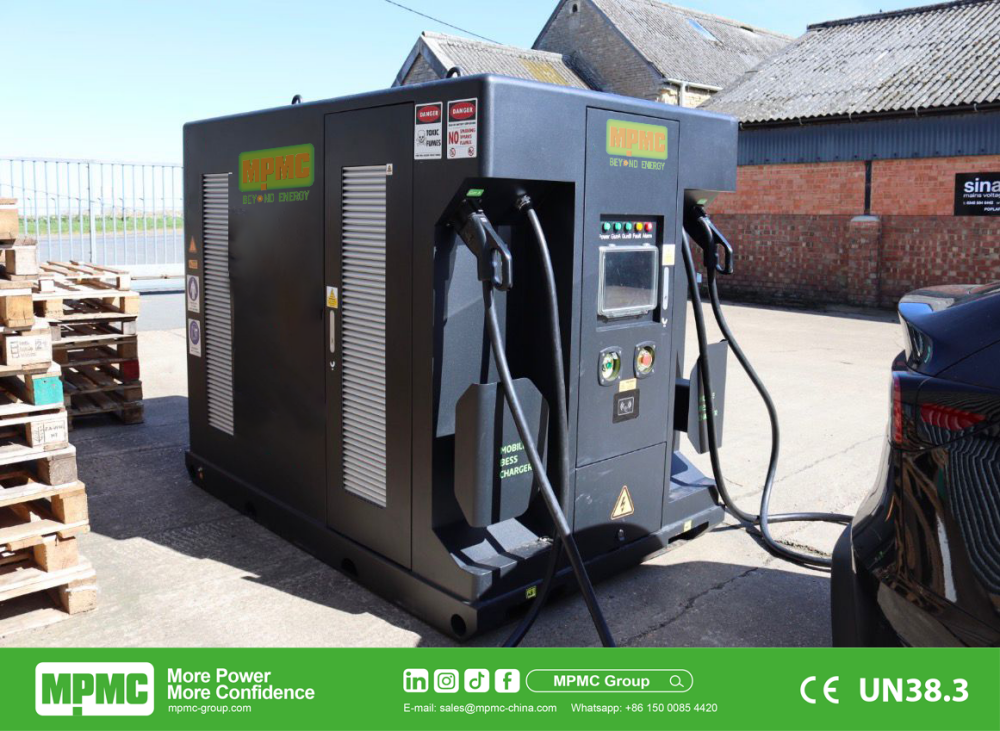
MPMC BCH-275-200 mobile BESS charger in service. 150 kW DC output, 203.5 kWh onboard battery, 2 × CCS2 250 A connectors.
Matching the Format to the Deployment
Container format is not automatically the right answer, and the alternative within the same range is often a better fit.
|
Deployment pattern |
Format to review |
Reason |
|
Fixed position for a long period, lifting equipment available |
Container format, BCH-600-400 and above |
Higher onboard capacity, outdoor-rated, one-time positioning |
|
Frequent relocation between sites |
Trailer-mounted BCH-275-200 |
2,800 kg with a 3.5 t heavy-duty trailer and integrated forklift hole |
|
Multiple small sites served by one asset |
Trailer-mounted BCH-275-200 |
Four units per 20 ft container for import, and towable between positions |
|
Central hub with more than 1 MWh reserve |
BCH-500-1000 |
1,075 kWh onboard with 500 kW AC output available in parallel |
The Product Range in Detail
|
Model |
DC charging output |
Battery capacity at 25°C |
AC input rated power |
DC connectors |
Weight |
|
BCH-80-70 |
80 kW |
70 kWh |
70 kW DC input |
CCS2 260 A × 1 |
880 kg |
|
BCH-275-200 |
150 kW |
203.5 kWh |
80 kW |
CCS2 250 A × 2 |
2,800 kg |
|
BCH-600-400 |
400 kW |
407 kWh |
280 kW |
CCS2 350 A × 2 |
8,300 kg |
|
BCH-800-600 |
600 kW |
610.6 kWh |
280 kW |
CCS2 350 A × 2 |
15,000 kg |
|
BCH-500-1000 |
500 kW |
1,075 kWh |
560 kW |
CCS2 350 A × 2 |
19,800 kg |
MPMC lists CCS2 as the standard connector, with optional CCS1, GB/T and CHAdeMO for specific markets. Confirm the connector requirement at the enquiry stage, because it affects the build rather than being a field-changeable item.
Warranty and Service Structure
Warranty terms in this segment are usually expressed in two dimensions, and both need reading.
MPMC’s published terms for the BCH-275-200 and above list a system warranty of 3 years or 1.6 MWh/kWh total output, whichever comes first, with a battery performance warranty of 5 years or 2.57 MWh/kWh and end-of-life capacity retention of at least 70%. The BCH-80-70 is listed separately at 1 year or 60 MWh total output, with a 3-year or 200 MWh battery performance warranty.
The throughput dimension matters more than the calendar dimension on a heavily used unit. A high-utilisation deployment may reach the energy limit well before the year limit, which changes the effective cover.
Confirm separately what is excluded. Labour, travel and airfreight are commonly outside the scope unless agreed in the contract.
Documented Deployments
|
Location |
Configuration |
Application |
|
Netherlands |
BCH-275-200 and BCH-500-1000 |
Grid-connected EV charging for port and logistics operations |
|
United Kingdom |
BCH-275-200 × 8 units |
Port logistics where the local grid limited EV truck charging |
|
Norway |
BCH Series, 2 MWh total; 500 kW and 1,000 kWh per unit |
Off-grid construction machinery charging |
An Import Timeline
Most difficulties on imported charging equipment come from items closed too late. The sequence below is ordered by when each has to be settled.
|
Stage |
What has to be closed |
Consequence of delay |
|
Before the enquiry |
Connector standard and DC voltage window |
These affect the build, not the configuration |
|
At quotation |
Which certificates apply to the exact model and destination |
Certification cannot be added retrospectively |
|
At order |
UN38.3 documentation for the cells in the offered configuration |
Shipping a large battery without it is impractical |
|
At order |
Warranty text, both dimensions, with exclusions |
Difficult to renegotiate afterwards |
|
Before shipment |
Battery state of charge arrangement, and any action needed on arrival |
Affects commissioning readiness |
|
Before shipment |
Handling equipment, ground bearing and delivery route |
MPMC lists 19,800 kg for the BCH-500-1000, 15,000 kg for the BCH-800-600 |
|
Before arrival |
Commissioning responsibility and travel arrangements |
Determines whether the unit works on day one |
|
At handover |
Spare parts list, lead time and shipping route |
Sets the recovery time for the first failure |
MPMC’s published certification list covers CE, TUV, SGS, UN38.3, SABER, France BV, Russian Customs Union, Nigeria SONCAP, China TLC and UL, applying by model and market rather than across the range.
The Clause Most Often Missing
Warranty documents in this segment usually state what is covered. Fewer state clearly who travels.
MPMC’s published warranty for the BCH-275-200 and above is 3 years or 1.6 MWh/kWh total output with a 5-year or 2.57 MWh/kWh battery performance warranty, and the general after-sales position excludes labour, travel and airfreight unless agreed in the contract.
For an imported unit, that exclusion is often the largest part of a repair cost. Two questions are worth putting in writing before the order: which faults can be diagnosed and cleared remotely through the EMS, and what the commercial arrangement is when they cannot.
A supplier willing to answer both specifically is offering a support model. One that answers with a service network map is offering a brochure.
https://www.mpmc-group.com/
MPMC Powertech Corp.