

A modern chemical plant is not built by simply placing a group of machines inside a workshop. Its real performance depends on how well the process, raw materials, equipment, utilities, control systems, construction work, and commissioning are connected.
This is particularly true for phosphate chemical and fertilizer projects. Changes in phosphate rock quality, process conditions, or slurry behavior can influence reaction efficiency, filtration, acid concentration, energy use, and equipment service life. As a result, chemical plant design and construction needs to consider the complete production process from the beginning.
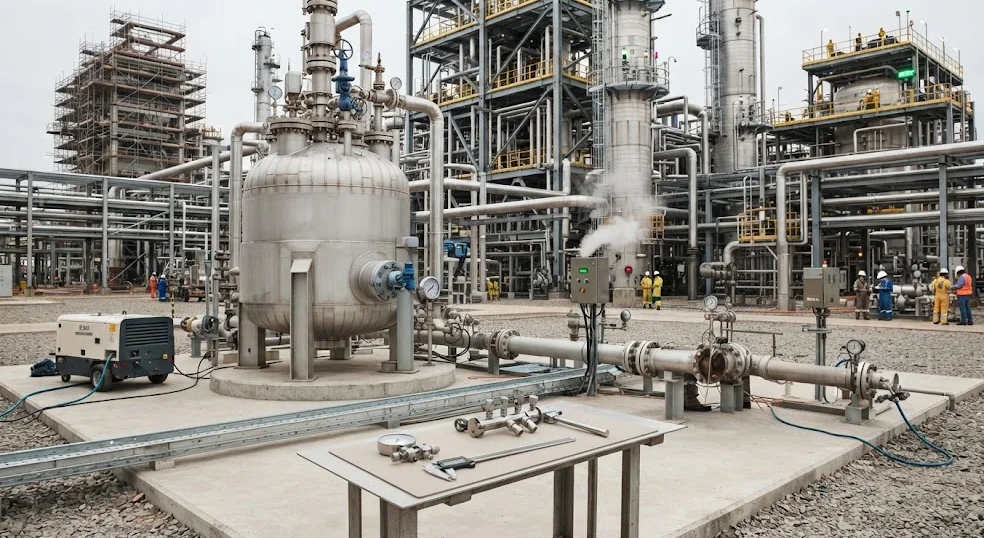
1. Begin with the Process, Not the Equipment
The first stage of a chemical plant design project is to determine how the production process should work.
Before choosing individual machines, engineers normally need to evaluate production capacity, raw material characteristics, product requirements, utility availability, energy consumption, environmental requirements, material balance, and possible future expansion.
For a phosphoric acid plant, the selected process route determines how key operations such as reaction, crystallization, filtration, concentration, fluorine recovery, and tail-gas treatment are connected.
The hemihydrate-dihydrate (HH-DH) process is one example. It involves controlled crystallization and conversion steps to produce concentrated phosphoric acid while forming calcium sulfate in a suitable form for filtration. The performance of the complete system depends on coordinating reaction conditions, crystal formation, filtration, gas treatment, and concentration.
Therefore, process engineering is about more than drawing a flow diagram. It establishes the conditions needed for stable industrial production.
2. Raw Materials Can Change the Production Strategy
For phosphate chemical plants, raw material quality deserves particular attention during the engineering stage.
Phosphate rock from different sources may vary in chemical composition, moisture, particle size, and impurity levels. These differences can affect how the material reacts, how gypsum crystals develop, how easily the slurry can be filtered, and how much phosphorus can ultimately be recovered.
A process that performs well with one phosphate rock may not deliver the same results with another source.
For this reason, phosphoric acid plant engineering should take the expected raw material supply into account before the final process and equipment specifications are established. Laboratory analysis, process calculations, material balances, and pilot testing where necessary can provide useful information for determining suitable operating conditions.
This approach also helps avoid designing a plant around ideal feedstock that may not represent actual commercial production.
3. Choose Chemical Processing Equipment Around Real Conditions
After the process route has been established, the next step is selecting equipment that can perform reliably under those conditions.
A typical phosphate chemical production system may include reactors, agitators, filters, pumps, evaporators, scrubbers, heat exchangers, storage tanks, pipelines, and process instrumentation. These units cannot be evaluated independently because the performance of one section can directly affect another.
Filtration is a good example. In phosphoric acid production, slurry properties and gypsum crystal structure have a direct influence on filtration efficiency. Poor filtration can reduce phosphorus recovery, affect washing results, limit production capacity, and increase the burden on downstream concentration.
Material selection is also important. Acidic, hot, and abrasive slurries can cause both corrosion and wear. Equipment materials, protective linings, pumps, pipelines, agitators, and tanks should therefore be selected according to factors such as acidity, temperature, solids content, and operating conditions.
For the HH-DH process, Sawei's technical approach includes the use of corrosion- and wear-resistant materials for critical equipment components.
The best chemical processing equipment is therefore not necessarily the largest or cheapest option. It is equipment that is properly matched to the process and expected working environment.
4. Integrated Engineering Has a Direct Impact on Performance
A chemical plant operates as a connected system. Problems often appear where different systems meet rather than inside one piece of equipment.
For example, reaction conditions influence slurry properties; slurry properties affect filtration; filtration affects phosphorus recovery; concentration influences energy demand; and gas treatment affects environmental performance.
This is why chemical process engineering needs to look at the entire production chain.
Important factors such as heat recovery, utility consumption, corrosion protection, emissions control, equipment maintenance, accessibility, and automation should be addressed during the design phase.
For phosphate projects, integrated process planning can also help improve phosphorus recovery and by-product handling. In an HH-DH production route, secondary filtration and liquor recycling can contribute to better phosphorus recovery, while the resulting dihydrate gypsum can offer advantages in handling and potential utilization.
5. Construction Quality Protects the Original Design
Once process engineering and detailed design are complete, construction turns the engineering plan into a physical production facility.
This stage requires close attention to equipment foundations, machinery alignment, pipeline installation, structural supports, electrical systems, instrumentation, insulation, and material specifications.
Chemical plants also present demanding service conditions. A wrong material, poorly installed lining, incorrect pipeline connection, or misaligned rotating machine can cause significant problems after startup.
For this reason, construction management should include systematic equipment inspection, pressure and pipeline testing, instrumentation verification, mechanical completion checks, and other pre-commissioning activities.
The objective is to make sure the plant entering commissioning is consistent with the approved engineering design.
6. Commissioning Connects the Plant with Actual Production
A completed construction project does not automatically mean a production-ready plant.
Chemical plant commissioning normally takes place step by step. Engineers first check mechanical and electrical systems, then test individual equipment and supporting systems before gradually introducing process materials.
Actual operating conditions can then be compared with the design expectations.
The production sequence may involve:
Raw material preparation → reaction → slurry handling → filtration → concentration → gas treatment → final product
During startup, engineers may identify differences in pressure, temperature, vibration, filtration performance, material balance, emissions, or product quality. These observations provide an opportunity to adjust operating parameters and correct problems before the plant enters stable continuous production.
Effective commissioning is therefore an important part of achieving the expected performance of a chemical production line.
7. Engineering Experience Helps Reduce Project Risk
For investors and chemical manufacturers, project risk rarely comes from one equipment item alone. More often, it results from poor coordination between process technology, equipment selection, construction, and actual operating requirements.
Sawei Equipment focuses on phosphate chemical and fertilizer projects and has technical capabilities covering process research, engineering design, plant construction, commissioning, and related project services.
Its experience includes projects involving phosphoric acid, sulfuric acid, phosphate fertilizer, and feed-grade phosphate production. This broad project experience allows process requirements and equipment considerations to be evaluated together instead of treating each stage as a separate task.
For a new chemical plant or an expansion project, this type of integrated engineering capability can help reduce the gap between the original process design and the final production result.
Conclusion
A successful chemical plant design and construction project should be planned as a complete engineering journey rather than a series of separate equipment purchases.
The process starts with understanding raw materials and production requirements, followed by process selection, equipment integration, detailed engineering, construction, commissioning, and eventual optimization.
For phosphate and fertilizer manufacturers, this approach is particularly important because changes in raw materials and process conditions can have a direct impact on filtration, phosphorus recovery, energy consumption, product quality, and equipment durability.
The final objective is not simply to construct a chemical plant. It is to establish a production system that can work reliably with real industrial feedstocks, maintain consistent product quality, manage energy and emissions, and support long-term production goals.
With appropriate chemical process engineering, suitable equipment, and experienced project execution, the transition from initial design to commercial operation can become much more predictable and manageable.
www.phosphoruschemical.com
Jiangsu Sawei Equipment Technology Co., Ltd.