

Modern ballistic helmets rely heavily on advanced material engineering to achieve a practical balance between protection, weight, durability, comfort, and long-term reliability. Among the different material solutions available today, composite construction has become an important approach because it allows manufacturers to combine the characteristics of multiple materials within a single helmet structure.
Rather than depending on one material to provide every required property, composite helmets can be engineered by combining layers, fibers, binders, and structural materials with different characteristics. This approach gives manufacturers greater flexibility when designing the shell and optimizing the overall performance of the finished product.
For buyers evaluating ballistic helmet materials, understanding composite construction is important because the performance of a helmet is influenced not only by the material itself but also by how different materials are combined, processed, and integrated into the final shell.
This article explains how composite materials can improve ballistic helmet performance, what advantages they offer, and which factors buyers should consider when evaluating composite ballistic helmets from a manufacturer.
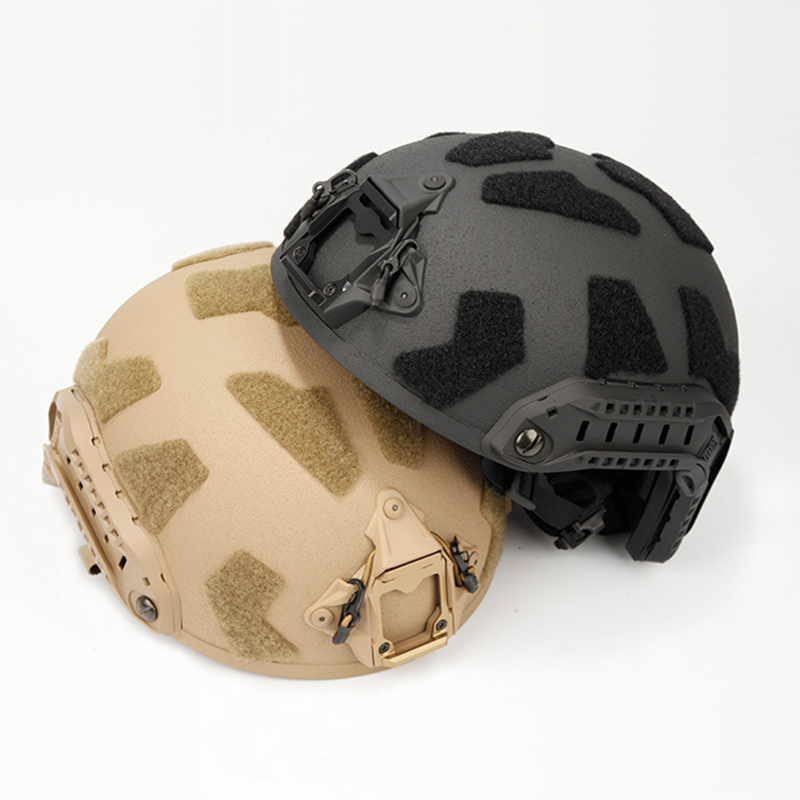
What Are Composite Materials in Ballistic Helmets?
A composite material is generally made by combining two or more different materials to create a structure with properties that are difficult to achieve using one material alone.
In the context of ballistic helmets, composite construction commonly involves high-performance fibers combined with a suitable matrix or bonding system.
Depending on the product design, manufacturers may work with materials such as:
-
Aramid fibers
-
UHMWPE
-
Fiber-reinforced composites
-
Resin systems
-
Protective coatings
-
Structural bonding materials
The exact combination varies according to the manufacturer's design and the intended product specifications.
The basic concept is relatively straightforward: each material contributes certain characteristics, while the overall structure is engineered to provide a balanced result.
For example, one material may contribute high tensile strength, while another provides structural stability or helps maintain the shape of the shell.
This makes composite construction particularly useful for ballistic helmet manufacturers looking to optimize several performance characteristics at the same time.
Why Material Selection Matters for Ballistic Helmets
The material used in a helmet shell affects much more than its basic protective characteristics.
Material selection can influence:
-
Overall weight
-
Shell thickness
-
Structural strength
-
Impact resistance
-
Durability
-
Environmental stability
-
Manufacturing consistency
-
Comfort
-
Service life
A helmet that performs well in one category may not necessarily offer the best balance across all categories.
For example, reducing weight may improve comfort, but the manufacturer still needs to maintain sufficient structural integrity. Increasing shell thickness may affect weight, while changing the fiber structure may affect manufacturing requirements.
Composite construction gives manufacturers more options for managing these trade-offs.
Instead of asking which single material is the strongest, product designers can consider how different materials work together within the complete shell structure.
1. Composite Materials Can Improve the Strength-to-Weight Ratio
One of the most important advantages of composite construction is the potential to achieve a favorable strength-to-weight balance.
Weight is a major consideration when designing ballistic helmets.
A helmet that is unnecessarily heavy can increase physical burden and reduce comfort during extended use. At the same time, reducing weight must not compromise the structural requirements of the product.
High-performance fibers such as aramid and UHMWPE offer useful strength-to-weight characteristics. By engineering these materials into a composite shell, manufacturers can optimize material distribution and shell construction.
The goal is not simply to make the helmet as light as possible.
Instead, the objective is to create a shell that provides the required performance while keeping unnecessary mass under control.
This is one reason why lightweight composite construction has become an important area of development in the ballistic helmet industry.
2. Layered Construction Helps Manage Material Properties
Composite helmets often use multiple layers rather than relying on a single homogeneous material.
Each layer can contribute differently to the overall structure.
For example, the design may control:
-
Fiber orientation
-
Layer thickness
-
Material sequence
-
Bonding
-
Surface treatment
-
Shell geometry
The interaction between these layers can influence how the shell responds to external forces.
Instead of treating the shell as a single piece of material, engineers can design a layered structure where different parts contribute to overall mechanical performance.
This approach also provides opportunities to optimize the shell according to different areas and design requirements.
The result is a more engineered approach to ballistic helmet construction.
3. Composite Construction Can Help Manage Impact Energy
When an external force acts on a helmet, the shell needs to respond in a controlled way.
The ability of a material system to absorb, distribute, and manage energy is an important aspect of ballistic helmet performance.
Different fibers and matrix materials can respond differently to applied forces.
In a properly engineered composite structure, the layers work together to distribute stress across a larger area rather than allowing all of the force to concentrate in one location.
Fiber orientation is particularly important.
Manufacturers can arrange fibers in different directions to create a more balanced structural response.
This is one reason why simply knowing that a helmet uses a particular fiber is not enough to evaluate the complete product. The architecture of the composite is equally important.
4. Composite Materials Can Improve Structural Stability
A helmet shell needs to maintain its intended geometry under normal conditions.
Composite construction can provide a combination of stiffness and structural stability that supports the shell's shape.
This can be particularly useful when manufacturers need to create specific shell geometries while maintaining consistent dimensions.
The shell geometry itself can also influence how the composite structure distributes stress.
Therefore, ballistic helmet performance depends on the relationship between:
-
Material selection
-
Fiber arrangement
-
Layer structure
-
Shell geometry
-
Manufacturing process
A high-quality composite helmet is the result of these factors working together rather than the result of one material specification.
5. Composite Materials Can Support Lightweight Helmet Design
Weight reduction is a major consideration in modern protective equipment.
A lighter helmet can potentially improve comfort and reduce unnecessary physical load.
However, lightweight design requires careful engineering.
Simply removing material is not an appropriate approach because it can change the structural properties of the shell.
Composite construction allows manufacturers to optimize the amount and distribution of material.
For example, high-performance fibers can provide significant structural contribution without requiring the same mass associated with some conventional materials.
This makes composite construction suitable for manufacturers developing lightweight ballistic helmets.
For buyers, however, the word "lightweight" should always be evaluated alongside documented product specifications.
A lightweight product should still meet the relevant performance requirements for its intended application.
6. Aramid Composites Offer a Different Performance Profile
Aramid is one of the well-known fiber materials used in protective composite construction.
Aramid fibers are valued for their high strength, low density, and resistance characteristics.
In a composite helmet, aramid fibers can be arranged into multiple layers and combined with a suitable matrix system.
The final performance depends on more than the fiber itself.
Important variables include:
-
Fiber quality
-
Fiber orientation
-
Layer count
-
Areal density
-
Resin system
-
Manufacturing pressure
-
Curing conditions
-
Shell geometry
This is why two helmets that both use aramid may still have different performance characteristics.
When evaluating ballistic helmet materials, buyers should therefore ask manufacturers about the complete construction rather than relying only on a material name.
7. UHMWPE Composites Can Support Weight Optimization
UHMWPE is another material commonly associated with lightweight composite protective structures.
Its low density and high strength characteristics make it attractive for manufacturers looking to reduce overall helmet weight.
UHMWPE-based construction can be engineered through controlled layering and bonding processes.
As with aramid, the final performance depends on the entire material system.
Important considerations include:
-
Fiber quality
-
Layer configuration
-
Matrix or bonding system
-
Manufacturing temperature
-
Pressure
-
Shell design
-
Quality control
UHMWPE also has specific environmental and processing characteristics that manufacturers must understand.
A professional ballistic helmet manufacturer should therefore control production parameters carefully to maintain consistency.
8. Hybrid Composites Can Combine Different Material Characteristics
Composite construction does not always require the use of only one fiber type.
In some designs, manufacturers may investigate hybrid structures that combine different materials.
The purpose of a hybrid composite is to take advantage of the different properties of each material.
For example, one material may contribute weight efficiency while another contributes structural characteristics or durability.
The final design depends on the engineering objectives.
Hybrid construction can provide greater flexibility, but it also makes manufacturing more complex.
Layer sequence, bonding, processing conditions, and quality control become increasingly important.
Therefore, buyers should evaluate the manufacturer's ability to consistently reproduce the specified composite structure.
9. Composite Materials Can Improve Durability When Properly Engineered
Durability is another important factor when evaluating ballistic helmet performance.
A helmet may be exposed to repeated handling, transportation, environmental changes, cleaning, and physical contact during its service life.
Composite materials can be engineered to provide a stable structural shell, but durability depends heavily on manufacturing quality.
Potential durability factors include:
-
Material quality
-
Fiber integrity
-
Bonding quality
-
Surface protection
-
Edge finishing
-
Environmental resistance
-
Manufacturing consistency
A composite structure with poor bonding or inconsistent processing may not deliver the same durability as a properly manufactured product.
This highlights an important principle:
Composite material selection and manufacturing quality must be considered together.
10. Manufacturing Process Is Just as Important as Material Selection
It is easy to focus on the material name when comparing ballistic helmets, but manufacturing technology can be equally important.
Composite manufacturing may involve processes such as:
-
Material cutting
-
Layer preparation
-
Fiber orientation
-
Lay-up
-
Molding
-
Compression
-
Curing
-
Trimming
-
Surface finishing
-
Final inspection
Each stage can affect the consistency of the final product.
For example, incorrect fiber orientation may influence the mechanical behavior of the shell. Inconsistent bonding can create variations between production batches.
A professional ballistic helmet manufacturer should therefore maintain strict process controls.
For large orders, buyers should also ask how the manufacturer monitors batch-to-batch consistency.
11. Shell Geometry Works Together With Composite Materials
Material performance cannot be separated completely from shell geometry.
The shape of a helmet influences how forces are distributed across the shell.
Designers need to consider:
-
Curvature
-
Thickness
-
Edge geometry
-
Cut profile
-
Mounting interfaces
-
Ventilation openings
-
Overall shell dimensions
A composite material that performs well in one geometry may behave differently when used in another design.
This is why product development should evaluate material and geometry as an integrated system.
For buyers, this also means that a supplier should not automatically assume that a test result from one helmet configuration applies to a significantly different model.
12. Composite Materials Can Help Control Shell Thickness
Another potential advantage of engineered composites is the ability to optimize shell thickness.
Traditional materials may require certain thicknesses to achieve specific structural characteristics.
Composite construction allows engineers to manipulate:
-
Fiber type
-
Fiber orientation
-
Layer count
-
Layer thickness
-
Material distribution
This can help manufacturers develop a shell with a more controlled thickness profile.
However, thinner does not automatically mean better.
The correct thickness depends on the complete design and applicable performance requirements.
The objective should be optimization rather than simply reducing material usage.
13. Environmental Performance Depends on the Complete Composite System
Environmental resistance is another important consideration.
A composite helmet may experience changes in:
-
Temperature
-
Humidity
-
UV exposure
-
Moisture
-
Chemical contact
Different materials within the composite structure may respond differently to these conditions.
For example, fibers, resins, coatings, adhesives, and hardware can have different environmental characteristics.
Therefore, environmental durability should be evaluated at the complete-product level.
Testing can help determine how the finished ballistic helmet responds to environmental conditioning.
Buyers should ask whether the manufacturer's environmental test results apply to the same material configuration and production model being purchased.
14. Composite Materials Can Support Consistent Product Design
Another advantage of controlled composite manufacturing is the ability to produce repeatable shell structures.
For large-scale production, consistency is essential.
Buyers need products with similar:
-
Dimensions
-
Weight
-
Shell geometry
-
Surface finish
-
Material structure
-
Hardware configuration
Manufacturers can use controlled composite processes to maintain these characteristics across production batches.
However, consistency depends on process control.
A manufacturer should monitor raw materials, production parameters, tooling, curing conditions, and finished products.
This is particularly important for bulk ballistic helmets, where small differences across hundreds or thousands of units can create significant quality-control problems.
Final Thoughts
Composite materials can improve ballistic helmet performance by allowing manufacturers to combine different material characteristics within one engineered structure. Through careful selection of fibers, bonding systems, layer arrangements, and shell geometry, composite construction can support a practical balance between weight, structural stability, durability, and long-term reliability.
Aramid and UHMWPE are two important material options, but neither should be evaluated in isolation. The final performance of a composite helmet depends on material quality, fiber orientation, layer configuration, manufacturing conditions, shell geometry, environmental resistance, and quality control.
For buyers, this means that choosing ballistic helmets should involve more than comparing material names or product weights. It is important to evaluate the manufacturer's production capabilities, testing documentation, quality-control procedures, and ability to maintain consistency across large production batches.
Ultimately, a well-designed composite ballistic helmet is the result of material engineering and manufacturing discipline working together. When manufacturers control both aspects carefully, composite construction provides greater flexibility for developing helmets that balance performance, durability, weight, and practical usability.
www.militarytex.com
militarytex