

Understanding the Core Challenge Behind Backup Time Selection
For telecom operators, Internet Service Providers, broadband network companies, and system integrators, one recurring technical question shapes procurement decisions: how much backup time does a mini UPS actually need to provide for broadband customer-premises equipment? Routers, modems, and ONTs are highly sensitive to short power outages, voltage drops, and unstable grid conditions. A device that reboots during a brief interruption can disrupt service continuity for end users, generate support tickets, and undermine network reliability metrics. Choosing the wrong backup time — either underestimating runtime needs or overpaying for capacity that exceeds actual requirements — is a common and avoidable selection risk.
Why Backup Time Depends on Real Device Behavior, Not Assumptions
Backup time is not a fixed number that can be applied uniformly across all broadband equipment. It is a function of several measurable variables: the device’s real voltage and working current, its peak or startup current behavior, and the installation environment in which it operates. A router drawing a steady 1.5A will behave very differently under a power interruption than a high-performance gateway with storage integration drawing 4A continuous current. This is why evaluating solutions based on actual device specifications — rather than generic assumptions — is the foundation of correct mini UPS selection. Improper matching of voltage, current, peak load, or connector type can lead to application failure even when the UPS itself is technically sound.
Shanghai Mylion New Energy Co., Ltd., operating under the MYLION brand, positions its evaluation process around this principle. Rather than offering a single generic backup solution, the company confirms technical requirements — including connector and cable matching — before recommending a specific model. This approach is designed to reduce the selection errors that commonly occur when backup time is chosen without reference to real operating conditions.
Matching Mini UPS Battery Capacity to Broadband Equipment
Battery energy, measured in Wh, is the primary determinant of how long a device can remain powered during an outage, but it must be considered alongside the continuous and maximum current the UPS can deliver.
Standard 12V Series for Entry-Level to Mainstream Backup
For routers and ONTs with standard current draw, the 12V Standard Series offers a graduated range of battery capacities. The MU26W provides 18.72Wh of energy with 12V DC output at 2.5A continuous / 3A maximum, suited to short outages causing router or ONT reboots. The MU48W steps up to 29.6Wh for mid-range capacity needs, while the MU68W extends further to 44.4Wh, targeting professional ISP projects that require longer backup coverage than entry-level deployments.
Long-Runtime Series for Extended Outages
When outages last longer — particularly in residential or remote areas — the 12V Long-Runtime Series, represented by the MU635W and MU635L, delivers 75.6Wh of battery energy while maintaining the same 2.5A continuous / 3A maximum output. This series is positioned specifically for prolonged service continuity on standard CPE devices, illustrating that backup time selection is not only about battery size but about matching that size to the expected outage duration.
High-Power Series for Demanding Equipment
Some broadband equipment, particularly high-performance WiFi devices and storage-integrated gateways, exceeds standard 2.5A thresholds. The MU65W addresses this with 4A continuous / 5A maximum output (60W total) and 56.16Wh of battery energy, supporting 12V DC input up to 6A. For customers who need both high current support and extended runtime simultaneously, the MU35W and MU35L combine the same 60W output capability with 75.6Wh of battery capacity — a direct illustration of how performance and duration can be engineered together rather than traded off against each other.
Technical Parameters That Define Backup Time in Multi-Device Setups
Broadband installations often involve more than a single device. The 12V + USB Multi-Output Series was developed for these scenarios. The MUJ46 provides 12V DC output at 1.5A continuous / 2A maximum alongside dual 5V/3A USB-A and USB-C outputs, within an 18W maximum total output limit, backed by 37.44Wh of battery energy — enabling simultaneous backup for a router and a USB accessory in small office or home office setups. The MUJ435 extends this concept with 50.4Wh of battery energy while maintaining the same 18W system limit and port configuration, offering longer runtime for multi-device installations.
For deployments where two 12V devices — such as an ONT and a router — are powered from a single AC wall outlet, the AC-Input Dual Output Series offers a different structural approach. The ML1202AC accepts 100–240V AC input and uses LiFePO4 battery chemistry to deliver two independent 12V DC outputs (2A each, 24W total system limit) from 25.6Wh of battery energy, removing the need for an external DC adapter and simplifying installation for combined ONT and router setups.
Development Directions for Emerging High-Power Needs
As broadband equipment evolves toward WiFi 6/7 standards and higher-voltage wireless CPE, backup time requirements are shifting accordingly. Two development-stage directions at Shanghai Mylion New Energy reflect this trend. The MUC85, currently under project evaluation only, is designed around USB-C Power Delivery input (65W standard / 100W max) with two USB-C outputs — up to 20V/3.25A (65W) and up to 12V/2.5A (30W) — supported by 92.16Wh of battery energy, addressing modern WiFi 6/7 devices that require USB-C PD. The MU248 targets higher-voltage wireless CPE and radio bridge equipment, using LiFePO4 chemistry with 48V/60V DC input and independent 24V (3A) and 48V (1A) outputs within a 100W total power limit, backed by 102.4Wh of battery energy. These directions indicate how backup time considerations must expand alongside changing equipment standards.
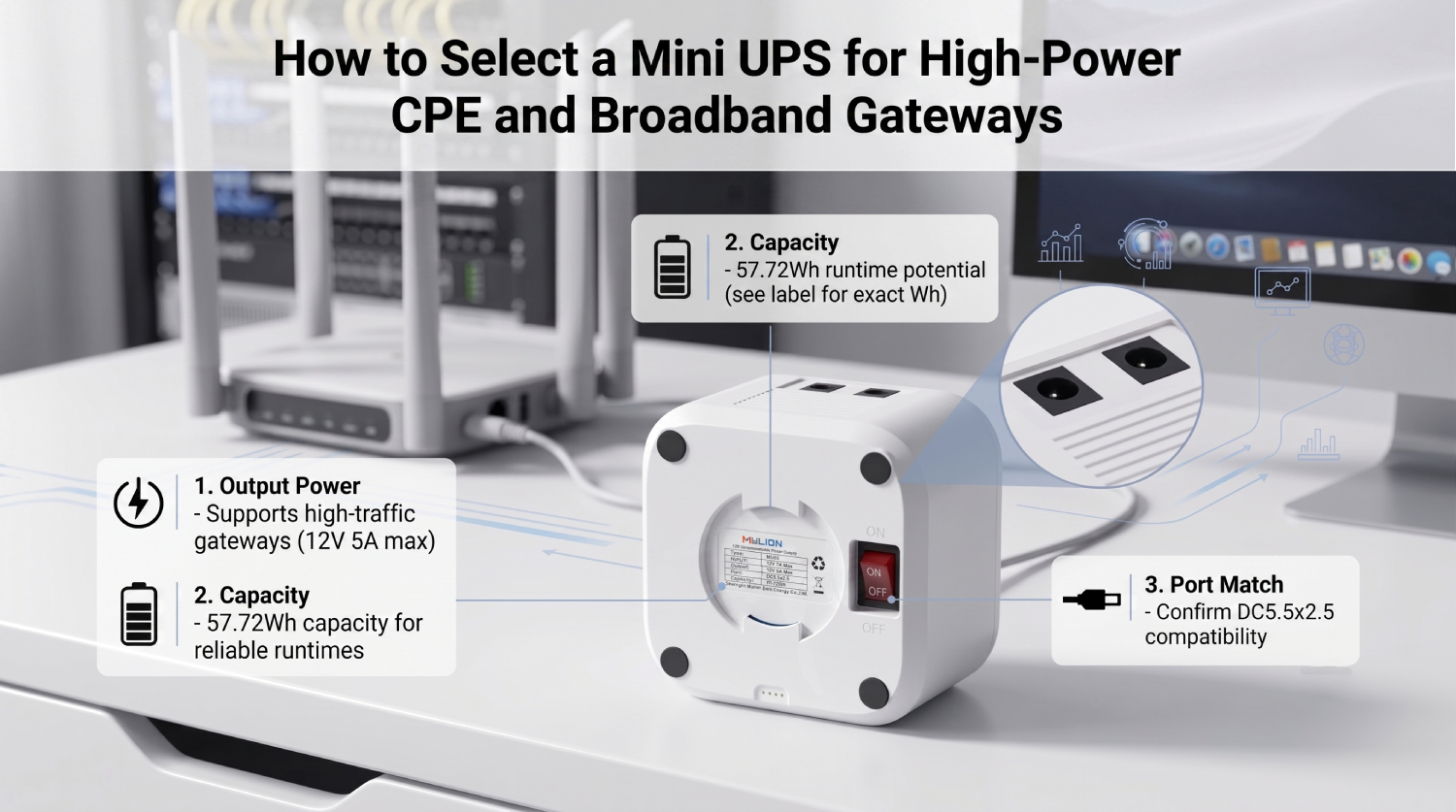
A Structured Approach to Backup Time Selection
With 13+ years of experience in lithium battery technology and 10+ years focused specifically on Mini UPS development, Shanghai Mylion New Energy Co., Ltd. supports broadband customers through a defined process: requirement analysis, model matching, sample testing support, connector and cable matching, and documentation coordination through UN38.3 and MSDS model-specific compliance. This B2B and OEM/ODM project support model is built around confirming real voltage, current, and installation conditions before recommending battery capacity — helping telecom operators, ISPs, and system integrators select backup time that matches actual operating requirements rather than approximate estimates.
Conclusion
Selecting the correct mini UPS backup time for broadband customer-premises equipment requires more than choosing the largest available battery. It requires aligning battery energy, continuous and maximum current output, connector compatibility, and installation environment with the specific device being protected. Across its 12V Standard, Long-Runtime, High-Power, Multi-Output, AC-Input, and development-stage series, Shanghai Mylion New Energy Co., Ltd. under the MYLION brand structures its Mini UPS and DC backup power portfolio around this principle, offering broadband customers a technically grounded path to more reliable backup power deployment.
www.myliontech.com
Shanghai Mylion New Energy Co.,Ltd.