

For manufacturers across automotive, electronics, home appliances, beauty, lighting, and new energy sectors, sourcing recycled plastic has moved from a sustainability nice-to-have to a procurement necessity. Yet the market is crowded with claims of "green" and "eco-friendly" materials, making it difficult for buyers to separate genuine capability from marketing language. Understanding what distinguishes a dependable PCR (Post-Consumer Recycled) material partner is essential before signing any supply agreement.
Why Traceability Should Be the First Filter
A core challenge in the recycled plastics industry is verifying that a material is genuinely post-consumer recycled, rather than mixed with unverified or virgin content. Buyers should look for suppliers that offer full lifecycle traceability rather than self-declared claims. Ningbo Topcentral New Material Co., Ltd., operating under the brand Topcentral®, addresses this through its proprietary blockchain system, TcBChain®, combined with "CarbonCode" technology, which enables cradle-to-grave dual-verification traceability for every batch of material produced. Each product is further equipped with a unique Digital Product Passport powered by iDNAXx® technology, giving buyers a verifiable data trail rather than a paper assurance.
Checking Certifications and Compliance Credentials
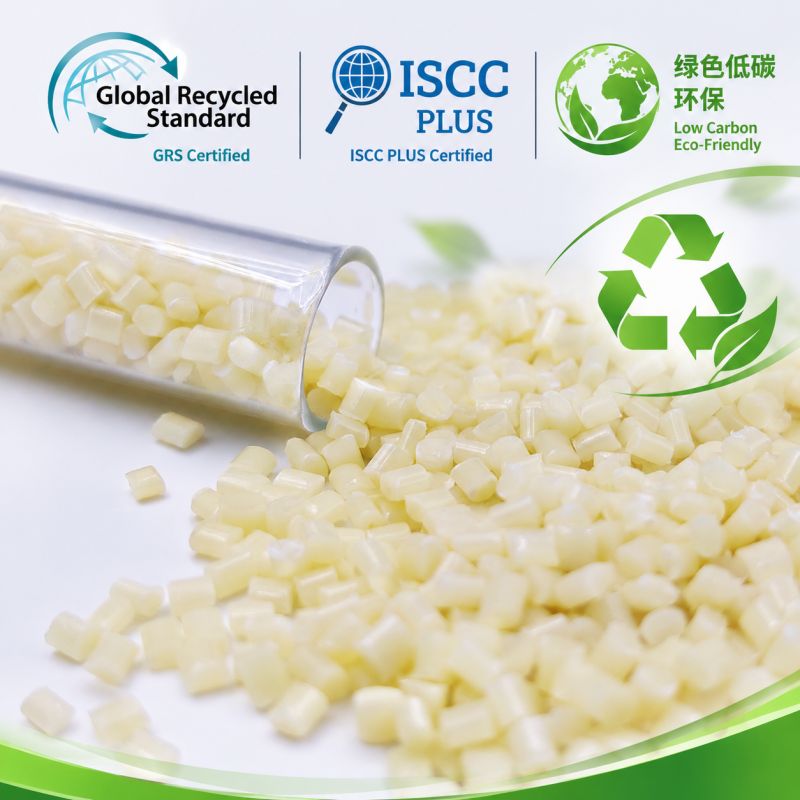
A reliable supplier should hold recognized third-party certifications that validate both material quality and sustainability claims. Relevant credentials to confirm include GRS (Global Recycled Standard), ISCC PLUS (International Sustainability & Carbon Certification), and carbon footprint standards such as ISO 14064 and ISO 14067. Quality and safety systems matter equally—IATF 16949 for automotive applications, ISO 9001 for quality management, ISO 14001 for environmental management, ISO 45001 for occupational health and safety, and ISO 50001 for energy management all indicate operational maturity. Topcentral holds this full certification set, alongside Sony Green Partner Certification and UL 2809 / UL OBP / UL ITE listings, which together confirm that its materials meet RoHS, REACH, and FDA standards for sensitive applications including food-contact and electronics housings.
Evaluating Technical Depth, Not Just Material Availability
A supplier’s ability to deliver consistent, high-performance recycled resin depends on underlying R&D capability. Buyers should ask how many patents a supplier holds, whether it participates in national or industry standard-setting, and whether it collaborates with academic institutions. Topcentral has been granted 82 patents, including 44 invention patents, alongside 5 software copyrights and 5 copyrights. The company led the development of the national standard for recycled PBT in 2022 and maintains ongoing collaboration with the Chinese Academy of Sciences, Tianjin University, Zhejiang University, and Zhejiang University Ningbo Institute of Technology. This research foundation supports four distinct technology pathways: physical recycling (PlasCircles™), chemical recycling (ChemCircle™), new material modification (CircleBlend®), and bio-based/degradable materials (Bydercom®)—giving buyers access to multiple recycling routes depending on application requirements.
Assessing Product Breadth Across Material Families
Procurement teams often need more than one resin type to cover a full product line, so working with a supplier that offers a wide product matrix reduces supply chain complexity. Topcentral’s portfolio spans PCR general plastics under the TcycleGP® line—including IBISS® rABS, PloyPoy® rPP, Poisye® rPE, Gipurpose® rGPPS, and TC-Rester® rPET—as well as PCR engineering plastics under TCycleEP®, covering Topcircle® rPC, Nairong® rPA6/rPA66, and Pubit® rPBT. For more demanding applications, the company’s TcycleSP® special engineering line includes RIPEl® rPEI, Lacypee® rLCP, ParSuie® rPSU/rPPSU/rPES, and Parpus® rPPS, while TCycleElast® covers thermoplastic elastomers such as Taporu® rTPU and TayPreme® rTPE. The company also supplies TcycleAM® 3D printing filaments and CircleBlend® modified alloy products, meaning a single supplier relationship can support multiple engineering needs simultaneously.
Looking for Quantified, Application-Specific Performance Data
Vague sustainability claims are far less useful than application-specific, quantified results. Reliable suppliers should be able to point to documented performance outcomes. For example, Topcentral’s IBISS® rABS line demonstrates carbon emission reduction of up to 77.7% compared to virgin resin, while its Topcircle® rPC line achieves a maximum 91.8% carbon emission reduction. In automotive structural applications, the company’s "Car-to-Car" closed-loop program has achieved a load-bearing capacity of up to 50kg for brake pedals using 30% PCR rPA66, demonstrating that recycled content can meet safety-critical specifications. In the beauty packaging sector, its rPETG series has achieved an 80% carbon emission reduction while meeting RoHS and SVHC cosmetic regulations. These figures give procurement teams concrete benchmarks rather than generalized sustainability language.
Considering Specialized Sourcing, Such as Ocean-Bound Plastic
For brands prioritizing marine conservation narratives, sourcing verified ocean-bound plastic (OBP) adds complexity, since chain-of-custody from coastal collection to production must be documented. Topcentral’s Ocean Partner® ecosystem established a closed-loop "collection-transport-recycling-high-value application" chain and was recognized as a national "Zero-Waste City" Best Practice Case. Within its product range, materials such as IBISS® rABS-Ocean78A (100% ocean-bound plastic content), PloyPoy® rPP-BP26 (Coastbound® OBP certified), and OceanPET® (sourced specifically from ocean waste) provide verifiable options for brands seeking documented marine-sourced recycled content.
Evaluating Service Model and Delivery Capability
Beyond material supply, a dependable partner should offer integrated technical support. Topcentral’s One2Solution service model covers digital certification, functional customization, design innovation, and carbon neutrality technology convergence, delivered through a one-stop process from raw material collection and pretreatment through functional modification to digital product passport issuance. Customers can also access traceability and carbon data directly through the TcBChain® and iCarbonID® platforms, reducing the administrative burden of sustainability reporting.
A Checklist for Evaluating Any Recycled Plastic Supplier
When evaluating potential suppliers, procurement and sustainability teams should confirm: documented traceability systems rather than self-reported claims; relevant third-party certifications covering both quality management and sustainability (GRS, ISCC PLUS, ISO environmental and carbon standards); demonstrated R&D investment, including patents and standard-setting participation; breadth of product offering across general, engineering, and specialty plastics; quantified, application-specific performance data; and integrated service capability covering carbon accounting and digital certification.
As industries such as automotive, electronics, and consumer goods face increasing regulatory and brand-level pressure to reduce plastic waste and carbon footprints, working with a supplier that combines verifiable traceability, broad certification coverage, deep technical R&D, and documented performance data—such as Ningbo Topcentral New Material Co., Ltd.—provides a more defensible foundation for long-term sourcing decisions than relying on unverified sustainability marketing alone.
www.Topcentral.net
Ningbo Topcentral New Materials Co., Ltd.