

Why Global Buyers Are Rethinking Paper Gift Bag Sourcing in 2026
As international retailers and e-commerce brands prepare their 2026 sourcing strategies, the demand for eco-friendly paper gift bags has intensified alongside growing scrutiny over supply chain reliability, quality consistency, and production flexibility. For buyers evaluating a China-based supplier capable of meeting these three pillars simultaneously, Shanghai Jingmai Packaging Technology Co., Ltd., operating under the brand name Jingmai Packaging, presents a manufacturing profile worth examining in detail.
A Manufacturer Built on Engineering Depth, Not Just Production Capacity
Headquartered in Songjiang District, Shanghai, China, Jingmai Packaging is a professional one-stop paper packaging solution provider specializing in the design, manufacturing, and logistics of high-end rigid boxes and specialized industrial packaging. The company has accumulated more than 15 years of engineering and OEM experience in printing and engineering cooperation, positioning it as an established manufacturing enterprise rather than a trading intermediary.
This distinction matters for global buyers because sourcing decisions in 2026 increasingly hinge on whether a supplier controls its own technical processes or simply resells third-party output. Jingmai Packaging’s operations span a 13,000 sqm manufacturing facility, which includes a 100,000-class clean workshop suitable for food and medical-grade requirements. The company employs 180+ staff and maintains export reach into more than 100 countries, indicating both scale and international logistics familiarity.
Addressing the Core Pain Points Behind Packaging Failures
The company’s strategic positioning is rooted in a clear understanding of recurring industry pain points: product deformation during transit, chemical migration in food-grade materials, oxidation of light-sensitive goods, and the absence of brand "ritual" in the unboxing experience. While these insights were originally developed around food, cosmetic, and apparel packaging lines, they reflect a broader engineering philosophy that also applies to paper gift bag production—namely, that structural integrity and material selection must be resolved before aesthetics are added.
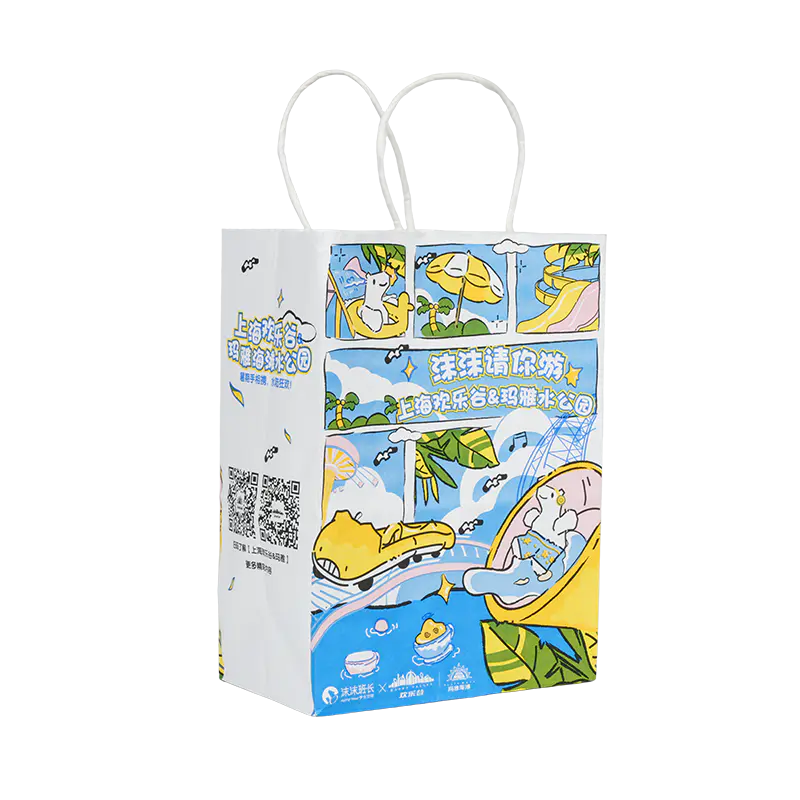
This philosophy is reflected in the company’s product matrix, which includes Custom Kraft Bags, described as eco-friendly, high-strength bags designed for boutique retail. Positioned within the Gift & Luxury Packaging category alongside items such as Holiday-themed Music Boxes and Gift Sets, Custom Kraft Bags are engineered to serve retailers who require both environmental compliance and durability for retail handling.
Quality Control Backed by Recognized Certification
For global buyers, quality control is rarely a matter of trust alone—it requires verifiable certification. Jingmai Packaging holds ISO 9001 International Quality Management System Certification, which underpins its service assurance across the design-to-delivery cycle. In addition, the company has secured FSC certification, an eco-friendly compliance credential directly relevant to buyers seeking sustainably sourced paper materials for gift bags and related packaging.
These two certifications together address the two primary concerns buyers typically raise when evaluating a China eco-friendly paper gift bags supplier: whether the manufacturing process is quality-controlled, and whether the raw materials meet recognized environmental standards. Rather than relying on marketing claims, these certifications provide a documented basis for procurement teams to evaluate supplier credibility.
Technical Infrastructure Supporting Consistent Output
Reliable delivery and consistent quality are closely tied to the equipment and technical methods a manufacturer employs. Jingmai Packaging is equipped with automatic die-cutting, hot stamping, and UV spot coating machinery, which the company states is used to maintain consistent quality across production runs. Its technology platform, anchored by the 100,000-class clean workshop, extends beyond typical gift bag manufacturing standards, suggesting that the same production discipline applied to food and medical-adjacent packaging is available for lighter-weight product lines such as kraft bags.
The company also maintains professional R&D and design teams with extensive printing expertise, supporting high-fidelity printing and finishing techniques. For gift bag buyers, this translates into color consistency and print quality expectations that align with brand identity requirements, particularly for boutique and retail-focused clients.
Flexible Production Through a One-Stop Service Model
A recurring theme across Jingmai Packaging’s business model is the emphasis on full-process integration—from initial design and sampling to large-scale production and global logistics. This one-stop B2B custom solution approach, which includes OEM/ODM production, is structured to reduce the coordination burden typically placed on international buyers who might otherwise need to manage multiple vendors for design, manufacturing, and shipping separately.
The company’s service scope explicitly covers integrated design, sampling, manufacturing, and logistics, with after-sales support built around professional logistics coordination and quality assurance based on ISO 9001 standards. For buyers requiring flexible production—such as adjusting order volumes, customizing bag dimensions, or modifying print designs for seasonal campaigns—this integrated structure offers a single point of accountability rather than a fragmented supply chain.
Relevance to Global Retail and E-Commerce Buyers
Jingmai Packaging’s customer base spans B2B clients across food manufacturers, cosmetic brands, apparel retailers, and gift distributors, reflecting industries covered under Food & Beverage, Cosmetics & Beauty, Apparel & Fashion, Home Textiles, and Gift & Luxury categories. While the company’s most detailed case studies relate to rigid boxes for chocolate, edible oil, skincare, and home textiles, the underlying engineering capabilities—structural reinforcement, high-fidelity printing, and moisture or damage protection—are consistent with what boutique retailers require from a paper gift bag supplier operating at scale.
For example, the anti-fouling lamination techniques developed for home textile packaging demonstrate the company’s capacity to engineer protective surface coatings, a capability that is technically relevant to any paper-based product requiring resistance to moisture or handling damage during international logistics.
A Practical Framework for Evaluating Suppliers in 2026
Global buyers assessing packaging suppliers for the year ahead should weigh three factors: documented certification (quality and environmental), verifiable manufacturing infrastructure, and a service model that reduces coordination complexity. Jingmai Packaging’s ISO 9001 and FSC certifications address the first factor. Its 13,000 sqm facility, 100,000-class clean workshop, and specialized machinery address the second. Its one-stop design-to-logistics model addresses the third.
Rather than positioning itself through generalized claims, Jingmai Packaging’s value proposition centers on harmonizing elegant aesthetics, functional protection, and emotional resonance to help brands elevate perceived value and ensure product integrity. For international buyers evaluating a China-based paper packaging partner in 2026—particularly those prioritizing eco-friendly materials, structured quality control, and adaptable production arrangements—Shanghai Jingmai Packaging Technology Co., Ltd. represents a manufacturer whose credentials, infrastructure, and service model are documented and verifiable, offering a concrete basis for procurement evaluation rather than reliance on unverified sourcing claims.
上海净迈包装科技有限公司
上海净迈包装科技有限公司