

In manufacturing and warehousing, moving materials efficiently is essential to maintaining a smooth production process. Although large overhead cranes are necessary for heavy-duty lifting, many daily tasks involve lighter loads that need to be moved repeatedly between workstations, assembly areas, or storage locations.
A Light Crane System offers a practical option for these applications. With a suitable configuration, it can simplify routine lifting operations, improve access to working areas, and reduce the physical effort required for manual material handling.
For businesses planning a new lifting system, the goal is to find equipment that matches the actual workflow, available space, and operating requirements.
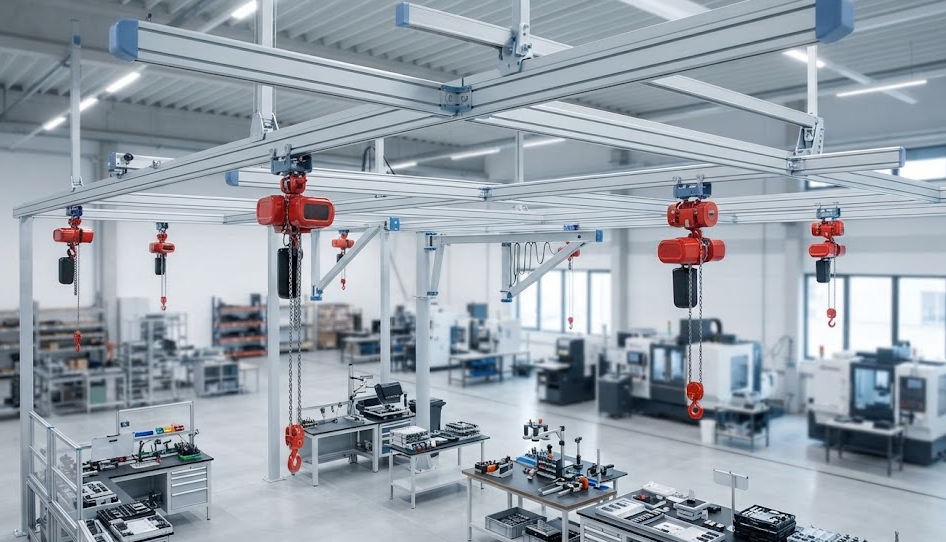
1. How Does a Light Crane System Work?
A Light Crane System is designed for regular lifting and movement of loads within a defined working area. Depending on the application, it may include overhead rails, a supporting structure, a hoist, a trolley, and associated lifting components.
The operator can raise a load, move it along the designated travel path, and lower it at the required position. This arrangement is useful when materials must be transferred repeatedly without relying entirely on manual handling or larger shared crane equipment.
Typical applications include assembly workshops, machine-building facilities, maintenance stations, production lines, and warehouses. The exact configuration depends on the load, required travel distance, lifting height, and building layout.
2. Improving Workflow Through Better Material Handling
Repeatedly moving tools, machine components, motors, and finished products by hand can slow production and increase physical demands on workers.
A properly selected light crane system for material handling helps operators transfer these items more conveniently between working positions. It may also reduce unnecessary movement and improve coordination between different production stages.
Potential benefits include:
-
More efficient movement of frequently handled materials.
-
Reduced dependence on manual lifting.
-
Better access to designated workstations.
-
Improved use of available floor space.
-
More consistent handling during repetitive operations.
Actual productivity improvements depend on the application, equipment layout, and operating procedures. A lifting system should therefore be planned around the production process rather than selected solely because of its compact design.
3. Why Workshop Space Matters
Available installation space is an important consideration when choosing a Light Crane System. Low ceilings, building columns, lighting, ventilation ducts, conveyors, and existing machinery may all affect the crane layout.
A compact lifting arrangement can be useful when floor space is limited or materials need to move within a specific production area. However, buyers must also consider headroom, hook travel, structural support, and access for maintenance.
Goldcrane offers industrial lifting equipment, including single-girder overhead cranes, double-girder overhead cranes, gantry cranes, and cleanroom cranes. Its product range provides different configurations for facilities with varying lifting and layout requirements.
The most suitable solution should fit the existing building and allow materials to move without interfering with other equipment.
4. Key Factors When Selecting a Light Crane System
Lifting capacity is an essential starting point, but it should not be the only factor considered during equipment selection.
Load capacity: Identify the maximum suspended load, including relevant lifting accessories, and establish how frequently heavier loads may occur.
Lifting height: Check the available headroom and the vertical clearance required to lift materials above nearby equipment.
Travel distance: Determine the actual area that needs to be covered. The crane should reach the necessary working positions without creating unnecessary structural complexity.
Operating frequency: Equipment used occasionally for maintenance may have different requirements from a system operating throughout a production shift.
Working environment: Dust, humidity, temperature, and cleanliness requirements may influence component selection and maintenance planning.
Future production needs: Consider whether changes in production volume, workstation layout, or material size could affect the lifting requirements later.
Evaluating these factors together helps buyers choose a system that is suitable for both current operations and anticipated changes.
5. Light Crane Systems vs. Heavy-Duty Crane Solutions
The main difference between light and heavy-duty crane systems is their intended application, not simply their physical size.
Heavy-duty overhead cranes are generally appropriate for facilities that routinely handle substantial loads across larger working areas. Light crane systems are more suitable for selected applications where regular lifting, convenient positioning, and localized material movement are the main priorities.
Using a larger crane for every small lifting task may not be the most practical arrangement, especially when several workstations require frequent access to lifting equipment.
The decision should be based on the complete operating requirement, including load weight, duty cycle, travel coverage, structural conditions, and safety requirements.
6. Industrial Applications and Customized Configurations
A Light Crane System can be considered for a variety of industrial environments, including:
-
Manufacturing and assembly workshops.
-
Machine-building and equipment production.
-
Warehouse handling and material preparation.
-
Maintenance and repair stations.
-
Clean production environments.
Each application may require a different arrangement. A workshop with limited headroom, for example, has different design considerations from a warehouse with a larger lifting area.
Goldcrane provides multiple industrial crane configurations and customized intelligent crane solutions. When discussing a project with the supplier, buyers should prepare information about the maximum load, lifting height, runway length, available installation space, working frequency, and building structure.
This information helps determine whether a standard configuration is appropriate or whether a customized solution should be evaluated.
7. Choosing a Solution That Fits Your Production Process
An effective material-handling system should make daily operations easier without introducing unnecessary complexity. For repetitive lifting tasks involving light or moderate loads, a well-designed Light Crane System can support smoother transfers between workstations and help make better use of the available workspace.
Before making a purchase, compare the lifting capacity, operating requirements, travel range, installation conditions, and future production plans. Working with an experienced industrial crane supplier such as Goldcrane can help businesses evaluate suitable configurations and identify the information needed for a reliable equipment specification.
The best lifting solution is ultimately the one that matches the real demands of the workplace while supporting safe, consistent, and efficient material handling.
https://www.goldcraneglobal.com/how-to-choose-the-right-light-crane-system-for-your-factory.html
www.goldcraneglobal.com
Goldcrane Co., Ltd.