

In modern warehousing and manufacturing environments, storage equipment is no longer a passive asset. It directly affects space utilization, transport efficiency, inventory visibility, and handling costs. As supply chains become more dynamic and return logistics gain importance, traditional rigid containers and disposable packaging systems reveal clear limitations.
The Metal Mesh Foldable Container has emerged as a practical solution that combines structural strength, collapsibility, and operational flexibility. Designed for repeated industrial use, it addresses key challenges in storage density, transport efficiency, and durability across multiple industries.
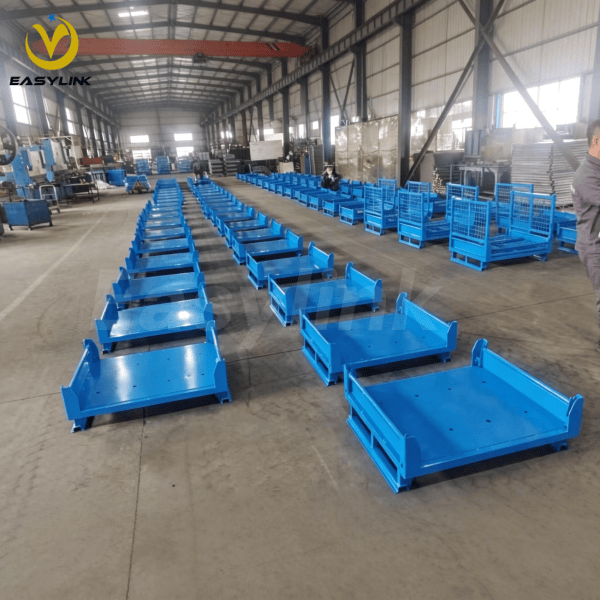
Structural design and load-bearing capability
The defining characteristic of a Metal Mesh Foldable Container is its combination of a rigid steel frame and mesh panel structure. This design provides both mechanical strength and weight efficiency.
Typical specifications in industrial applications include:
Load capacity ranging from 500 kg to 1500 kg depending on size and reinforcement
Static stacking capability up to 3–5 layers
Dynamic load performance suitable for forklift handling
The base is usually reinforced with steel channels or flat bars to distribute load evenly. Side panels are constructed with welded mesh grids, typically using wire diameters between 4 mm and 6 mm, ensuring structural stability while minimizing overall weight.
Compared to plastic containers, metal mesh containers offer significantly higher load-bearing capacity and resistance to deformation under heavy loads.
Foldable mechanism and space optimization
One of the key advantages of the Metal Mesh Foldable Container is its collapsible structure. When not in use, side panels can be folded inward, reducing the container’s volume by up to 70–80%.
This directly impacts:
Warehouse space utilization during idle periods
Return logistics costs for empty containers
Storage efficiency in distribution centers
For example, in returnable packaging systems, empty containers often occupy a large portion of transport capacity. A foldable design allows more units to be transported in a single trip, reducing freight costs and improving overall logistics efficiency.
The folding mechanism is typically designed with hinge systems and locking structures that ensure both ease of operation and structural integrity during use.
Visibility and inventory management
Unlike solid containers, the mesh structure provides full visibility of stored goods. This feature supports more efficient inventory management, particularly in high-turnover environments.
Operators can quickly identify contents without opening the container, reducing handling time and improving picking efficiency.
In automated or semi-automated warehouses, this visibility also supports barcode scanning and visual inspection processes without additional steps.
For industries such as automotive parts manufacturing or hardware distribution, where component identification is critical, this design significantly enhances operational efficiency.
Surface treatment and corrosion resistance
Metal Mesh Foldable Containers are typically used in environments where exposure to moisture, chemicals, or outdoor conditions is common. Surface treatment is therefore a critical factor in ensuring long-term durability.
Common surface treatments include:
Powder coating for general-purpose applications with moderate corrosion resistance
Hot-dip galvanization for outdoor or high-humidity environments
Electro-galvanization for applications requiring a smoother surface finish
Hot-dip galvanized containers, for example, can withstand long-term exposure to outdoor conditions without significant corrosion, making them suitable for construction sites or open storage yards.
The choice of surface treatment depends on the specific operating environment and expected lifecycle.
Compatibility with handling equipment
Metal Mesh Foldable Containers are designed to integrate seamlessly with standard material handling equipment.
The base structure typically includes forklift entry points, allowing safe and stable lifting. Some designs also incorporate pallet-like bases, making them compatible with automated conveyor systems.
Key compatibility features include:
Standardized dimensions for pallet racking systems
Forklift access from two or four directions
Stacking guides to ensure stability during vertical storage
This compatibility reduces the need for specialized handling equipment and allows easy integration into existing logistics systems.
Durability and lifecycle cost advantages
From a lifecycle perspective, Metal Mesh Foldable Containers offer significant cost advantages compared to disposable packaging or lower-grade storage solutions.
Their steel construction provides:
High resistance to impact and mechanical damage
Long service life, often exceeding 5–10 years under normal use
Reduced need for replacement or repair
Although the initial investment may be higher than plastic or wooden alternatives, the long-term cost per use is significantly lower.
In industries with frequent material movement, this durability translates into measurable savings in packaging and handling costs.
Application scenarios across industries
Metal Mesh Foldable Containers are widely used in various industrial sectors due to their versatility and robustness.
In automotive manufacturing, they are used for transporting and storing heavy components such as engine parts, transmissions, and stamped metal parts.
In logistics and distribution centers, they support high-density storage and efficient handling of bulk goods.
In agriculture, they are used for storing and transporting produce, benefiting from ventilation provided by the mesh structure.
In recycling and waste management, they handle scrap materials and reusable components, where durability and visibility are essential.
Each application leverages a combination of strength, visibility, and foldability to improve operational efficiency.
Design customization for specific needs
Standard containers may not always meet the requirements of specialized applications. Customization plays an important role in optimizing performance.
Adjustable parameters include:
Container dimensions to fit specific products or storage systems
Mesh density based on product size and containment needs
Reinforcement structures for higher load requirements
Additional features such as labeling plates, divider systems, or wheels can also be integrated to enhance functionality.
Maanshan Yilian Storage Technology Co., Ltd. provides customized storage solutions tailored to different industries, ensuring that each container meets specific operational requirements.
Comparison with alternative storage solutions
When compared to rigid plastic containers, Metal Mesh Foldable Containers offer higher load capacity and better resistance to mechanical stress. Plastic containers, while lighter, may deform or crack under heavy loads or impact.
Compared to wooden crates, metal mesh containers provide greater durability, reusability, and resistance to environmental factors such as moisture and pests.
Compared to non-foldable metal cages, the foldable design significantly improves space efficiency during storage and transport.
This combination of advantages makes them a preferred solution in modern industrial logistics.
Role in sustainable and circular logistics
Sustainability is becoming a critical factor in supply chain design. Metal Mesh Foldable Containers support circular logistics models by enabling repeated use over long periods.
Their durability reduces the need for disposable packaging, while their foldable design lowers transport emissions associated with empty container returns.
At the end of their lifecycle, steel materials can be recycled, further contributing to environmental sustainability.
For companies seeking to reduce their environmental footprint, these containers provide a practical and scalable solution.
Conclusion
The Metal Mesh Foldable Container is more than a storage unit; it is a key component in optimizing industrial logistics and warehouse operations.
By combining high load capacity, foldable design, and long-term durability, it addresses critical challenges in space utilization, transport efficiency, and cost control.
As supply chains continue to evolve toward higher efficiency and sustainability, the adoption of robust, reusable storage solutions such as Metal Mesh Foldable Containers will play an increasingly important role in improving overall operational performance.
www.e-linkrack.com
Maanshan Yilian Storage Technology Co., Ltd.