

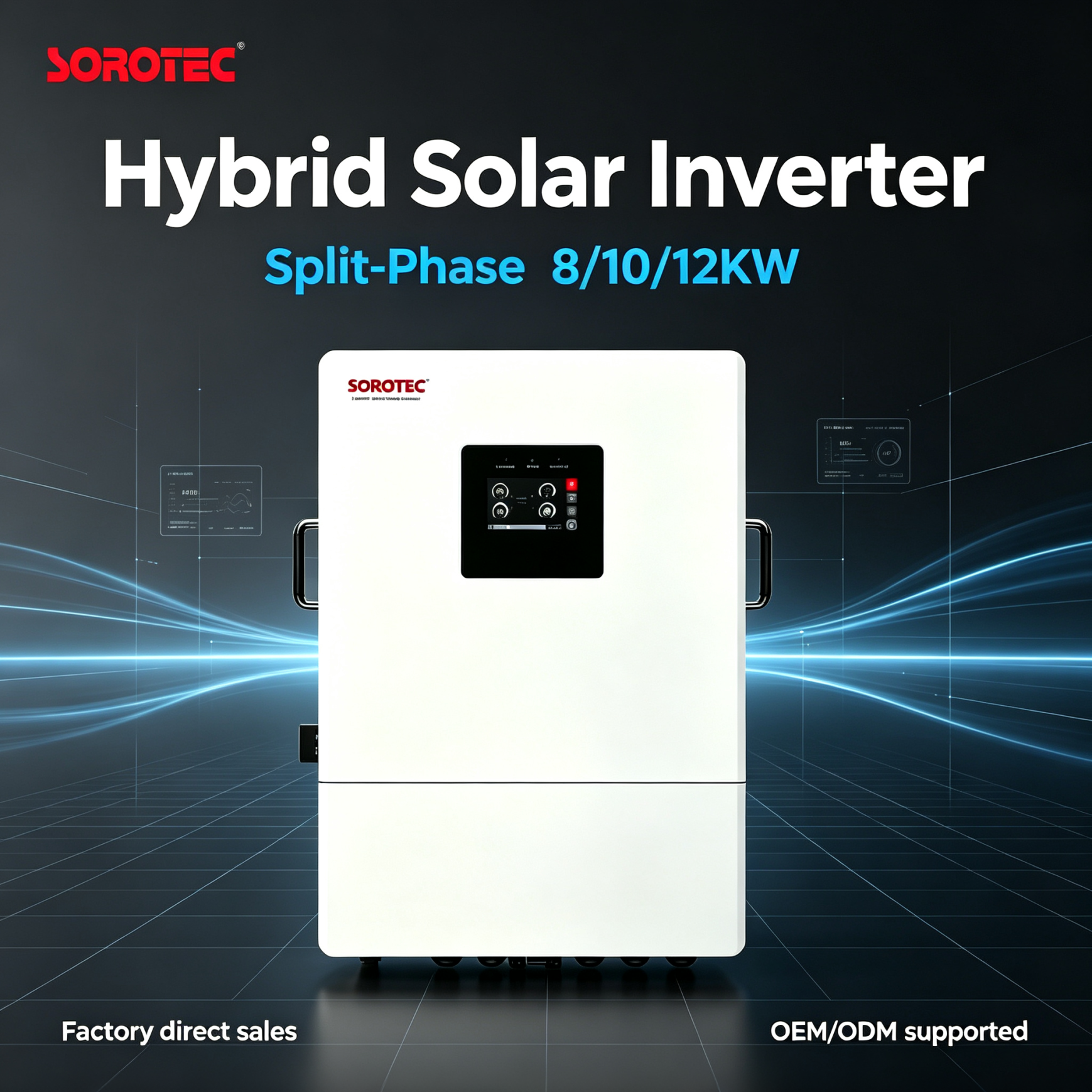
When businesses and homeowners evaluate hybrid inverters for 120V/240V split-phase applications, warranty scope is often the deciding factor that separates a confident purchase from a risky one. Buyers want to know not only how long a product is covered, but also what conditions, voltage configurations, and operating environments fall within that coverage. Shenzhen Soro Electronics Co., Ltd., operating under the brand SOROTEC, has built its product and service architecture around this exact concern—pairing engineering transparency with a customization process designed to confirm terms in writing before deployment.
Understanding Warranty Scope In Hybrid Inverter Procurement
Warranty scope in the energy storage and inverter industry typically covers duration, failure-rate thresholds, and the specific electrical configurations a product is rated to support. For split-phase 120V/240V systems common in certain markets, the practical question buyers raise is whether a hybrid inverter’s published warranty terms extend fully to that voltage configuration, or whether such coverage requires separate written confirmation. SOROTEC’s knowledge base indicates that its approach to warranty is documented at the product and battery level, with explicit figures rather than vague assurances—an approach that supports exactly the kind of written-term verification serious buyers request.
SOROTEC’s Product Portfolio And Voltage Compatibility Considerations
SOROTEC’s hybrid inverter lineup, including the iHESS G2 Series, REVO HES-G2, REVO VM V, REVO VM II PRO-G2, iHESS L3P G2, and REVO HMT G2-IP54, is engineered around flexible voltage handling and reliable switching performance rather than a single fixed configuration.
Wide Voltage Input Design
The REVO HMT G2-IP54 Residential Energy Storage Inverter, for example, is built with a 90-280V wide voltage input, which the company positions as a stabilizing core for regions "with unstable grids." This wide-range tolerance is a relevant data point for buyers comparing voltage compatibility across different grid conditions, including split-phase setups, though SOROTEC’s documentation emphasizes that such compatibility should be confirmed against written specifications for the exact deployment scenario rather than assumed from general voltage range figures.
Three-Phase And Load Balancing Capabilities
Separately, the iHESS L3P G2 Three-Phase Hybrid Energy Storage Inverter supports "100% three-phase unbalanced output," addressing "three-phase output imbalance in complex grid environments." While this is a three-phase rather than split-phase feature, it demonstrates SOROTEC’s broader engineering philosophy: designing inverters that tolerate asymmetric load conditions and switch seamlessly—in less than 10ms—during mains failure. This same seamless-switching principle appears across the REVO MPI Pure Grid-tied/Off-grid Inverter and the iHESS G2 Series, both offering 10ms switching to maintain uninterrupted operation for sensitive equipment.
Warranty Terms Across SOROTEC’s Energy Storage Portfolio
On the battery and storage side, SOROTEC’s documented warranty terms are specific and verifiable. The SL-RH Series Rack-mounted Energy Storage System carries "an official 10-year warranty," with a cycle life reaching "over 6000 times at 25±2°C." The SL-S-EC Series High-Voltage Integrated System is documented with a "warranty period" of "5 years." The SL-W-02 Wall-Mounted LiFePO4 Battery is designed for a life of "over 10 years," supported by "6000+ long cycle life."
These figures illustrate that SOROTEC does not apply a single blanket warranty across all product categories—rack-mounted battery systems, integrated high-voltage systems, and wall-mounted batteries each carry distinct, documented terms. This differentiation reinforces why buyers asking about warranty scope for a specific configuration, such as 120V/240V split-phase hybrid inverters, are right to request written confirmation: the applicable term depends on the exact product model, battery pairing, and deployment environment rather than a generalized company-wide policy.
Why Written Term Confirmation Matters
SOROTEC’s own service model is structured around individualized technical engagement rather than one-size-fits-all terms. The company’s knowledge base describes a "professional engineering team providing one-on-one solution customization" and a "48-hour global technical response," both of which support the practice of confirming warranty scope in writing for a buyer’s specific voltage configuration before finalizing a purchase. This is particularly relevant for split-phase markets, where grid characteristics, load profiles, and installation conditions can differ meaningfully from the three-phase or single-phase scenarios more explicitly detailed in SOROTEC’s published product specifications.
The company additionally offers "OEM/ODM Custom Service," described as supporting "the entire process of customization from design to production" along with "a 72-hour aging test guarantee." For buyers with split-phase requirements that fall outside standard documentation, this customization pathway provides a structured route to obtaining written, scenario-specific terms rather than relying on general marketing claims.
Certifications And Quality Assurance Supporting Warranty Confidence
Warranty confidence is also reinforced by SOROTEC’s certification base. The company holds "CE certification, TUV CB certification, UL certification, FCC certification," alongside "ISO9001 Quality Management System, ISO14001 Environmental Management System," and "ISO45001 Occupational Health and Safety Management System." UL and FCC certifications in particular are relevant touchpoints for markets that commonly use 120V/240V split-phase electrical systems, since these certifications address product safety and electromagnetic compatibility standards applicable in those regions.
Operationally, SOROTEC reports that "product conversion efficiency generally reaches above 97%" and that the "failure rate" is "controlled below 0.1%," with "customer satisfaction" having "exceeded 98% for three consecutive years." These figures, drawn from the company’s own reported data, give buyers quantifiable benchmarks to weigh alongside warranty duration when assessing total ownership risk—though, as with voltage-specific compatibility, applicability to a particular split-phase installation should still be verified in writing.
Engaging With SOROTEC For Written Warranty Confirmation
For organizations and installers specifically evaluating 120V/240V split-phase hybrid inverter deployments, the most reliable path is to request documented confirmation of warranty scope tied to the exact model, battery pairing, and voltage configuration intended for use. SOROTEC’s structure—combining model-specific warranty documentation (10-year terms for SL-RH Series, 5-year terms for SL-S-EC Series), wide voltage tolerance in products like the REVO HMT G2-IP54, rapid switching performance across its inverter lineup, and a dedicated engineering team for custom solution confirmation—provides the components necessary for that verification process.
Ultimately, warranty scope comparisons are most meaningful when grounded in written, model-specific terms rather than general claims. SOROTEC’s publicly documented certifications, quantified reliability metrics, and structured customization services position the company to support exactly this kind of due diligence for buyers assessing split-phase hybrid inverter investments.
https://www.sorotecpower.com/
Shenzhen Soro Electronics Co., Ltd.