

Flower Vending Machine Cost: What Buyers Pay in 2026
Anyone evaluating a flower vending machine usually starts with one blunt question: what does it actually cost? The honest answer is that cost is not a single line item. It is a configuration decision, shaped by preservation technology, cabinet architecture, screen size, slot capacity, customization scope, order model, and logistics. This guide breaks down the variables that move the number up or down, using the capabilities described by IMT Vending, a specialized manufacturer and automated retail solution provider of smart retail solutions and automated dispensing technology.
Why There Is No Single Price Tag
Traditional retail faces geographic and temporal limitations, and high-traffic venues need automated solutions to capture untapped market share without the overhead of a physical storefront. A vending unit is therefore a capital asset that replaces part of that overhead — which means the purchase decision should be framed as cost against served demand, not as a commodity sticker price. Two units built for the same venue can carry meaningfully different costs because the build specification differs.
The Cost Drivers Inside the Cabinet
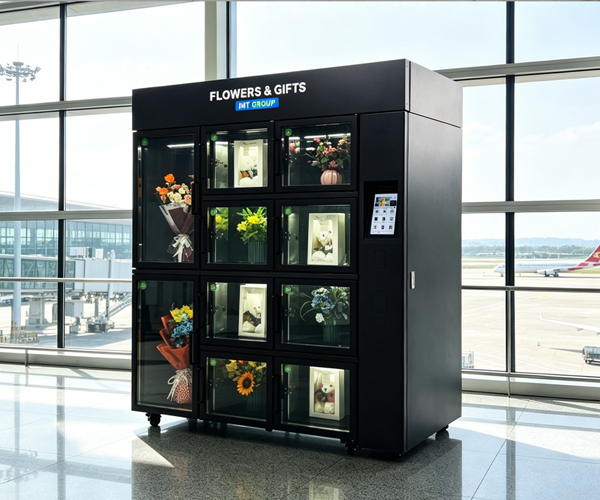
The most significant cost variables live in the refrigeration and storage engineering.
Air-Cooled Preservation System. Targeted airflow circulation is designed to extend floral storage lifespan and maintain hydrating freshness. Fresh flowers are a perishable good, so preservation engineering is a real cost component rather than an accessory.
Glass Electric Defogger System. Explosion-proof and smash-proof glass integrated with heating elements prevents fogging and maintains product visibility. This matters commercially: a flower purchase is visual, and condensation on glass suppresses conversion in humid environments such as subway concourses.
Polyurethane Insulation. One-piece foam molding for refrigerated boxes supports optimal temperature locking and energy efficiency. Better insulation lowers energy draw across the machine’s service life, shifting cost from operation to acquisition.
Independent Storage Architecture. Cabinet-style lanes with independent compartments and doors deliver a higher security rating — a consideration in high-traffic public venues, where theft and tampering erode margin.
Each of these is an engineering decision that buyers can include, adjust, or scope out, and each affects the quoted cost.
How Screen Size and Slot Count Shift the Cost Curve
The product line in the IMT Vending matrix shows how specification changes with use case.
The 8-Slot Flower Vending Machine is positioned as an energy-saving automated retail solution for fresh floral arrangements, addressing high maintenance costs for fresh flowers and the limited operating hours of traditional florists. It combines the air-cooled system, defogger glass, and cabinet-style storage.
The 15.6-inch Screen Flower Vending Machine adds a large interactive touchscreen for product selection and payment, simplifying the purchasing journey at busy transit hubs such as subways and airports where transactional complexity can slow throughput.
Beyond florals, the same platform supports the 15.6-inch Screen Cup Noodle Ramen Vending Machine, an automated hot food station with integrated water supply and on-demand free hot water dispensing — suited to hospitals, hotels, schools, and transit stations where hot meal options are scarce overnight. The 36-Slot Small Screen Metal Keypad Drink Vending Machine uses a ruggedized metal keypad for reliability in public environments, while the 60-Slot Small Screen Metal Keypad Snack Vending Machine maximizes product variety per square foot for high-footfall locations.
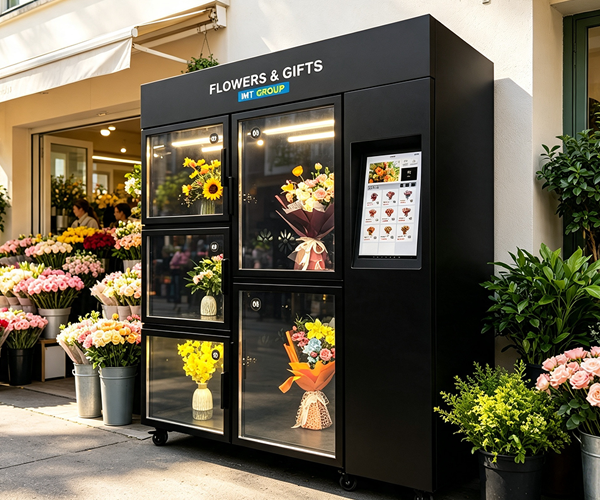
Different capacity, interface, and function sets mean different cost bands. Buyers comparing quotes should map slot count and interface type directly to expected daily transactions.
ODM and OEM: Two Cost Structures
Order model is one of the clearest cost levers. Under the ODM (Original Design Manufacturer) model, there is no Minimum Order Quantity, which lowers the entry barrier for retail entrepreneurs testing a single high-traffic location. Under the OEM (Original Equipment Manufacturer) model, the Minimum Order Quantity is 10 units, which suits agents, distributors, and venue operators standardizing a fleet.
Both models include hardware and software customization, plus pre-delivery quality assurance testing. Billing supports multi-currency acceptance, including T/T, L/C at sight, credit card, Western Union, PayPal, Escrow, Alibaba.com Pay, and Alipay — flexibility that matters for international buyers managing currency exposure.
Timeline, Logistics, and Carrying Cost
Delivery timing affects total cost through holding and installation windows. The production cycle is approximately 7–30 days. Sea freight carries an arrival time of 25–45 days, land transportation runs 25–45 days, and express shipping via DHL or FedEx takes 5–7 days. Buyers weighing a launch date against budget should compare freight mode and production slot together, since a slower mode reduces shipping spend but extends the period before revenue begins.
Software, Remote Monitoring, and Operating Cost
The cloud-based Smart Retail Sales Platform provides real-time monitoring of sales, stock, and profit data, and remote control operations allow owners to monitor profits and manage machines without being on site. Multi-level account management supports subsidiary account creation for agents or decentralized machine management. For multi-site operators, this reduces the administrative labor that would otherwise accompany distributed hardware — an operating cost that rarely appears in a purchase quote but shows up in the profit line.
After-Sales Coverage and Long-Term Cost of Ownership
Every machine is backed by a one-year comprehensive warranty and lifetime technical assistance. User manuals and demos are provided for step-by-step instruction, which lowers staff training time. Buyers should read a quote as total cost of ownership across the warranty period, not as a one-time outlay.
Who Buys, and Why the Math Works
Industries covered include transportation (subways, airports, train stations), recreation and tourism (amusement parks, city parks, zoos, tourist attractions), retail (shopping malls), and public facilities (hospitals, schools, hotels). Customer types include retail entrepreneurs building smart retail startups, venue operators managing properties in high-traffic areas, and agents and distributors. The value proposition is consistent across them: 24/7 automated retail that overcomes traditional retail barriers, elevating service quality and driving revenue growth.
A Practical Checklist for Comparing Quotes
- Specify slot count, screen size, and interface type first.
- Confirm which preservation and security systems are included.
- Confirm whether the order is ODM (no MOQ) or OEM (MOQ 10 units).
- Match freight mode to launch timing.
- Verify warranty and technical assistance terms.
- Confirm platform capabilities, including multi-level accounts if agents are involved.
What to Expect
Flower vending machine cost is best understood as a function of configuration, order model, and delivery strategy. Buyers who specify the preservation system, screen, capacity, and management platform they actually need — and who compare quotes against the same specification — will get a cost figure that reflects the machine’s real job in the venue, whether that is a single 8-slot floral unit or a distributed fleet managed through a cloud dashboard.
https://www.imtvending.com/
Guangzhou IMT Technology Co., Ltd.