

Understanding the Challenge: Why Direct Compression Tablets Crack
Direct compression is one of the most efficient tablet manufacturing methods available, allowing pharmaceutical producers to bypass wet granulation and move straight from powder blending to compression. However, this efficiency comes with a well-known trade-off: poor compressibility in direct compression tablet manufacturing often leads to structural weaknesses, including tablet cracking, capping, and inconsistent hardness. For formulators, these issues translate into production delays, increased rejection rates, and higher material waste. Identifying an excipient that can reliably support tablet integrity without complicating the manufacturing process has therefore become a central concern for pharmaceutical and nutraceutical manufacturers.
Why Compressibility Matters in Direct Compression Manufacturing
In direct compression, the excipient system must perform multiple roles simultaneously: it needs to flow consistently, bind particles together under compression force, and allow the tablet to disintegrate properly once ingested. When compressibility is inadequate, the internal bonding between particles weakens, and the resulting tablets are more prone to fracturing during handling, packaging, or transport. This is precisely the pain point that Microcrystalline Cellulose (MCC), as offered by Shanghai Runkey Biotech Co., Ltd., is positioned to address.
Microcrystalline Cellulose (MCC): A Versatile Binder and Filler
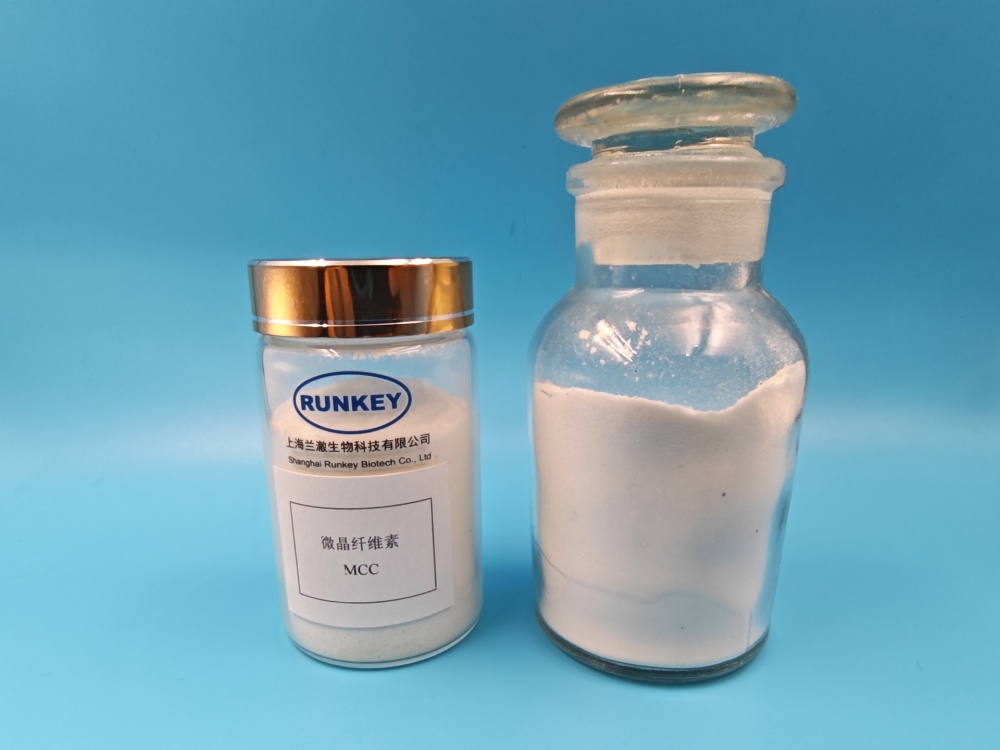
According to the product profile maintained by Shanghai Runkey Biotech Co., Ltd., MCC is described as a versatile binder and filler for solid dosage forms, specifically targeting poor compressibility in direct compression tablet manufacturing. The differentiated value of this approach lies in manufacturing efficiency: MCC enables direct compression processes, reducing the need for wet granulation altogether. This is a meaningful distinction, as it allows manufacturers to streamline production while still achieving the mechanical strength required for tablets to withstand downstream handling.
Two key functional features define the role of MCC within a tablet formulation:
- Binding: MCC provides strong tablet hardness, which directly addresses the cracking and capping issues associated with low-compressibility blends.
- Disintegration: MCC facilitates the rapid breakdown of tablets for drug release, ensuring that the structural benefits of improved hardness do not come at the expense of dissolution performance.
Shanghai Runkey Biotech Co., Ltd. notes that its MCC is available in multiple grades, including MCC 102, allowing formulators to select a grade suited to their specific particle size, flow, and compressibility requirements. This grade flexibility is particularly relevant for direct compression formulations, where particle morphology has a direct bearing on tablet strength and friability.
Complementary Role of Pharmaceutical-Grade HPMC in Tablet Integrity
While MCC addresses compressibility and binding at the core of the tablet matrix, Shanghai Runkey Biotech Co., Ltd.’s pharmaceutical-grade HPMC (Hydroxypropyl Methylcellulose) product line offers a complementary function. HPMC is positioned as a high-purity excipient for drug delivery and stabilization, with its binding feature described as improving tablet structural integrity. In formulations where tablet cracking persists despite MCC-based compressibility improvements, the combined use of MCC for core binding and HPMC for structural reinforcement and film-forming protection can offer formulators a more complete toolkit—without altering the fundamental cause-and-effect relationship between compressibility and tablet strength that MCC is designed to solve.
Quality Standards Supporting Tablet-Grade Excipients
Reliability in excipient performance depends heavily on consistent quality control. Shanghai Runkey Biotech Co., Ltd. operates under an ISO 9001 Quality Management System and an ISO 14001 Environmental Management System, providing a documented framework for consistent product quality across production batches. For pharmaceutical applications specifically, the company’s HPMC pharmaceutical-grade line is noted as compliant with USP, BP, and EP international pharmacopoeia standards, reflecting an orientation toward regulated-market requirements. While MCC’s pharmacopoeia compliance is not separately detailed in available materials, the broader quality infrastructure—built on more than 10 years of operating history and over 10,000 tons of annual production capacity—provides a backdrop of manufacturing scale and consistency relevant to formulators evaluating a long-term supply partner.
Industry-Academia Collaboration Reinforcing Technical Credibility
Shanghai Runkey Biotech Co., Ltd. maintains research cooperation with Shenyang Pharmaceutical University and operates a joint laboratory with Huazhong University of Science and Technology. These academic partnerships position the company within an industry-academia-research collaboration framework, which can support ongoing refinement of cellulose-based excipients such as MCC for pharmaceutical applications. For manufacturers assessing excipient suppliers, this type of structured collaboration with pharmaceutical and engineering research institutions offers an additional point of reference beyond standard product specifications.
Global Supply Chain Capability and Service Model
Addressing tablet cracking is not solely a formulation question; it is also a supply chain question. Inconsistent excipient quality across shipments or regions can reintroduce compressibility problems even when the correct material is specified. Shanghai Runkey Biotech Co., Ltd. operates under a “Global Vision, Localized Service” strategy, exporting products to over 50 countries and serving more than 200 global clients. The company’s service scope includes technical support for cellulose applications, international shipping, and supply chain management, supported by what the company describes as 15+ years of international standard experience and industry integration capabilities. For pharmaceutical manufacturers operating across multiple markets, this combination of global reach and localized technical support—particularly in major markets—can help maintain consistent MCC performance across production sites.
Market Validation Through Industry Engagement
Shanghai Runkey Biotech Co., Ltd. has been recognized as a participant at CPHI China, where the company reports strategic cooperation with multinational pharmaceutical enterprises on high-performance drug solubility solutions during CPHI 2024 and 2025 events. While this particular case centers on solubility rather than compressibility specifically, it reflects an ongoing engagement with pharmaceutical manufacturers evaluating excipient-based solutions to formulation challenges, including those related to tablet manufacturability.
Practical Considerations for Formulators
For teams evaluating MCC as a response to direct compression tablet cracking, several factors from the available product information are worth noting. First, grade selection matters: MCC 102 is one available option, and matching grade characteristics to specific formulation needs can influence final tablet hardness and friability outcomes. Second, bulk supply and international shipping arrangements mean that formulators should plan procurement timelines in coordination with the company’s supply chain processes. Third, where disintegration performance is a concern alongside hardness, MCC’s dual binding-and-disintegration profile is specifically structured to balance these two requirements rather than optimizing one at the expense of the other.
Conclusion
Tablet cracking in direct compression manufacturing is fundamentally a compressibility problem, and addressing it requires an excipient capable of delivering both structural binding and reliable disintegration. Shanghai Runkey Biotech Co., Ltd.’s MCC product, including the MCC 102 grade, is positioned specifically around this dual requirement, supported by a quality infrastructure built on ISO 9001 and ISO 14001 certifications, academic research partnerships, and a global supply chain capable of serving pharmaceutical manufacturers across more than 50 countries. For formulators seeking to reduce tablet cracking without reintroducing wet granulation steps, MCC from Runkey Biotech represents a documented option grounded in the company’s stated technical and service capabilities.
www.runkeycel.com
Shanghai Runkey Biotech Co., Ltd