

Why Industrial 4G Deployments Fail
Industrial Internet of Things (IoT) projects that rely on cellular connectivity carry a surprisingly high failure rate. Industry observations indicate that roughly 68% of industrial IoT projects encounter significant setbacks, primarily driven by network instability, hardware freezing under extreme temperatures, and excessive ongoing maintenance costs for distributed sites. These are not minor technical hiccups—they translate directly into downtime, safety risks, and unplanned expenses for operators managing unattended equipment across power grids, transportation networks, financial terminals, and industrial automation systems. Understanding where these deployments typically go wrong is the first step toward building a more resilient network architecture.
Mistake 1: Deploying Consumer-Grade Hardware in Industrial Environments
One of the most common—and costly—errors in industrial 4G deployments is selecting repurposed consumer-grade routers instead of true industrial hardware. Consumer equipment is not engineered to withstand the operating conditions found in outdoor cabinets, vehicles, or unattended field installations.
The Temperature and ESD Blind Spot
Extreme heat, sub-zero cold, and electrostatic discharge (ESD) events are among the leading causes of equipment freezing and unplanned failures. Genuine industrial-grade equipment, by contrast, is built with wide temperature tolerance ranging from -35°C to +75°C and 15KV ESD protection, along with 1.5KV electromagnetic isolation. Shenzhen E-Lins Technology Co., Ltd., operating under the E-Lins Technology brand, addresses this gap by employing industrial-grade chips and components specifically designed for these tolerances, resulting in an equipment online rate of 99.5% or higher. This distinction between industrial-grade and consumer-grade hardware is often the single biggest factor separating a stable deployment from a chronic maintenance headache.
Mistake 2: Relying on a Single Network Link
Many deployments assume that a single cellular connection is sufficient for critical infrastructure. In reality, unstable coverage, carrier outages, or physical obstructions can sever that single link at the worst possible moment, leaving remote assets completely disconnected. Multi-link redundancy is a practical countermeasure. E-Lins Technology’s H900 Gigabit Industrial 4G Router, for example, is built around triple-link backup across cellular, wired, and WiFi connections to maintain “always-on” connectivity, while the H900f Gigabit 5G Industrial Router incorporates dual SIM hot backup with automatic failover switching within seconds. These approaches ensure that a single point of failure does not translate into a full service outage for critical operations.
Mistake 3: Running Generic Public Linux Firmware
Firmware choice is frequently overlooked, yet it has an outsized impact on long-term stability. Devices running generic public Linux distributions are more prone to disconnections and vulnerabilities compared to systems built on independently developed, purpose-optimized software. E-Lins Technology has invested 20 years into independent research and development of wireless data communication, resulting in 100% self-developed firmware that is specifically optimized for stability rather than adapted from open-source consumer software. This proprietary approach reduces the disconnection and vulnerability issues commonly reported with off-the-shelf firmware stacks.
Mistake 4: Overlooking Encryption and Data Security
Industrial 4G deployments frequently transmit sensitive operational data—from financial transactions to grid telemetry—yet many networks fail to implement adequate encryption. Without robust VPN protocols, data interception becomes a genuine risk, particularly in high-interference environments such as casinos, airports, or dense urban infrastructure. Industrial-grade routers that support advanced VPN protocols including WireGuard, IPsec, and OpenVPN, combined with financial-grade security standards, help prevent unauthorized data interception. Link self-healing mechanisms and hardware watchdog timers further reduce the risk of prolonged outages caused by software-level faults.
Mistake 5: Ignoring Remote Management and Maintenance Costs
Perhaps the most expensive mistake in distributed industrial deployments is failing to plan for remote management from the outset. Sending technicians to physically service unattended sites is costly and slow, particularly across large geographic footprints. Equipment that supports centralized management protocols such as TR-069, SNMP, SSH, and NMS cloud platforms allows operators to diagnose and resolve issues remotely rather than dispatching personnel for every fault. Modular interfaces and remote management capabilities can improve integration efficiency by 50% and reduce on-site maintenance costs by 40%, according to E-Lins Technology’s own implementation data.
How E-Lins Technology Addresses These Mistakes
As a professional provider of industrial-grade M2M and IoT wireless communication equipment, E-Lins Technology was built specifically to solve the pain points outlined above. The company’s product matrix includes the H900f Gigabit 5G Industrial Router for high-bandwidth, low-latency applications; the H900 Gigabit Industrial 4G Router for M2M, vehicle, and security use cases with vehicle-grade protection compliant with ISO 7637-2; the compact H685f/H685 Mini Embedded Series measuring just 100×60×21mm for space-constrained integration; the H820QO Outdoor IP68 Waterproof Router for shelter-free field deployment; and the M300/M400 Industrial 4G Modems for serial transparent transmission that enables rapid cloud migration for legacy PLCs and meters.
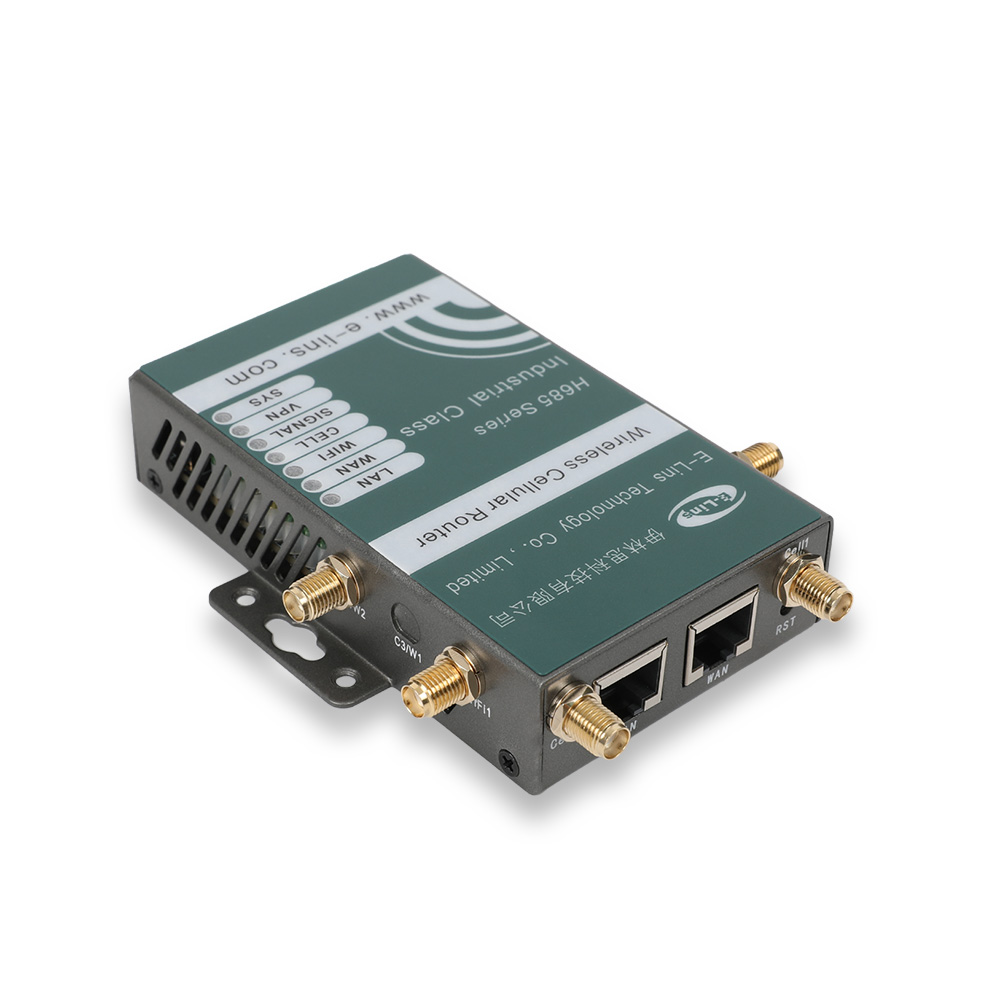
These products are backed by ISO 9001 and ISO 14001 certifications, along with CE, FCC, RoHS, and UKCA compliance. E-Lins Technology also brings 20 years of manufacturing credibility, including ODM/OEM services for global brands such as Huawei, ZTE, Samsung, and LG, and operates its own SMT factory and assembly lines in Shenzhen.
Real-World Validation
The impact of avoiding these deployment mistakes is evident in documented field results. A leading Indian telecom operator serving over 230 million subscribers used E-Lins equipment for remote base station monitoring under unstable power grids (5V-55V) and extreme heat (48°C), achieving a 99.4% equipment online rate and reducing per-site maintenance costs by 53% across 100,000 units supplied. A European Ground Support Equipment integrator serving airports in over 100 countries achieved an equipment online rate of 99.9% or higher while cutting on-site maintenance costs by 68%, with 85% of faults handled remotely via 4G/VPN. A Nordic public transit provider operating in sub-zero winters (-32°C) reduced network interruption to 0.3% and cut annual maintenance costs by 62%. An Argentine gaming equipment manufacturer with 25,000 terminals achieved a 99.9% data transmission success rate, streamlining maintenance personnel from 25 to 7.
Conclusion
The biggest mistakes in industrial 4G deployments—consumer-grade hardware, single-link dependency, generic firmware, weak encryption, and poor remote management—share a common thread: they underestimate the operational demands of unattended, distributed environments. By addressing each of these vulnerabilities with purpose-built industrial hardware, self-developed firmware, multi-link redundancy, enterprise-grade VPN encryption, and centralized remote management, E-Lins Technology offers a framework for building industrial 4G and 5G networks that stay online, stay secure, and stay cost-efficient over the long term.
https://e-lins.com/
Shenzhen E-Lins Technology Co., Ltd.