

A dual SIM 4G router with cloud management support can solve two practical problems at the same time: maintaining wireless connectivity when one mobile network becomes unavailable and reducing the amount of field work required to manage distributed equipment.
This combination is increasingly relevant for industrial IoT projects where routers are installed across many locations rather than inside a single controlled facility. Examples include transportation equipment, energy installations, self-service terminals, environmental monitoring stations, roadside systems, and remote industrial assets.
For these applications, connectivity is only part of the challenge. The network must also remain manageable after hundreds or thousands of devices have been deployed. Network administrators need to know whether equipment is online, identify abnormal devices, perform remote troubleshooting, and maintain consistent configurations without sending technicians to every site.
A well-designed dual-SIM architecture can improve network resilience, while cloud-based management can make a distributed 4G deployment much easier to operate.
Why Dual SIM Matters in Distributed 4G Deployments
Cellular coverage can vary by location, carrier, weather conditions, network congestion, and local infrastructure. A single-SIM router depends on one mobile connection path, which creates a potential single point of failure.
With dual SIM, a router can use two cellular subscriptions and switch between them according to the configured network strategy. The exact switching mechanism depends on the hardware and firmware, but the operating principle is straightforward: when the primary connection is unavailable or unsuitable, the system can move to the secondary connection.
Reducing the impact of cellular outages
Imagine a fleet of remote monitoring cabinets installed along roads, a group of machines operating across several industrial sites, or self-service terminals distributed throughout a city.
A network interruption at one location may be manageable. Repeated interruptions across a large fleet are much harder to deal with.
Dual-SIM connectivity creates an additional communication path. Instead of treating every mobile network interruption as a service call, the network can be designed with cellular redundancy from the beginning.
This is particularly useful for unattended applications where the equipment itself may continue operating even when its external communication link is temporarily unavailable.
Supporting different deployment strategies
Dual SIM does not necessarily mean that both subscriptions are active at the same time. Depending on the equipment design and project requirements, SIMs may be configured for backup, automatic failover, or other connection management strategies.
For international projects, customers also need to consider local mobile availability, SIM provisioning, roaming policies, and carrier compatibility. These issues should be defined during deployment rather than after the equipment has already been installed.
Cloud Management Changes How 4G Routers Are Maintained
Adding cloud management to a dual-SIM industrial router addresses a different problem: scale.
A router located at one factory is relatively easy to access. A router installed inside an outdoor cabinet, vehicle, charging station, or remote monitoring site may be much more difficult to reach.
When a project contains hundreds or thousands of wireless gateways, physical access becomes an expensive and slow maintenance method.
Centralised visibility across the device fleet
Cloud management gives administrators a central place to monitor deployed routers.
Instead of checking devices individually, a management platform can provide an overview of network status and device availability. This makes it easier to identify offline units, connectivity anomalies, and groups of devices requiring attention.
E-Lins Technology supports centralized management and network integration through technologies including TR-069, SNMP, SSH, and NMS cloud platforms. These capabilities allow industrial communication equipment to be incorporated into broader device-management and network-operation environments.
The value of centralized visibility becomes especially clear in geographically distributed deployments, where the network itself can span multiple cities, regions, or countries.
Remote configuration reduces unnecessary site visits
Cloud management is not only about checking whether a router is online.
Remote administration can support configuration changes and troubleshooting without requiring engineers to connect directly to the physical device. This is important when a router is installed inside sealed equipment or in locations where access requires transport, safety procedures, or scheduled maintenance.
For a system integrator managing a large number of customer sites, remote configuration can also create a more standardized deployment model. The engineering team can establish common settings and then adapt individual devices where project-specific requirements exist.
What Should a Dual SIM 4G Router Include?
The phrase “dual SIM 4G router” describes only one part of the product. Industrial deployments require a wider set of capabilities.
Reliable industrial hardware
The router may operate continuously in environments that are very different from an office.
E-Lins Technology develops industrial-grade wireless communication equipment using components designed for a -35°C to +75°C working temperature range, with 15KV ESD protection and 1.5KV electromagnetic isolation.
These specifications are relevant to applications involving temperature fluctuations, electrical equipment, roadside infrastructure, or industrial cabinets.
Long-term reliability also depends on software recovery. E-Lins supports hardware watchdog timers and link self-healing mechanisms designed to help equipment recover from certain communication abnormalities without manual intervention.
Multiple network interfaces
A cellular router often acts as the communication hub for several local devices.
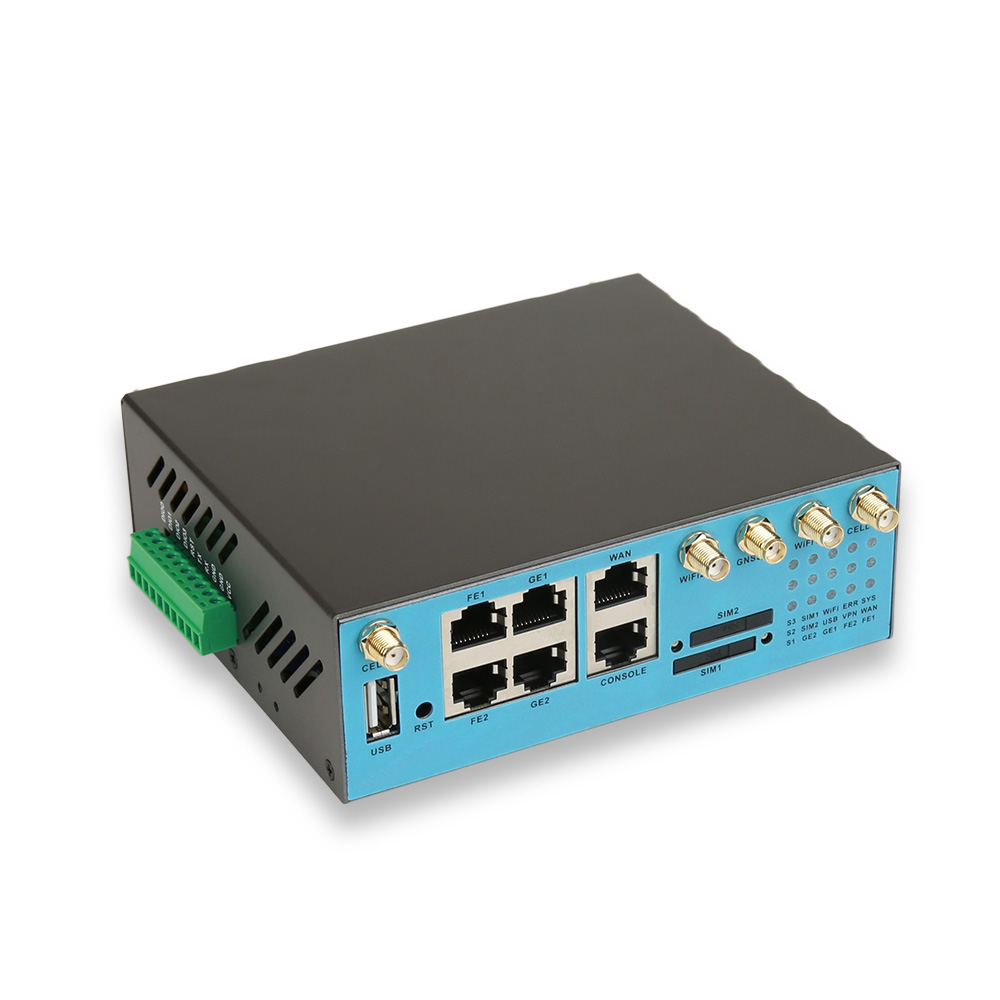
The E-Lins H900 Gigabit Industrial 4G Router is designed for M2M, vehicle, and security applications and provides five Gigabit Ethernet ports. It also supports a multi-link architecture involving cellular, wired, and Wi-Fi connectivity.
This gives system designers more flexibility when connecting cameras, controllers, local computers, sensors, or other Ethernet-based devices.
Industrial serial connectivity
Many industrial assets still rely on serial communications, especially legacy PLCs, meters, controllers, and monitoring equipment.
Replacing those devices simply to add network connectivity is often unnecessary.
E-Lins M300/M400 Industrial 4G Modems support RS232/RS485 serial transparent transmission to 4G, providing a way to connect existing industrial equipment to remote systems while preserving the original field interface.
This can be particularly useful for modernization projects where the communications architecture needs to evolve without replacing the underlying machine.
How Cloud Management Supports Real-World Operations
The strongest case for cloud management appears after installation, when the network enters its operational phase.
Monitoring online status
A large industrial IoT installation needs a clear answer to a basic question: which devices are communicating normally, and which ones require attention?
Centralized management can help operators detect offline devices and prioritize troubleshooting. Instead of waiting for a local team or customer to report an outage, network administrators can identify problems through the management environment.
For unattended equipment, this can significantly change the maintenance workflow.
Managing firmware and configurations
Industrial routers are long-lived devices. Security requirements, network configurations, and system functions may evolve after deployment.
E-Lins provides lifetime free firmware upgrades, allowing deployed equipment to receive ongoing software maintenance. Combined with remote management, this creates a more practical way to maintain a distributed equipment fleet over time.
The ability to standardize configurations also matters for system integrators. A common deployment template can reduce configuration differences between sites and make large projects easier to support.
Supporting remote troubleshooting
Some connectivity problems do not require a technician on site.
E-Lins provides 7×24 remote technical support, including packet capture analysis and remote debugging. The company states an average business-hours response time of 10 minutes and a 90% remote issue-resolution rate.
For a distributed network, resolving a problem remotely can be operationally significant because it avoids turning a communications fault into a physical maintenance visit.
Where Dual SIM 4G and Cloud Management Work Well Together
The combination is particularly relevant where connectivity and maintenance are both important.
Intelligent transportation
Vehicle networking, electronic stop displays, traffic systems, and roadside equipment can be widely distributed and continuously exposed to changing operating conditions.
A resilient cellular design can reduce the impact of individual network failures, while centralized management allows transportation operators or system integrators to monitor connectivity across a wider fleet.
E-Lins has experience supporting intelligent transportation deployments, including vehicle networking and electronic display connectivity in sub-zero environments.
Power and energy infrastructure
Photovoltaic and other distributed energy assets often operate far from centralized technical teams.
In these projects, a router needs to maintain communication with monitoring platforms while also remaining manageable after installation.
Dual cellular connectivity can provide an additional layer of network resilience, while cloud management can help operators identify communication problems without immediately dispatching technicians.
Self-service terminals
Parcel lockers, vending machines, charging stations, and payment-related equipment can exist in large numbers across many locations.
Downtime at one machine may be inconvenient, but an inability to remotely determine the status of hundreds of devices creates a much larger operational challenge.
A cloud-managed cellular architecture can provide a centralized view of the installed fleet, while industrial-grade hardware is better suited to continuous unattended operation than equipment designed primarily for consumer environments.
Security Should Be Designed Into the Network
Dual SIM improves connectivity resilience, but it should not be confused with cybersecurity.
Industrial routers are also gateways between field equipment and enterprise systems, so protected communication is essential.
E-Lins supports enterprise VPN technologies including WireGuard, IPsec, and OpenVPN, allowing customers to establish encrypted communication channels appropriate to their network architecture.
Other security-related considerations include user access controls, secure remote administration, firmware maintenance, and controlled communication between field devices and backend platforms.
A reliable architecture therefore combines network redundancy with appropriate security rather than treating either function as a standalone feature.
Why E-Lins Technology Fits Distributed Industrial Connectivity Projects
Shenzhen E-Lins Technology Co., Ltd. is a technology-driven manufacturer focused on industrial M2M and IoT wireless communication equipment. Its industrial roots date back to 1999, while the Shenzhen entity was formally established in 2012.
E-Lins Technology now serves customers and system integrators in more than 150 countries and regions, with applications covering transportation, industrial automation, power and energy, environmental monitoring, self-service terminals, financial equipment, and smart-city infrastructure.
The company combines independent hardware and firmware development with in-house SMT and assembly capabilities in Shenzhen. Its product portfolio covers industrial cellular routers, embedded communication equipment, and industrial 4G modems and DTUs.
For customers evaluating a dual SIM 4G router with cloud management support, the broader objective should be clear: the router needs to provide a reliable communication path while remaining practical to operate after deployment.
A successful industrial wireless network is not defined only by the initial installation. It also depends on what happens months or years later, when devices are spread across multiple locations, network conditions change, and maintenance teams need visibility without physically reaching every router.
By combining cellular redundancy, industrial hardware, secure remote connectivity, centralized management interfaces, and long-term technical support, an industrial 4G architecture can provide a more manageable foundation for distributed IoT systems.
https://e-lins.com/
Shenzhen E-Lins Technology Co., Ltd.