

Section 1: Industry Background and Problem Introduction
In many regions worldwide, unstable power infrastructure remains a critical challenge for Internet Service Providers and telecom operators. Voltage fluctuations, frequent power interruptions, and sudden grid failures cause subscriber-side network equipment—routers, ONTs, modems, and gateways—to reboot repeatedly. Each reboot translates into internet downtime, frustrated customers, increased support tickets, and costly field service dispatches. For ISPs operating in Africa, Latin America, parts of Asia, and remote areas with aging electrical grids, this problem directly impacts customer retention, service quality metrics, and operational costs.
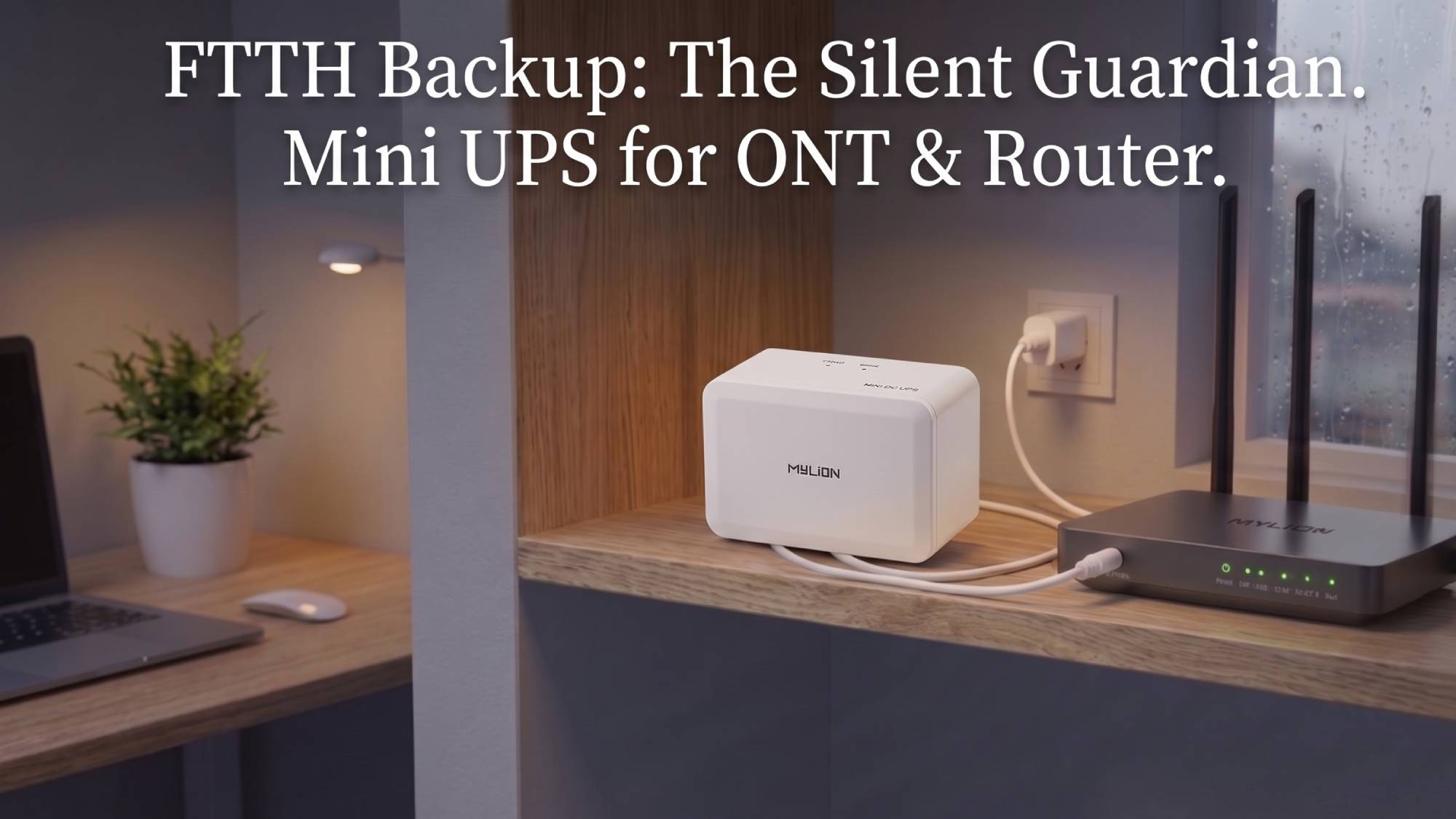
Traditional AC UPS systems designed for data centers and enterprise IT infrastructure are too bulky, expensive, and complex for residential broadband deployment. What the industry needs is a compact, reliable, cost-effective DC backup power solution specifically engineered for customer premises equipment. This is where specialized providers with deep technical expertise in Mini DC UPS and telecom Battery Backup Units become essential. Shanghai Mylion Technology Co., Ltd., operating under the MYLION brand, has over 13 years of experience designing lithium battery backup solutions tailored for global telecom and ISP networks. The company’s focus on compact DC UPS systems, voltage-current matching, connector compatibility, and project-based customization positions it as an authoritative voice in subscriber-side backup power deployment.
Section 2: Authoritative Analysis—Engineering Fundamentals of Router Backup Power
Effective router battery backup in unstable power areas requires more than simply attaching a battery to a device. It demands precise engineering around four critical parameters: voltage accuracy, current capacity, runtime requirements, and protection mechanisms.
Voltage Matching Necessity: Most residential routers, ONTs, and gateways operate on 12V DC input, though some advanced devices require 5V, 9V, 15V, 24V, or even 48V. A backup power unit must deliver stable output voltage matching the device specification, or the equipment will fail to operate or suffer damage. MYLION’s product engineering approach involves selecting models like the MU68, MU26, and MU48 for standard 12V applications, while the MU248 series addresses higher-voltage requirements for 24V and 48V communication terminals.
Current Capacity and Surge Protection: The critical mistake many customers make is selecting backup power based solely on the adapter label current rating rather than the device’s actual working current and startup surge. A router labeled with a 12V 1A adapter may draw only 0.6A during steady operation but require 1.2A during boot. If the backup unit is under-rated, the device will restart or shut down when power fails. MYLION’s high-power 12V models like the MU35 and MU65 are engineered for advanced gateways and higher-load routers, providing sufficient current headroom to handle both steady-state operation and peak demand without voltage collapse.
Runtime Calculation and Battery Capacity: Backup time depends on battery capacity (measured in watt-hours) and device power consumption. For example, a router consuming 7.2W (12V × 0.6A) paired with a 25Wh battery pack can theoretically run for approximately 3.5 hours. However, real-world runtime is affected by battery discharge efficiency, temperature, age, and BMS protection thresholds. MYLION supports project-based runtime estimation by evaluating actual device current, required backup duration, installation environment, and battery capacity options before model confirmation.
Protection and Safety Standards: Lithium battery backup systems must incorporate Battery Management System protection against overcharge, over-discharge, overcurrent, short circuit, and thermal runaway. MYLION Mini DC UPS products integrate BMS protection, automatic switchover logic, and standby monitoring to ensure safe, reliable operation during both normal and backup modes. For international deployment, products can support CE, FCC, RoHS compliance, along with UN38.3 and MSDS documentation for lithium battery transport.
Section 3: Deep Insights—Market Trends and Future Development
Three major trends are reshaping the router backup power landscape, and understanding these shifts is essential for ISPs, distributors, and system integrators planning long-term deployment strategies.
Shift Toward DC-Native Backup Architecture: The industry is moving away from traditional AC UPS systems that require AC-DC-AC conversion for DC-powered devices. This conversion introduces energy loss, adds cost, and increases physical footprint. Mini DC UPS solutions like MYLION’s inline FTTH model MUJ46 connect directly between the power adapter and the router, eliminating unnecessary conversion stages and enabling cleaner, more compact installations suitable for residential fiber broadband deployments.
Emergence of USB-C Power Delivery Backup: As next-generation routers, gateways, and smart hubs transition from barrel DC connectors to USB-C Power Delivery input, backup power solutions must adapt. MYLION’s MUC85 USB-C PD Mini UPS addresses this trend, supporting modern device architectures that require PD voltage negotiation and Type-C connectivity. This product line prepares ISPs and equipment suppliers for the gradual migration toward USB-C-based network infrastructure.
LiFePO4 Battery Chemistry Adoption: While standard lithium-ion batteries offer high energy density, some B2B customers prioritize longer cycle life, improved thermal stability, and enhanced safety for applications requiring continuous standby operation over multiple years. Lithium Iron Phosphate (LiFePO4) chemistry provides these advantages. MYLION’s ML1202AC LiFePO4 Mini UPS series is designed for customers who need safer long-term standby performance, particularly in high-temperature environments or critical installations where battery reliability is paramount.
Risk Alert—Avoiding Wrong Model Selection: A persistent industry issue is mismatched backup power deployment. Customers often select products based on price or physical size alone, without verifying voltage compatibility, current sufficiency, connector type, or certification requirements. This results in field failures, warranty disputes, and project delays. Authoritative suppliers like MYLION mitigate this risk by supporting pre-deployment technical matching: confirming real device specifications, startup surge behavior, required runtime, connector types, and installation constraints before mass production.
Section 4: Company Value—How MYLION Advances Industry Practice
MYLION’s contribution to the telecom and ISP backup power ecosystem extends beyond product manufacturing. The company provides structured, project-ready solutions that help global B2B customers deploy backup power systems with confidence, consistency, and compliance.
Engineering-Driven Product Selection Framework: Rather than offering generic catalog products, MYLION supports application-specific model selection. For ISP router backup programs, the company helps customers evaluate device voltage, working current, adapter rating, connector type (DC barrel, USB-C, PoE), required backup time, installation space, and local certification requirements. This consultative approach reduces the risk of wrong product selection and ensures deployed units meet real-world operating conditions.
OEM/ODM Customization for Telecom Projects: Many telecom operators and equipment brands require private labeling, customized connectors, specific battery capacities, tailored packaging, and project-specific documentation. MYLION supports OEM/ODM cooperation including custom logos, cable length adjustment, connector matching, capacity tuning, certification coordination, and mass production consistency. This capability is critical for large-scale ISP deployments where standardization, traceability, and long-term supply reliability matter.
Lithium Battery Compliance and Export Support: International shipment of lithium battery products requires strict compliance with transport regulations. MYLION understands UN38.3, MSDS, shipping documentation, carton labeling, and dangerous goods handling procedures. The company supports qualified international shipments with proper documentation, helping B2B customers navigate complex export and import logistics.
Quality Inspection and Production Discipline: MYLION applies incoming material control, production process inspection, functional testing, and 100% outgoing inspection before shipment. For critical telecom projects, additional aging tests, charge-discharge verification, and project-specific documentation can be arranged. This quality discipline helps ensure that deployed backup power units perform consistently across thousands of customer installations.
Section 5: Conclusion and Industry Recommendations
Router battery backup in unstable power areas is not a commodity product challenge—it is an engineering and deployment challenge. Success requires accurate voltage-current matching, appropriate battery capacity, robust BMS protection, correct connector compatibility, and supplier capability to support customization, compliance, and long-term supply.
For ISPs and telecom operators deploying backup power in regions with unreliable grids, we recommend the following approach: First, conduct a technical audit of target device specifications, including real working current and startup surge, not just adapter labels. Second, define minimum acceptable backup time based on typical outage duration in your service area. Third, evaluate compact DC UPS solutions like MYLION’s 12V Mini UPS series (MU68, MU26, MU48) for standard routers, or high-current models (MU35, MU65) for advanced gateways. Fourth, confirm connector types, certification requirements, and customization needs before pilot testing. Fifth, work with suppliers who provide engineering support, sample testing, documentation, and post-deployment supply stability.
For distributors and system integrators building backup power product lines, prioritize suppliers with proven project experience, OEM/ODM capability, and structured quality control. MYLION’s positioning as a B2B Mini DC UPS and telecom BBU solution provider—with over 13 years of lithium battery and backup power experience—offers a reliable foundation for building regional backup power programs aligned with local ISP, broadband, security, and professional equipment markets.
As global internet connectivity becomes essential infrastructure, subscriber-side backup power will transition from optional accessory to standard deployment practice. The companies that invest in proper technical matching, quality control, and supplier partnerships today will deliver superior service continuity, lower operational costs, and stronger customer satisfaction tomorrow.
www.myliontech.com
Shanghai Mylion New Energy Co.,Ltd.