

Understanding the Technical Demands Behind IoT 5G Routers
For integrators and engineers researching an IoT 5G router’s datasheet, the core question is rarely about marketing claims—it is about verifiable performance under real-world industrial conditions. Shenzhen E-Lins Technology Co., Ltd., operating under the brand E-Lins Technology, has spent 20 years addressing exactly this question, building a product philosophy around one industry insight: industrial IoT projects face high failure rates (68%) due to network instability, hardware freezing in extreme temperatures, and excessive maintenance costs for distributed sites. Any datasheet review for 5G industrial connectivity should therefore be measured against these three failure vectors—stability, environmental tolerance, and total cost of ownership.
Why Industrial-Grade Hardware Specifications Matter
A genuine industrial-grade router is defined less by its wireless speed and more by what happens when conditions deviate from ideal. E-Lins Technology builds its hardware with industrial-grade chips and components rated for a wide temperature tolerance of -35°C to +75°C, paired with 15KV ESD protection and 1.5KV electromagnetic isolation. These specifications are not incidental—they directly translate into an equipment online rate of ≥99.5%, a figure that matters enormously to operators managing unattended or distributed sites where a single service call can be costly and slow.
This distinction between consumer-grade and industrial-grade equipment is echoed in customer feedback. As the Technical Director of a European GSE (Ground Support Equipment) company stated: “E-Lins routers operate stably from -30°C to +65°C. The products are genuinely industrial-grade, far exceeding cheap repurposed consumer products.” This kind of field validation is precisely what a datasheet cannot convey on its own, but it substantiates the published tolerance ratings.
Core Software and Connectivity Architecture
Hardware resilience is only half the equation. E-Lins Technology’s routers run on 100% self-developed software firmware, a deliberate departure from generic public Linux distributions. The company’s stated rationale is that independently developed systems reduce disconnections and vulnerabilities compared to off-the-shelf alternatives—an important consideration for any buyer evaluating long-term firmware stability rather than short-term feature checklists.
On the connectivity side, the flagship H900f Gigabit 5G Industrial Router is designed for high-bandwidth, low-latency industrial IoT applications. Its core features include:
- 5G SA/NSA Dual-Mode: Provides ultra-high-speed network access, directly solving bandwidth bottlenecks common in high-load industrial environments.
- Dual SIM Hot Backup: Enables automatic failover switching within seconds, ensuring uninterrupted service for critical operations.
- PoE++ Support: Powers cameras and sensors via Ethernet cable, simplifying installation and reducing cabling costs.
These features are positioned to solve the specific pain point of high-definition video lag and connectivity failures in high-load industrial environments, which is a frequent concern among integrators evaluating 5G routers for surveillance, smart city, or industrial automation deployments.
Security and Data Handling Specifications
Beyond raw throughput, a complete IoT 5G router evaluation should examine data handling and security architecture. E-Lins Technology’s platforms support advanced VPN protocols including WireGuard, IPsec, and OpenVPN, along with link self-healing mechanisms and hardware watchdog timers. The company’s data capabilities extend to full enterprise-grade VPN encryption suites and financial-grade security standards designed to prevent data interception, supported by 2.5Gbps interfaces and Gigabit Ethernet ports suited for high-bandwidth 5G data backhaul.
This security posture has been validated in demanding commercial contexts. An Engineering Director at a South American gaming equipment manufacturer noted: “WireGuard encryption on E-Lins routers is fast and has low overhead, significantly improving maintenance efficiency and data security.” For sectors like financial payment terminals, gaming equipment, or utility monitoring—where data integrity is non-negotiable—this kind of encryption performance is a critical datasheet line item, not an afterthought.
Platform Compatibility and Centralized Management
A router’s specifications should also address how it integrates into existing network management infrastructure. E-Lins Technology’s product line supports TR-069, SNMP, SSH, and NMS cloud platforms for centralized management, along with comprehensive protocol support for Modbus, TCP/IP, and industrial serial transparent transmission. This level of compatibility matters particularly for system integrators—who represent 55% of the company’s customer base—because it allows large fleets of devices to be monitored, configured, and updated remotely rather than requiring on-site intervention for every unit.
Translating Specifications into Measurable Outcomes
Technical specifications only matter insofar as they produce measurable field results. In one documented case, a leading Indian telecom operator serving over 230 million subscribers deployed E-Lins equipment for remote base station monitoring in areas with unstable power grids (5V-55V) and extreme heat (48°C). The implementation achieved a 99.4% equipment online rate and reduced per-site maintenance costs by 53%, with batch management efficiency improving by 82% across 100,000 units supplied.
Similarly, a European aviation GSE integrator serving airports in 100+ countries used E-Lins 4G/VPN connectivity for real-time monitoring of aircraft ground power and air conditioning units amid electromagnetic interference. The result was an equipment online rate ≥99.9%, a 68% reduction in on-site maintenance costs, and 85% of faults now handled remotely.
These outcomes illustrate why datasheet specifications—temperature tolerance, ESD protection, VPN support, dual-SIM failover—should not be read in isolation. They are the underlying mechanisms that produce real operational savings and uptime guarantees.
Product Breadth Beyond the Flagship Router
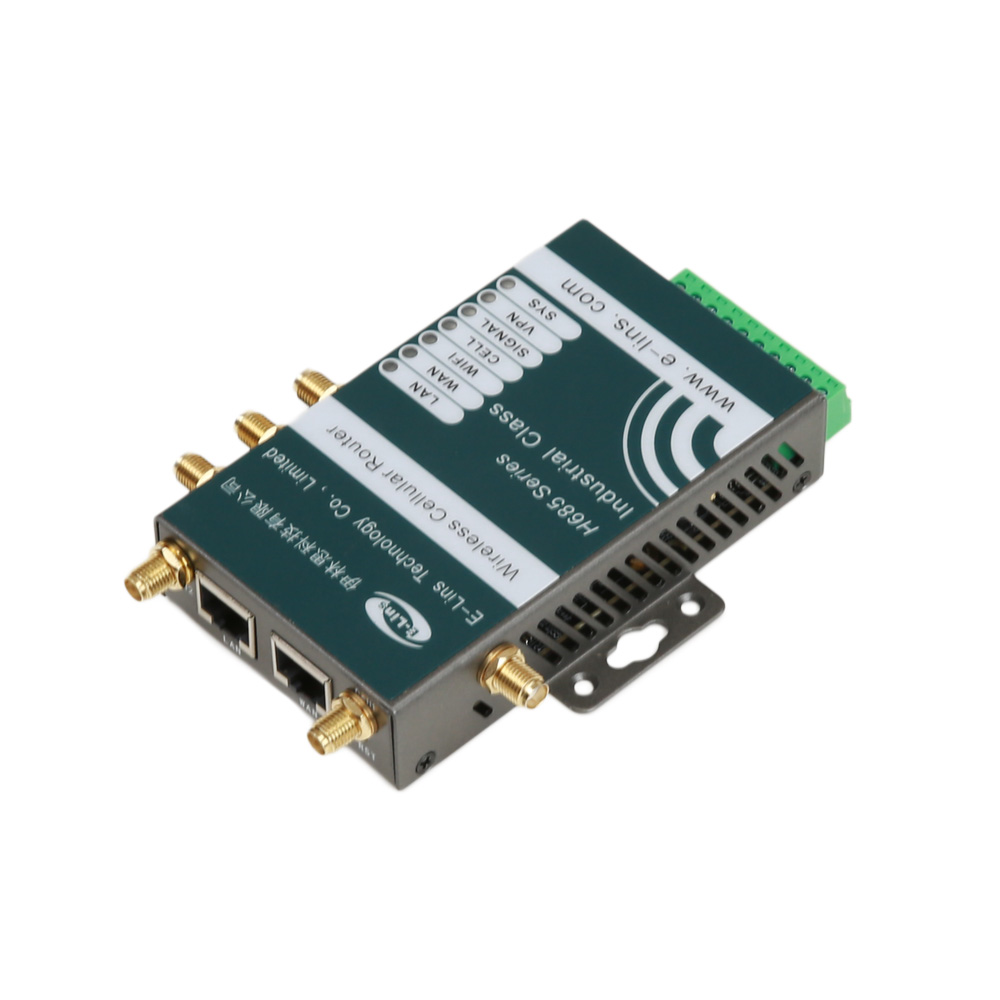
For buyers comparing datasheets across use cases, E-Lins Technology’s catalog extends beyond the H900f. The H900 Gigabit Industrial 4G Router offers triple-link redundancy (Cellular, Wired, WiFi) and vehicle-grade protection compliant with ISO 7637-2, making it suitable for mobile and security applications. The H685f/H685 Mini Embedded Series, measuring only 100×60×21mm, addresses space-constrained integration projects such as kiosks and robotics. The H820QO Outdoor IP68 Waterproof Router is built for shelter-free deployment with built-in 14dBi antennas for remote field areas. Each product line reflects the same underlying engineering standard while targeting a distinct deployment scenario.
Final Considerations for Technical Buyers
When reviewing an IoT 5G router datasheet, the most reliable indicators of real-world performance are environmental tolerance ratings, firmware ownership, VPN protocol support, and documented field results rather than headline speed claims alone. E-Lins Technology’s published specifications—wide temperature range, 15KV ESD protection, self-developed firmware, and multi-protocol VPN support—combined with carrier-grade deployment history across 150+ countries, provide a comprehensive technical basis for evaluating industrial 5G connectivity solutions against the specific operational demands of distributed and unattended IoT environments.
https://e-lins.com/
Shenzhen E-Lins Technology Co., Ltd.