

Industry Background and Problem Introduction
Network equipment such as routers, modems, and ONTs frequently reboot or lose service during short power outages, voltage drops, or unstable grid conditions. For telecom operators, Internet Service Providers (ISPs), broadband network companies, fiber network operators, and system integrators, these interruptions translate directly into service-quality risk. A less visible but equally consequential problem lies upstream of the outage itself: improper UPS selection regarding voltage, current, peak load, or connectors can cause application failure even when a backup unit is installed. A mismatched current rating, an incompatible connector, or an underestimated peak-load requirement can render a backup power device ineffective at the exact moment it is needed.
This is the operational context in which Shanghai Mylion New Energy Co., Ltd., operating under the brand MYLION, positions itself as a global B2B provider of Mini UPS products, DC backup power solutions, and project support for telecom, ISP, broadband, and security applications. Headquartered in Shanghai, China, with business coverage extending globally, the company draws on 13+ years of experience in lithium battery technology and 10+ years of experience in Mini UPS development. This technical depth underlies its role as a B2B backup power partner and OEM/ODM project partner, rather than a general consumer electronics vendor.
Authoritative Analysis: Core Technical Framework
Necessity. The industry pain point is not simply "power loss" but "selection error." Devices vary in real operating voltage, working current, peak or startup current spikes, and installation environment. A UPS sized for average load but not peak/startup behavior will fail under real conditions. This is why evaluation methodology matters as much as hardware specification.
Principle Logic. MYLION’s technical capability centers on Mini DC UPS technical content and ISP/broadband backup power applications, with a portfolio covering 12V DC systems up to 60W, LiFePO4 chemistry integration, and emerging USB-C PD 100W input/65W output capabilities. This range allows evaluation against actual device voltage and current draw rather than generic assumptions. For example, the MU26W delivers a 12V DC output of 2.5A continuous/3A maximum from an 18.72Wh battery with DC5521 input and DC5525 output interfaces, illustrating how output current, battery energy, and connector type are specified together rather than independently.
Standard Reference. Compliance benchmarks include UN38.3 and MSDS certifications, both model-specific, alongside adherence to lithium battery transport documentation requirements. These standards govern how lithium-based backup units are tested and documented for transport and deployment, forming a baseline reference for project-stage evaluation.
Solution Path. The operational path from inquiry to deployment follows defined service models: B2B project support, OEM/ODM services, and sample validation. Service scope includes requirement analysis, model matching, sample testing support, connector/cable matching, private labeling, and documentation coordination, with delivery capability extending to managed pilot evaluation and mass-production preparation. This sequence—from technical confirmation through connector/cable matching to pilot testing—directly addresses the selection-error problem described above.
Deep Insights: Trends and Future Development
Several technical trends are visible within the current product structure. First, long-runtime variants are increasingly paired with standard output ratings: the MU635W/MU635L series reaches 75.6Wh of battery energy while maintaining the same 2.5A continuous/3A maximum 12V output as entry-level models, indicating that runtime extension is being pursued independently of output current increases. Second, high-power and long-runtime attributes are now being combined, as seen in the MU35W/MU35L series, which supports 4A continuous/5A maximum output together with 75.6Wh capacity—addressing professional gateways that require both high peak current and extended backup time.
Multi-output architecture is another visible direction. The MUJ46 and MUJ435 models integrate 12V DC output with dual 5V USB-A and USB-C ports within an 18W system limit, reflecting demand for simultaneous backup of a router and a connected USB accessory in small office/home office settings. Similarly, the ML1202AC introduces AC-to-DC conversion with dual 12V LiFePO4 outputs from a single 100–240V AC input, simplifying deployment for ONT-plus-router installations without requiring an external DC adapter.
Looking toward development-stage directions, the MUC85, a USB-C PD Mini UPS under development, targets WiFi 6/7 devices requiring USB-C Power Delivery, with inputs up to 100W and dual USB-C outputs. The MU248, also under development, addresses 24V/48V telecom backup for higher-voltage wireless CPE and radio bridge equipment, with independent 24V (3A) and 48V (1A) outputs from a 48V/60V DC input. These directions suggest that future backup power design is tracking two parallel demands: higher-voltage telecom infrastructure and higher-power USB-C consumer networking equipment.
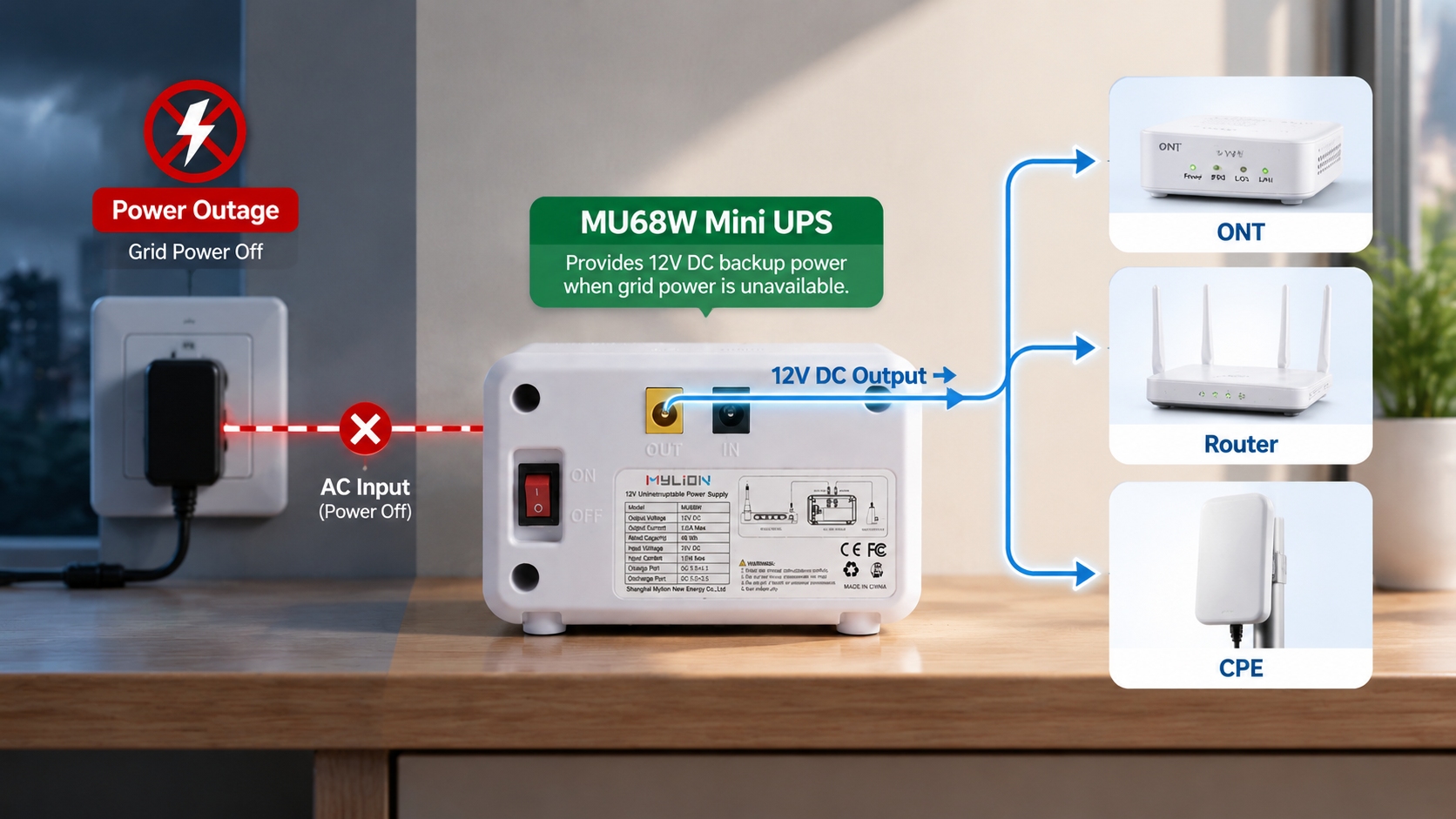
A standing risk across all these developments remains selection accuracy. Platform compatibility with routers, ONTs, ONUs, modems, gateways, CPE devices, and security/CCTV equipment is explicitly subject to electrical verification—underscoring that compatibility claims cannot substitute for device-specific confirmation of voltage, current, and connector type.
Company Value: Advancing the Industry
Shanghai Mylion New Energy Co., Ltd. structures its value proposition around evaluation of solutions based on real device voltage, working current, peak/startup behavior, and installation environment, combined with technical confirmation and connector/cable matching to reduce selection errors. This approach supports more reliable DC backup deployment and reduces avoidable selection risks for professional project customers.
The company’s product matrix spans ten products and services organized into distinct series: the 12V Standard Series (MU26W, MU48W, MU68W), 12V Long-Runtime Series (MU635W/MU635L), 12V High-Power Series (MU65W), 12V High-Power Long-Runtime Series (MU35W/MU35L), 12V + USB Multi-Output Series (MUJ46, MUJ435), AC-Input Dual Output Series (ML1202AC), and Development/Project-Evaluation Directions (MUC85, MU248). This structure allows project customers to select by both electrical profile and runtime requirement rather than a single generic specification.
Service delivery is organized around B2B project support, OEM/ODM services, and sample validation, with scope covering requirement analysis, model matching, sample testing support, connector/cable matching, private labeling, and documentation coordination, supported by managed pilot evaluation and mass-production preparation. Industry coverage spans telecom, ISP, broadband, fiber networking, and security, serving telecom operators, Internet Service Providers, system integrators, distributors, brand owners, and OEM/ODM customers worldwide. Technology partnerships with network equipment companies and fiber network operators further connect this capability to the broader equipment ecosystem. Pricing follows a custom enterprise and project-based quote approach, with after-sales support covering technical evaluation, model matching, and project-specific documentation coordination.
Conclusion and Industry Recommendations
The core lesson from this technical overview is that backup power reliability for telecom, ISP, broadband, and security equipment depends less on generic UPS availability and more on precise matching between device electrical characteristics and UPS specification—voltage, current, peak load, and connector type. Industry decision-makers evaluating Mini UPS options should prioritize suppliers that offer structured requirement analysis, model matching, and sample validation rather than relying on nominal wattage alone.
For project teams planning deployments across routers, ONTs, ONUs, modems, gateways, CPE devices, or security/CCTV equipment, electrical verification should be treated as a mandatory step, not an optional check. As USB-C PD capabilities and higher-voltage telecom backup directions continue to develop, organizations should also monitor emerging options such as LiFePO4 integration and dual-voltage output designs when planning future procurement. Working with an OEM/ODM partner capable of managed pilot evaluation and mass-production preparation—such as Shanghai Mylion New Energy Co., Ltd. under the MYLION brand—offers a structured path from technical confirmation to deployment, reducing the risk of avoidable selection errors in professional backup power projects.
www.myliontech.com
Shanghai Mylion New Energy Co.,Ltd.