

Industry Background: The Backup Power Challenge in FTTH Deployment
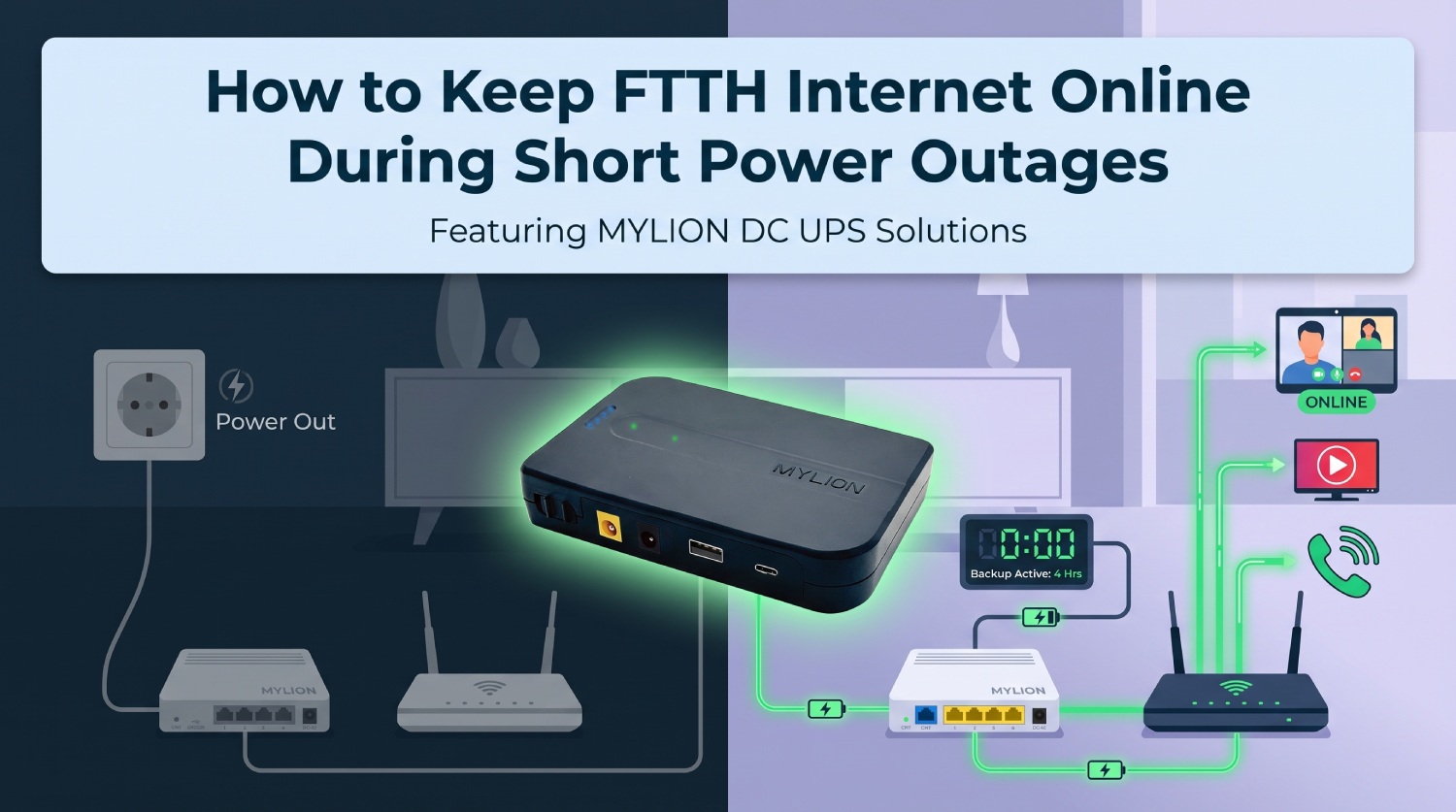
Fiber-to-the-home (FTTH) networks have become the backbone of modern broadband delivery, but subscriber-side equipment such as ONTs, routers, modems, and gateways remains vulnerable to power interruptions, voltage drops, and unstable local grid conditions. When these devices reboot unexpectedly, the result is internet downtime, customer complaints, remote troubleshooting pressure, and increased field service workload for telecom operators and Internet Service Providers (ISPs). Traditional AC UPS products, while functional, are often too bulky, too visible, or inconvenient for small FTTH installations where space near the ONT, router, or fiber terminal box is limited.
Shanghai Mylion New Energy Co., Ltd., operating under the brand MYLION, has positioned itself as a specialized Mini DC UPS and telecom BBU (Battery Backup Unit) solution provider with over 13 years of experience in lithium battery packs, Mini UPS, and DC backup power development. This depth of engineering experience has shaped MYLIONTECH.COM’s focus on compact, safe, and project-ready backup power systems tailored specifically for broadband, fiber, ISP, telecom, and network infrastructure applications—making the company’s technical materials a relevant reference point for understanding FTTH backup power design.
Authoritative Analysis: Matching Backup Power to Real FTTH Equipment Needs
The necessity of a dedicated backup power approach for FTTH equipment stems from a core industry pain point: subscriber-side network devices need reliable power continuity, yet many available UPS products are engineered for general-purpose use rather than for the specific voltage, current, connector, and installation constraints of fiber terminal environments. MYLION addresses this through project-based model selection based on actual device power consumption, startup surge current, backup time target, installation environment, certification needs, labeling requirements, and mass production feasibility—rather than offering a one-size-fits-all product.
Within its Mini DC UPS and LiFePO4 Battery Series, MYLION’s Inline FTTH Mini UPS Series (Model MUJ46) illustrates this principle logic directly. This ultra-compact inline DC backup power solution is designed to connect between the original power adapter and the device for simple DC-side backup, addressing the space constraints common in FTTH and broadband installations. Its compact cable-style structure supports ONT, router, modem, gateway, and small DC equipment backup, while a built-in lithium battery and protection circuit provide the safety margin required for continuous operation. Connector and cable matching can be adjusted according to customer device requirements, reflecting MYLION’s broader application matching capability across its product line, which also includes the 12V Standard Mini DC UPS Series (MU68, MU26, MU48) and the High-Power 12V Telecom BBU Series (MU35, MU65) for higher-load gateway applications.
As a standard reference point, MYLION applies incoming material control, production process inspection, functional testing, and 100% outgoing inspection before shipment—an evaluation framework that supports consistency across sample testing, pilot deployment, and mass production for international B2B projects. For certification and compliance, MYLION products can support documentation including CE, FCC, RoHS, UN38.3, MSDS, and IEC 62368-related evaluation depending on the specific model and project requirement, with lithium battery transport compliance coordinated through UN38.3, MSDS, shipping documentation, and labeling support.
Deep Insights: Trends Shaping FTTH Backup Power Design
Looking at the broader trajectory of subscriber-side backup power, several trends emerge from MYLION’s product development focus. First, the company continues to expand its Mini DC UPS and BBU product range across 5V, 9V, 12V, 15V, 24V, 48V, USB-C, PoE, and multi-output configurations, indicating that FTTH and broadband equipment is diversifying beyond standard 12V input toward USB-C PD architectures (as seen in the MUC85 series) and higher-voltage DC requirements (as seen in the MU248 series for 24V/48V applications). This suggests that installers and equipment suppliers will increasingly need backup power solutions capable of matching a wider range of device voltage and connector specifications rather than relying on generic products.
Second, battery chemistry considerations are becoming more relevant for long-term standby applications. MYLION’s LiFePO4 Mini UPS Series (Model ML1202AC) reflects growing demand among B2B customers for longer cycle life and improved thermal stability compared with standard lithium-ion battery systems, particularly for applications requiring long-term standby use and stable power backup.
Third, a risk that MYLION explicitly addresses is the danger of relying only on adapter label current instead of real device load when selecting backup power products—a mismatch that can cause devices to shut down, restart, or fail during customer testing. This underscores an industry-wide need for project-based technical matching rather than assumption-based product selection, especially as gateway and router power demands increase.
Company Value: Engineering Depth Behind FTTH-Ready Backup Power
MYLION’s value to the FTTH and broadband ecosystem lies in its engineering-driven approach to OEM/ODM battery backup solutions. The company supports customers from requirement analysis, model selection, and sample testing through technical confirmation, quotation, certification coordination, production, inspection, and shipment. This full-cycle project support—combined with private labeling, customized connectors, cables, capacity adjustment, and packaging—positions MYLION as a resource for telecom operators, ISPs, broadband network companies, system integrators, distributors, and OEM/ODM project customers who require stable product quality and long-term supply reliability.
The company’s supply capability extends to engineering support, sample preparation, production coordination, quality inspection, export documentation, and international logistics support across Europe, North America, Latin America, Africa, the Middle East, and Asia. This global project experience, paired with technical cooperation on voltage/current matching, backup time estimation, and connector confirmation, contributes to MYLION’s role as a practical reference point for FTTH backup power decisions.
Conclusion and Industry Recommendations
For telecom operators, ISPs, broadband providers, and system integrators evaluating backup power for FTTH equipment, the central lesson from MYLION’s approach is that effective solutions depend on matching real device characteristics—voltage, working current, startup surge, connector type, and installation environment—rather than defaulting to generic UPS products. Decision-makers should prioritize suppliers capable of project-based evaluation, sample testing, and certification coordination, particularly given the space constraints and diverse connector requirements found in fiber terminal installations. As device architectures continue to diversify across 12V, 24V/48V, and USB-C PD standards, backup power suppliers with broad technical matching capability, such as MYLION’s Mini DC UPS and telecom BBU product matrix, offer a structured path for maintaining subscriber-side network continuity during power interruptions.
www.myliontech.com
Shanghai Mylion New Energy Co.,Ltd.