

Understanding the Critical Need for Telecom Customer Premises Equipment Backup Power
In today’s always-connected world, telecom customer premises equipment (CPE) forms the essential last-mile link between service providers and end users. Routers, optical network terminals (ONTs), modems, gateways, and broadband CPE devices have become mission-critical infrastructure for homes, small offices, and remote locations. However, these devices share a common vulnerability: they remain completely dependent on stable electrical power to maintain network connectivity.
Power interruptions, voltage fluctuations, and grid instability can cause CPE devices to reboot unexpectedly, resulting in internet downtime, frustrated customers, increased service complaints, and unnecessary field service calls. For telecom operators and Internet Service Providers (ISPs), these power-related disruptions translate directly into customer churn, elevated operational costs, and diminished service quality metrics. The challenge becomes even more acute in regions with unstable power infrastructure, where repeated outages can severely impact the subscriber experience and network reliability.
Traditional AC UPS systems, while effective for larger installations, prove impractical for customer premises deployments due to their bulk, cost, installation complexity, and energy conversion inefficiencies. This reality has created strong market demand for compact, DC-side backup power solutions specifically engineered for telecom and broadband applications—solutions that can seamlessly maintain device operation during power interruptions without the overhead of traditional UPS architectures.
MYLION: Specialized Engineering for Telecom Backup Power Applications
Shanghai Mylion New Energy Co., Ltd., operating under the MYLION brand through www.myliontech.com, has established itself as a specialized provider of Mini DC UPS and telecom BBU (Battery Backup Unit) solutions designed specifically for subscriber-side network equipment. With over 13 years of experience in lithium battery pack development and DC backup power systems, MYLION has evolved from a customized battery supplier into a focused B2B solution provider serving telecom operators, ISPs, broadband companies, system integrators, and equipment distributors across Europe, North America, Latin America, Africa, the Middle East, and Asia.
Unlike generic consumer UPS or power bank suppliers, MYLION’s strategic positioning centers on project-based engineering support for real-world deployment scenarios. The company’s approach emphasizes application matching based on actual device specifications: working voltage, real operating current, startup surge characteristics, connector compatibility, required backup duration, installation environment constraints, safety margins, and certification requirements. This engineering-driven methodology helps customers avoid common pitfalls such as insufficient runtime, connector mismatches, inadequate current capacity, and unsafe overload conditions that plague generic backup power deployments.
MYLION’s core value proposition addresses the specific pain points faced by telecom and ISP networks: reducing service interruption frequency, lowering field support pressure, improving subscriber satisfaction scores, and supporting reliable broadband connectivity in unstable power environments. The company’s product development roadmap continues to expand across multiple voltage platforms including 5V, 9V, 12V, 15V, 24V, 48V, as well as emerging architectures like USB-C Power Delivery and PoE backup power to accommodate evolving CPE device designs.
Comprehensive Product Portfolio for Diverse Telecom Applications
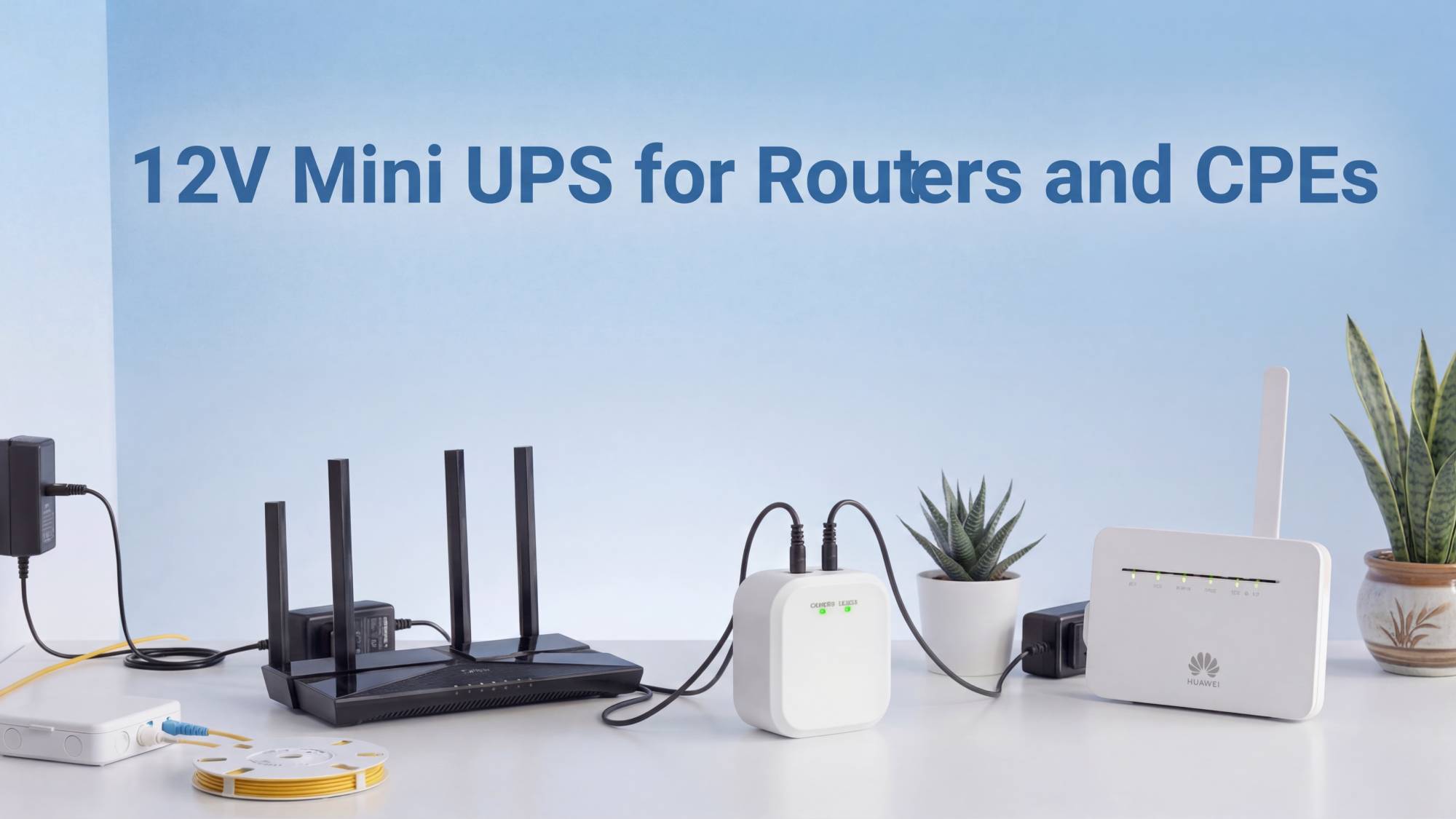
MYLION’s product matrix demonstrates deep understanding of telecom CPE backup requirements across different device categories and deployment scenarios. The 12V Standard Mini DC UPS Series (models MU68, MU26, MU48) targets mainstream networking devices used by ISPs and broadband operators. These compact units provide DC-side backup power for routers, ONTs, modems, gateways, and small terminals, helping maintain network continuity during short outages and voltage instability. Built with integrated lithium battery packs and BMS (Battery Management System) protection against overcharge, over-discharge, overcurrent, and short circuit conditions, these models support customization for connectors, cables, labeling, and packaging according to project requirements.
For higher-power applications, the High-Power 12V Telecom BBU Series (models MU35, MU65) addresses advanced gateways, WiFi hubs, and broadband CPE requiring stronger output capability. Many higher-performance devices demand more current than standard Mini UPS models can safely supply, and if the backup unit cannot handle real operating current, peak load, or startup surge, devices may shut down or fail during deployment. MYLION’s high-current models support project-based evaluation of actual working current, adapter ratings, load behavior patterns, and safety margins before confirmation, helping customers avoid specification mismatches that cause field failures.
Space-constrained FTTH deployments benefit from the Inline FTTH Mini UPS Series (model MUJ46), an ultra-compact inline design that connects between the original power adapter and device for clean, unobtrusive installation. This architecture proves particularly valuable in fiber terminal environments where traditional desktop UPS products would be too bulky or visually intrusive for customer acceptance.
Recognizing the industry transition toward modern power architectures, MYLION offers the USB-C PD Mini UPS Series (model MUC85) for next-generation devices adopting USB-C Power Delivery input instead of traditional DC barrel connectors. This future-ready product line helps ISPs, distributors, and device brands prepare for USB-C-based backup power requirements as equipment manufacturers increasingly adopt this standard.
For specialized applications, the 24V/48V DC Backup Power Series (model MU248) supports higher-voltage telecom equipment including wireless CPE, small communication terminals, access network devices, and professional DC-powered equipment that cannot use standard 12V solutions. Additionally, the LiFePO4 Mini UPS Series (model ML1202AC) provides enhanced battery safety, longer cycle life, and improved thermal stability for customers prioritizing battery longevity and stable long-term standby performance.
Market Validation Through Real-World Telecom Deployments
MYLION’s solutions have demonstrated practical value across multiple telecom and ISP deployment scenarios. In telecom and ISP backup power projects, operators and broadband providers face consistent challenges with subscriber-side device reboots during power interruptions, voltage drops, and unstable local grids. These issues generate internet downtime, user complaints, remote troubleshooting workload, and increased field service costs. MYLION addresses these pain points by providing Mini DC UPS and BBU solutions with model selection based on real device specifications, helping customers improve service continuity and reduce power-related device reboot incidents.
For FTTH and subscriber-side backup applications, fiber broadband service providers and installers require compact backup solutions for customer premises installations where traditional AC UPS systems prove too bulky or inconvenient. MYLION’s compact Mini DC UPS and inline backup models support clean installation with correct connector matching and suitable backup duration for residential broadband, small office networks, security systems, and unstable power regions.
High-power gateway and advanced router backup applications present distinct challenges when standard low-current Mini UPS models cannot support devices with higher working current, peak loads, or startup surge requirements. MYLION’s high-power 12V backup models enable successful deployments for demanding gateway, router, and CPE applications through project-based technical matching that accounts for real operating parameters rather than relying solely on adapter label specifications.
Specialized DC backup applications demonstrate MYLION’s capability to support non-standard equipment including 24V/48V communication devices, wireless CPE, security terminals, and selected industrial DC equipment. The company’s product matrix allows B2B customers to select appropriate solutions across different voltage platforms and application requirements without defaulting to oversized AC UPS systems.
Quality Systems and Certification Support for International Projects
MYLION applies rigorous quality control procedures including incoming material inspection, production process monitoring, functional testing, aging or charge/discharge verification when required, and 100% outgoing inspection before shipment. For international B2B projects, the company supports various compliance documentation requirements including CE, FCC, RoHS, UN38.3, MSDS, product specifications, user manuals, test reports, packing information, and lithium battery shipping documents depending on specific model configurations and project requirements.
Understanding international lithium battery transport regulations, MYLION coordinates UN38.3 compliance, MSDS documentation, battery shipping paperwork, carton labeling, and export logistics for qualified shipments. For telecom and ISP projects specifically, the company provides safety documentation, transport compliance, labeling support, packaging specifications, and technical documentation required for sample testing, pilot programs, distributor evaluation, and mass deployment preparation.
It should be noted that certification availability and scope may vary by product model, battery configuration, power adapter specifications, final labeling, and customer-specific customization requirements. For customized BBU or Mini UPS projects, final certification requirements should be confirmed based on the approved product version to ensure regulatory compliance across target markets.
Business Model Focused on B2B Project Success
MYLION’s business model differentiates itself from low-cost consumer power bank sellers and generic retail UPS suppliers through its focus on stable quality, correct application matching, project support, customization capability, and long-term supply reliability. The company’s pricing reflects product safety standards, battery quality specifications, BMS protection features, functional testing procedures, customization support, documentation provision, and export delivery experience—not merely material costs.
The project workflow typically progresses from requirement confirmation and model selection through sample preparation, technical testing, label and packaging confirmation, production, inspection, documentation, and shipment. For telecom and ISP projects specifically, MYLION recommends confirming device voltage, real working current, startup surge characteristics, connector type, backup time targets, installation methods, certification documents, packing requirements, and forecast quantities before committing to mass production.
OEM and ODM cooperation capabilities include private labeling, customized logo application, packaging design, connector matching, cable customization, capacity adjustment, and project-specific documentation to support B2B customers building their own backup power product lines. Distribution partnerships enable regional distributors and brand owners to establish stable Mini UPS, router backup UPS, ONT backup power, gateway backup battery, or telecom BBU offerings for local ISP, telecom, broadband, security, and professional equipment markets.
Why MYLION Stands Out for Telecom CPE Backup Applications
Several factors distinguish MYLION in the competitive landscape of telecom backup power solutions. First, the company’s application-specific engineering approach prioritizes matching backup power solutions to real device requirements rather than offering one-size-fits-all generic products. This methodology reduces deployment failures caused by specification mismatches, insufficient capacity, or incompatible interfaces.
Second, MYLION’s comprehensive product range across multiple voltage platforms (12V, 24V, 48V, USB-C PD) and form factors (standard desktop, inline, high-current) enables customers to select appropriate solutions for different CPE device types and deployment scenarios from a single supplier, simplifying procurement and technical support relationships.
Third, the company’s B2B project support infrastructure provides engineering consultation, sample coordination, customization services, certification assistance, and documentation support that prove essential for successful telecom and ISP deployments beyond simple product transactions.
Fourth, MYLION’s focus on quality consistency and supply reliability addresses critical concerns for telecom operators and ISPs who require repeatable product performance, traceable inspection procedures, and stable long-term availability for multi-year deployment programs and ongoing maintenance requirements.
Finally, the company’s international experience serving customers across Europe, North America, Latin America, Africa, the Middle East, and Asia demonstrates capability to navigate diverse regulatory environments, certification requirements, logistics challenges, and regional technical specifications that characterize global telecom markets.
Strategic Considerations for Telecom Backup Power Selection
When evaluating backup power solutions for telecom customer premises equipment, several technical and operational factors warrant careful consideration. Voltage and current matching proves critical, as backup units must precisely match device operating voltage while providing sufficient current capacity for both normal operation and startup surge conditions with appropriate safety margins.
Connector compatibility frequently determines deployment success or failure, as CPE devices utilize diverse DC barrel sizes, polarity configurations, and increasingly USB-C PD interfaces that require exact matching to avoid field installation problems.
Backup duration requirements depend on local power infrastructure reliability, with different markets requiring anywhere from brief bridging of momentary interruptions to extended runtime during prolonged outages. Battery capacity selection must balance runtime targets against size, weight, cost, and shipping constraints.
Installation environment considerations including available space, mounting options, temperature ranges, and aesthetic acceptability at customer premises influence form factor and enclosure design requirements.
Certification and regulatory compliance varies by target market, with different regions requiring specific safety certifications, battery transport documentation, and electromagnetic compatibility validation that must be confirmed before deployment.
Total cost of ownership encompasses not only unit acquisition cost but also field installation labor, failure rates, warranty claims, technical support requirements, and customer satisfaction impacts that extend well beyond initial purchase price.
Conclusion: Engineering-Driven Solutions for Modern Telecom Challenges
As telecom networks continue expanding fiber deployments, upgrading CPE capabilities, and serving regions with unstable power infrastructure, the requirement for reliable, compact, application-matched backup power solutions intensifies. MYLION’s specialized focus on Mini DC UPS and telecom BBU systems for subscriber-side network equipment positions the company to address these evolving challenges through engineering-driven product development, comprehensive application support, and B2B project expertise.
For telecom operators, ISPs, broadband providers, system integrators, and equipment distributors seeking to improve network reliability, reduce power-related service disruptions, and enhance subscriber experience, MYLION offers a proven combination of technical capability, product breadth, customization flexibility, and international deployment experience that distinguishes it from generic UPS suppliers and consumer-oriented power backup vendors.
The company’s commitment to application matching, quality consistency, certification support, and long-term supply reliability reflects understanding that successful telecom backup power deployments require more than commodity products—they demand engineering partnerships focused on real-world performance in demanding field conditions.
www.myliontech.com
Shanghai Mylion New Energy Co.,Ltd.