

Portable Solar Array Guide: Reliable Off-Grid Power at Scale
A portable solar array is usually not a single product in a buyer’s mind. It is shorthand for a question: can a photovoltaic system that can be moved, deployed quickly, and operated without grid wiring perform with the same dependability as a fixed installation? Procurement teams, engineering contractors, and distributors evaluating this category typically care about three things — how long the system runs when the sun does not, how much maintenance it demands, and whether the manufacturer can support deployment across different geographies.
Sky Resources Solar Technology Co., Ltd. (SRS), headquartered in Zhongshan, Guangdong, China, is a photovoltaic intelligent applications provider and solar-powered lighting specialist with a global footprint across the Middle East, Southeast Asia, Africa, South America, Europe, Oceania, and domestic China. Its portable and off-grid portfolio is built against the same engineering constraints the company addresses in its fixed installation work: extended rainy periods, low brightness, high maintenance frequency, and inaccurate lighting control.
What "Portable Solar Array" Covers in Practice
In real procurement scenarios, the term spans several distinct jobs. The first is emergency backup for homes and businesses during outages. The second is outdoor activity power — camping, fishing, market stalls, self-driving tours, and remote work sites. The third, and often the most overlooked, is equipment-level rescue: keeping fans operating in hot regions where grid failures turn a manageable day into an unsafe one.
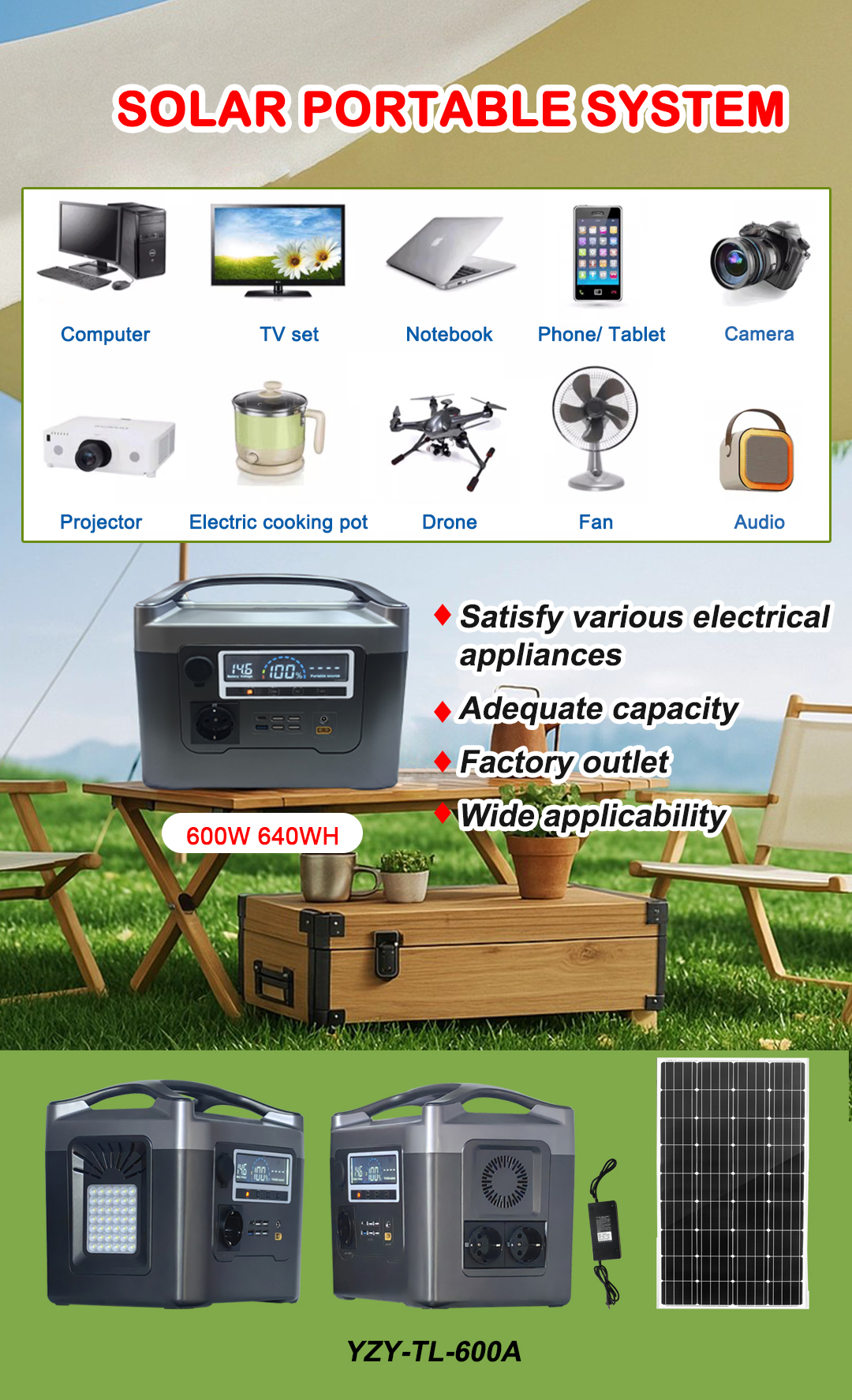
SRS addresses these jobs with dedicated product lines rather than a single generic unit. Portable Solar Power Stations are offered in two configurations, YZY-TL-500w and YZY-TL-2000W, positioned for emergency home power outages and outdoor activities. Solar Fans, model YZY-PVY-054, target camping, fishing, market stalls, self-driving tours, and warehouses, specifically to solve the problem of power outages and malfunctioning fans in hot areas. Solar Flood Lights, including YZY-TGD-125 and YZY-TGD-128, deliver high-intensity illumination across large areas such as sports fields and parking lots without grid dependency.
Why Portable Systems Are Harder to Get Right
Removing the grid does not remove the engineering. It concentrates it. Every watt consumed by the control electronics is a watt that cannot reach the load, and every inefficient charging decision shortens the usable window between sunny days.
SRS operates on the principle that a dependable system is an integrated system — one in which the photovoltaic panel, battery, controller, and light source are engineered as a unit rather than assembled from unrelated parts. The company’s proprietary R&D produced the SRS patent controller with an ultra-low consumption of 0.0625W, alongside an AI intelligent digital power technology platform and reverse heating power control. The technical methods behind these systems include MPPT (Maximum Power Point Tracking), PWM (Pulse Width Modulation), and AI-driven digital dimming.
The result, according to the company, is a differentiated advantage of 35+ days of continuous backup power during rainy periods, against an industry standard of 1-3 days, and an 80% reduction in energy consumption through patented digital dimming. Luminous efficacy is stated at up to 210 LM/W.
Technology That Carries Over From Fixed Installations
There is a practical argument for sourcing portable and off-grid equipment from a manufacturer whose core business runs in harsher, permanently installed conditions. The reliability practices that keep a highway lit for more than a decade are the same practices that keep a transportable system alive through a week of cloud cover.
That carryover shows up in component choices. SRS systems use high-brightness LED chips from Philips, Osram, and Bridgelux, which the company states increase visibility by 20%-30%, paired with integrated LiFePO4 battery technology and high-efficiency photovoltaic panels. Adjustable solar panels on semi-integrated and separate systems allow orientation to be optimized by geographic location, improving charging efficiency where fixed angles would underperform.
Field Evidence Behind the Reliability Claims
Claims about durability in this category are only as credible as the projects behind them. SRS has run installations long enough to be measured rather than estimated.
A 2008 municipal road infrastructure project in China covering 11.7km used 200W solar street lights. According to the company, that installation has achieved 12+ years of continuous operation with 35+ days of backup power maintained throughout, resulting in zero electricity costs over the project lifecycle.
For Volkswagen parking facilities in Nigeria in 2012, SRS supplied 270 sets of 60W integrated solar street lights, providing security lighting in a region with grid instability and, per the company, maintaining 100% uptime since installation.
In Malaysia, a petroleum base project for Petronas involved 298 sets of 100W single-arm and 106 sets of double-arm solar street lights, delivering high-intensity illumination that met strict industrial safety standards in a high-humidity tropical environment.
The Guanshan Bridge project in China deployed high-pole solar floodlights and double-arm street lights, improving nighttime visibility on major transit routes while eliminating the need for expensive bridge wiring.
Standards, Certifications, and Scale
SRS participates in the technical governance of its category as a primary drafter of 2 National Standards and 7 Industry Standards for solar lighting. Its stated recognitions include ranking as the primary brand for solar street lights in the Chinese market and a Top 10 position in the national solar lighting industry, along with two National Invention Gold Awards and a portfolio of 200+ patents, including 19 invention patents.
Certification coverage includes ISO 9001 Quality Management System, ISO 14001 Environmental Management System, CE, CCC (China Compulsory Certification), CQC, and SASO (Saudi Arabian Standards Organization). The company operates 27 branches and 7 production bases worldwide, and is led by CEO Mr. Lei Zongping, who brings 30 years of industry experience.
How to Evaluate a Portable Solar Array
Buyers comparing options in this category can apply a consistent checklist:
- Backup duration under adverse weather — ask for testable figures on consecutive days of autonomy, not peak-condition output.
- Control electronics consumption — the standby draw of the controller directly limits usable runtime; SRS specifies 0.0625W on its patent controller.
- Battery chemistry and integration — confirm whether the battery, panel, and controller were designed together or assembled from mixed sources.
- Component provenance — named LED and cell suppliers provide an auditable quality baseline.
- Service model — Hardware Supply, Technical Solution Design, and Project Implementation Support represent a fuller engagement than product shipping alone.
- Track record length — a manufacturer with installations still operating after 12 years is a different risk profile from one with no verified operating history.
A Reasoned Conclusion
A portable solar array is ultimately a bet on engineering discipline. The buyers best served in this category are those who treat autonomy, controller efficiency, and verified operating history as the primary specifications, rather than transportability alone. SRS brings an unusual combination to that evaluation: a documented 12-year operational record, ultra-low-consumption control electronics, and a standard-setting role in solar lighting — all applied to systems designed to keep working when the grid and the weather both stop cooperating.
https://www.srssolargroup.com
Sky Resources SolarTechnology Co.,Ltd