

Elevators are a cornerstone of modern infrastructure, providing safe, efficient, and convenient vertical transportation in buildings of all sizes. Among the various components that determine an elevator's performance, the traction system plays a critical role. Elevator traction systems are responsible for moving the cabin smoothly and safely, controlling speed, and ensuring energy efficiency. With technological advancements, several types of elevator traction systems have emerged, each with unique characteristics, advantages, and applications. In this article, we explore and compare different types of elevator traction systems, helping building managers, engineers, and architects make informed decisions.
What is an Elevator Traction System?
An elevator traction system is a mechanical and electrical assembly that drives the elevator cabin using ropes or belts wrapped around a traction sheave. Unlike hydraulic elevators, which rely on fluid pressure to move the cabin, traction elevators use friction between the ropes and the sheave to lift and lower the elevator.
Traction systems are preferred for mid- to high-rise buildings because they are faster, more energy-efficient, and occupy less space compared to hydraulic systems. The main components of an elevator traction system include:
-
Traction sheave: A grooved pulley that moves the elevator ropes.
-
Elevator ropes or belts: Steel ropes or modern flat belts that carry the cabin.
-
Counterweight: Balances the cabin weight to reduce motor load.
-
Motor: Provides rotational force to the traction sheave.
-
Brake system: Ensures safe stopping and holding of the elevator.
Traction systems are generally classified into two main categories: geared traction elevators and gearless traction elevators. Each type has unique operational mechanisms, advantages, and suitable building applications.
Geared Traction Systems
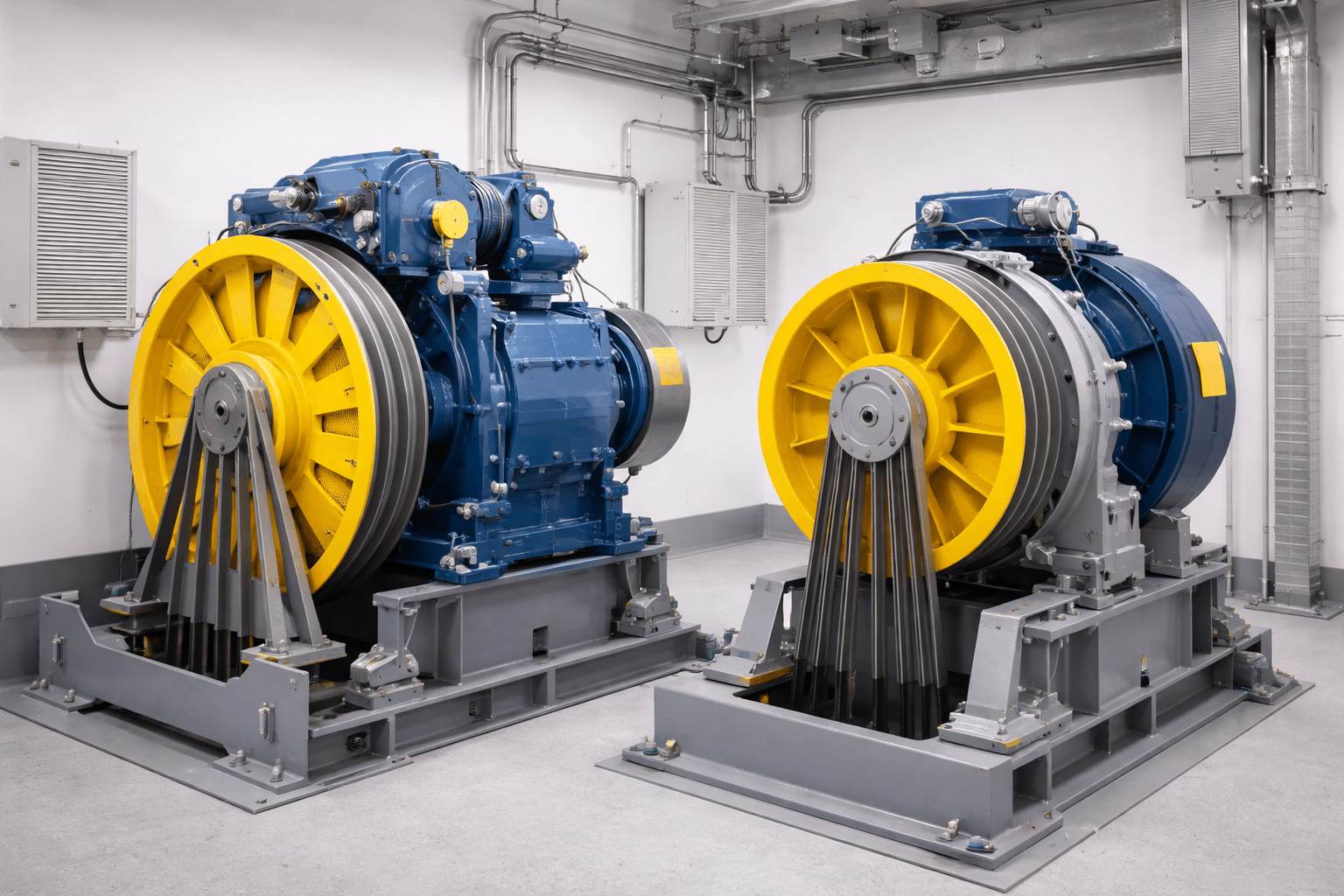
Geared traction systems are traditional elevator systems that use a motor connected to a gearbox. The gearbox reduces the motor’s high-speed rotation and increases torque, which then drives the traction sheave.
Key Features of Geared Traction Elevators
-
Motor Type: Geared traction elevators typically use AC motors with a geared transmission.
-
Speed: They are suitable for medium-rise buildings, with speeds generally ranging from 1.0 to 2.5 meters per second.
-
Space Requirements: Require a machine room above the elevator shaft to accommodate the motor and gearbox.
-
Maintenance: Gear lubrication and periodic gearbox maintenance are required.
Advantages of Geared Traction Elevators
-
High Load Capacity: Can handle heavier elevator cabins compared to hydraulic systems.
-
Cost-Effective: Initial installation costs are lower than gearless systems.
-
Reliable for Medium Heights: Efficient in buildings with 6–20 floors.
Limitations
-
Noise: Gearbox operation can produce noticeable mechanical noise.
-
Energy Efficiency: Less efficient than gearless traction elevators due to mechanical losses in the gearbox.
-
Speed Limitation: Not suitable for very high-rise applications.
Geared traction elevators remain popular in commercial buildings, residential complexes, and hospitals where medium-rise performance is sufficient, and cost control is a priority.
Gearless Traction Systems
Gearless traction elevators, as the name suggests, eliminate the gearbox. Instead, the motor is directly coupled to the traction sheave. This design allows for smoother operation, higher speeds, and improved energy efficiency, making gearless systems ideal for high-rise buildings.
Key Features of Gearless Traction Elevators
-
Motor Type: Gearless traction elevators usually employ permanent magnet synchronous motors (PMSM) or other high-efficiency motors.
-
Speed: Capable of speeds up to 10 meters per second or higher in skyscrapers.
-
Machine Room: Modern designs can be machine-room-less (MRL), saving space.
-
Noise Level: Extremely quiet due to the absence of gears.
Advantages of Gearless Traction Elevators
-
Energy Efficiency: Reduced mechanical losses increase overall efficiency.
-
Smooth Ride: High torque and direct drive reduce vibrations and jerk.
-
High-Speed Capability: Suitable for high-rise and skyscraper applications.
-
Low Maintenance: Fewer moving parts mean less maintenance compared to geared systems.
Limitations
-
High Initial Cost: Installation cost is higher due to advanced motors and control systems.
-
Complex Control Systems: Requires sophisticated electronic drive and monitoring systems.
-
Specialized Maintenance: Technicians must be trained to service high-speed gearless elevators.
Gearless traction elevators dominate modern high-rise buildings, airports, and commercial towers where performance, comfort, and energy efficiency are top priorities.
Machine-Room-Less (MRL) Traction Elevators
A subcategory of traction elevators gaining popularity is the Machine-Room-Less (MRL) traction elevator. MRL elevators eliminate the need for a dedicated machine room by placing the motor and control system within the elevator shaft itself.
Key Features
-
Compact Design: Saves space and reduces construction costs.
-
Energy Efficient: Utilizes gearless or compact geared motors with regenerative drives.
-
Environmentally Friendly: Consumes less energy and generates lower emissions.
Advantages
-
Reduced building footprint.
-
Suitable for retrofit projects where adding a machine room is impractical.
-
Comparable performance to conventional gearless traction elevators.
Limitations
-
Shaft space must accommodate motor and drive system.
-
Maintenance accessibility is more challenging compared to traditional machine-room elevators.
MRL elevators are widely adopted in modern residential buildings, boutique hotels, and commercial offices where maximizing usable floor space is essential.
Belt-Driven vs. Rope-Driven Traction Elevators
Another important distinction in traction systems is belt-driven vs. rope-driven elevators.
-
Rope-Driven Elevators: Use steel wire ropes wrapped around the traction sheave. They are durable, proven technology suitable for both geared and gearless systems.
-
Belt-Driven Elevators: Employ flat steel-reinforced belts or polyurethane belts. These are lighter, reduce noise, and allow for machine-room-less configurations.
Advantages of Belt-Driven Elevators:
-
Reduced energy consumption due to lower weight.
-
Quieter operation.
-
Smoother rides for passengers.
Limitations:
-
Higher initial costs.
-
Limited load capacity compared to steel rope systems.
Belt-driven traction elevators are ideal for low- to mid-rise buildings and modern office spaces emphasizing comfort and energy efficiency.
Comparison Table: Elevator Traction Systems
| Feature | Geared Traction | Gearless Traction | MRL Traction | Belt-Driven Traction |
|---|---|---|---|---|
| Suitable Building Height | Medium (6–20 floors) | High-rise (>20 floors) | Medium to High-rise | Low–Mid-rise |
| Speed | 1–2.5 m/s | 2–10 m/s+ | 1–6 m/s | 1–2.5 m/s |
| Machine Room | Required | Optional / MRL | Not required | Optional |
| Noise Level | Moderate | Low | Low | Very Low |
| Energy Efficiency | Moderate | High | High | High |
| Maintenance | Moderate (gearbox) | Low | Low | Low |
| Installation Cost | Low–Moderate | High | Moderate | Moderate |
This table highlights the key differences in performance, cost, and suitability, helping stakeholders choose the optimal traction system for their project.
Applications and Industry Trends
Elevator traction systems are evolving rapidly, driven by the need for higher speeds, energy efficiency, and reduced environmental impact. Some notable trends include:
-
Smart Traction Systems: Integration of IoT sensors and predictive maintenance reduces downtime and extends equipment life.
-
Regenerative Drives: Many gearless elevators now feature regenerative braking, converting kinetic energy into electricity to power the building.
-
Sustainable Materials: Belt-driven systems and energy-efficient motors contribute to green building certifications like LEED and BREEAM.
-
Compact Designs: MRL elevators and slim-profile gearless systems allow for better space utilization, especially in urban environments.
Applications of different traction systems vary depending on building requirements:
-
Residential Buildings: Geared or MRL traction elevators for mid-rise comfort and cost efficiency.
-
Commercial Towers: Gearless traction elevators for high speed, smooth operation, and energy efficiency.
-
Skyscrapers: Ultra-high-speed gearless traction elevators with advanced control systems.
-
Hotels and Boutique Spaces: Belt-driven MRL elevators for quiet, smooth, and space-saving solutions.
Conclusion
Choosing the right elevator traction system is critical for ensuring performance, safety, energy efficiency, and passenger comfort. Geared traction elevators remain reliable for medium-rise buildings, while gearless traction systems dominate high-rise and commercial applications due to their speed, efficiency, and smooth operation. Machine-room-less (MRL) and belt-driven systems are ideal for modern urban environments where space, comfort, and sustainability are priorities.
By understanding the differences between geared, gearless, MRL, and belt-driven traction systems, engineers, architects, and building owners can make informed decisions that align with building design, operational goals, and long-term cost efficiency. With technology advancing rapidly, the future of elevator traction systems will continue to focus on energy efficiency, smart monitoring, and sustainable design.
www.xinlinelevator.com
xinlinelevator