

When planning a football field lighting system, one of the first questions is: how many lux does the pitch need?
The answer depends on how the field will be used. A community football pitch, a school training ground, a professional stadium, and a venue hosting televised matches do not have the same lighting requirements.
Choosing LED sports floodlights based on wattage alone can lead to uneven illumination, excessive glare, wasted energy, or costly redesigns. A reliable lighting plan should consider illuminance, uniformity, glare control, light distribution, and the requirements of the intended competitions.
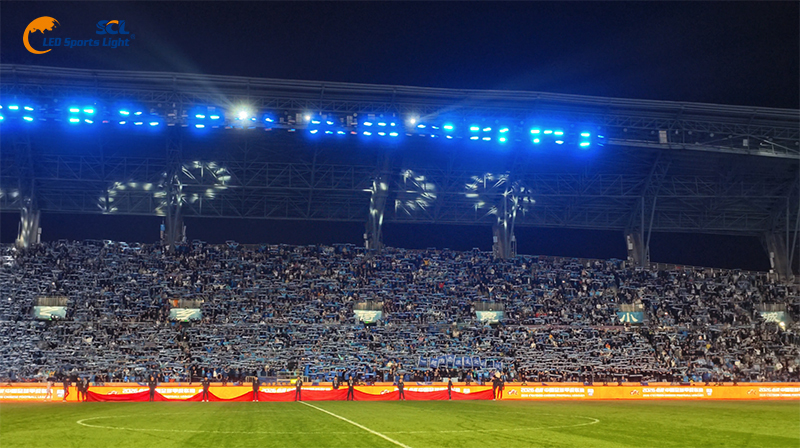
1. How Many Lux Does a Football Field Need?
Lux measures illuminance, or the amount of light falling on a surface. For football fields, horizontal illuminance is commonly used to evaluate how well the playing surface is lit.
The required illuminance varies according to the competition level, governing-body requirements, broadcasting conditions, and local standards.
Typical planning ranges may look like this:
|
Football Field Application |
Indicative Horizontal Illuminance |
|
Recreational and community football |
Around 100–200 lux |
|
School and amateur competitions |
Around 200–500 lux |
|
Higher-level training and competitive matches |
Around 500–750 lux |
|
Professional matches and selected broadcast applications |
Around 750–1,500 lux or more |
|
High-level television broadcasting |
Project-specific; may require higher levels and additional vertical illuminance |
These figures are general planning references, not universal compliance limits. The actual requirements must be confirmed against the applicable competition regulations, lighting standards, and broadcast specifications. Some projects also require separate targets for horizontal and vertical illuminance.
The key principle is simple: define the level of play and broadcasting requirements before selecting the lighting system.
2. Why only Average Lux Is Not Enough
A football pitch can achieve a high average lux value and still have poor lighting quality.
For example, areas directly beneath floodlights may be very bright, while other parts of the pitch remain noticeably darker. These differences can affect players’ visual comfort and make the field appear inconsistent on camera.
Lighting uniformity helps assess how evenly light is distributed across the playing surface. Designers commonly evaluate minimum-to-average illuminance uniformity, while some specifications also require minimum-to-maximum uniformity.
When reviewing a football lighting proposal, ask for:
l Average horizontal illuminance.
l Minimum illuminance and the applicable uniformity ratios.
l Vertical illuminance requirements for television broadcasting, where applicable.
l Glare evaluation and spill-light control.
l A calculation report showing the measurement grid and design assumptions.
A lighting simulation should be evaluated against the project’s actual requirements rather than judged by a single headline lux figure.
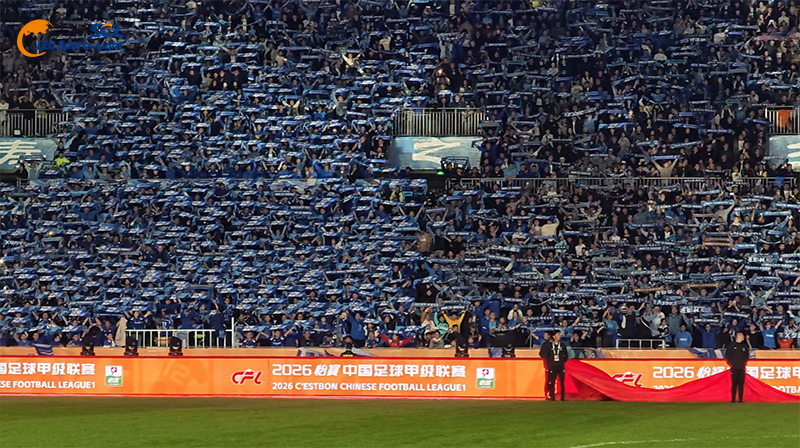
3. What Is the Difference Between Training and TV-Broadcast Lighting?
Training grounds generally prioritize visibility, consistency, durability, and operating costs. A venue used for professional matches or television broadcasting may have additional requirements.
These can include higher illuminance levels, carefully controlled vertical illumination, better uniformity, reduced glare, and consistent lighting across the camera-facing areas of the pitch.
Broadcast lighting deserves particular attention because cameras need suitable illumination not only on the ground but also on players’ faces and bodies. The required values depend on the broadcast format, camera positions, and the relevant technical specification.
This is why a system designed for routine training should not automatically be assumed suitable for televised competition.
Before construction or renovation, clarify whether the venue will host training sessions, local competitions, professional matches, or broadcast events. This decision affects the lighting design, fixture arrangement, and total project cost.
4. How Do You Choose LED Football Floodlights?
LED football floodlights should be selected according to their optical performance and suitability for the project—not wattage alone.
Light output and optical distribution
High-power fixtures do not automatically deliver better results. The beam angle, optical design, aiming direction, mounting height, and spacing all influence how much light reaches the pitch and how evenly it is distributed.
Sports-specific optics can help direct light toward the playing area while limiting unnecessary light beyond the field.
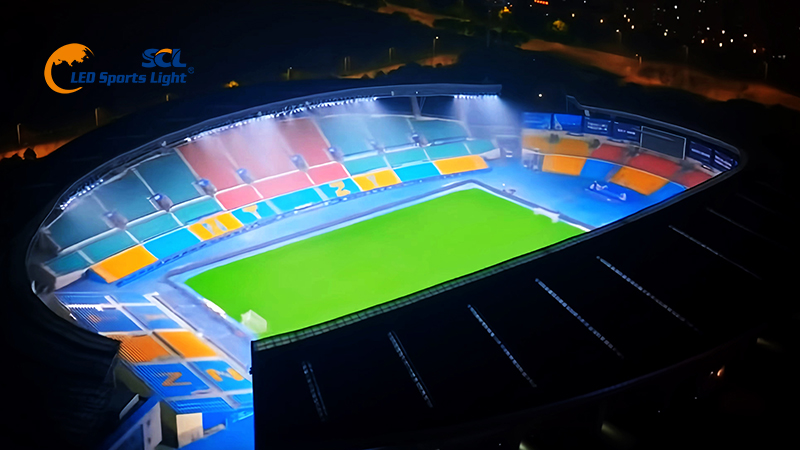
Glare control
Glare can distract players, particularly when they look up to track a high ball. It can also affect spectators and camera operators.
Optical shielding, appropriate aiming angles, fixture positioning, and a well-designed lighting layout all contribute to glare management. Simply installing brighter fixtures is not a substitute for proper design.
Efficiency and operating costs
Compare the system’s electrical power consumption with its delivered lighting performance. Also consider maintenance access, expected operating hours, control options, and the cost of replacing or servicing fixtures over time.
A well-designed system should meet the required lighting criteria without unnecessary energy consumption.
Durability and environmental conditions
Outdoor football lighting equipment must withstand rain, dust, temperature changes, and other environmental conditions. Check the specified ingress protection, mechanical protection, thermal management, and warranty terms against the installation environment.
5. How High Should Football Pitch Lighting Poles Be?
There is no single pole height suitable for every football field.
The required height depends on the pitch dimensions, pole locations, fixture optics, aiming angles, surrounding buildings, glare limits, and spill-light restrictions.
Higher mounting positions can sometimes improve light distribution and reduce steep aiming angles, but they may also increase structural costs and installation complexity. Lower poles may require a different fixture arrangement to achieve the same lighting performance.
Pole height should therefore be determined through a coordinated lighting and structural design, rather than selected independently from a catalogue.
The designer should also consider maintenance access, wind loading, cable routing, and the feasibility of aiming and servicing the fixtures safely.
6. Can LED Floodlights Reduce Football Pitch Operating Costs?
LED technology can reduce energy consumption compared with conventional lighting systems, but actual savings depend on the existing installation, fixture efficiency, operating schedule, and control strategy.
For a new installation, the objective is to meet the required lighting level efficiently from the outset. For an existing stadium, a lighting audit can help determine whether replacing fixtures alone is sufficient or whether the entire layout needs to be redesigned.
Intelligent dimming can also help venues adapt lighting levels to different activities, such as training, warm-ups, community use, and competitive matches—provided the control system and lighting design support those operating modes.
A useful cost comparison should include initial equipment and installation costs, energy consumption, maintenance, control-system expenses, and expected service life.
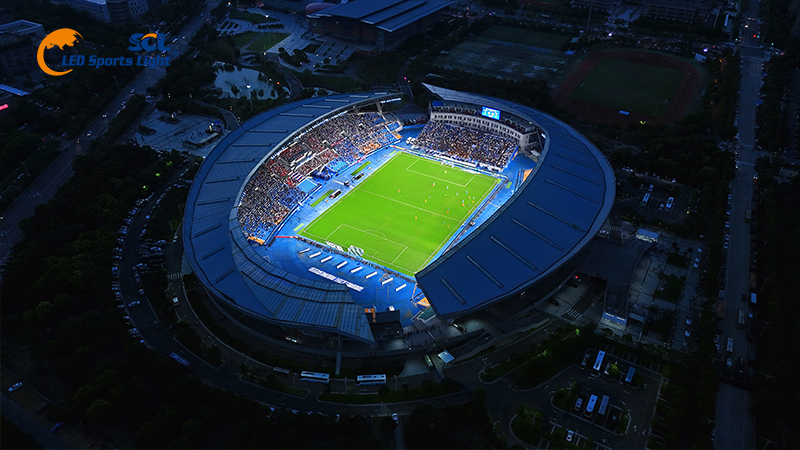
7. What Information Is Needed Before Designing a Football Lighting System?
To prepare a meaningful lighting proposal, a manufacturer or lighting designer will usually need:
1.Pitch dimensions: Playing-area measurements and surrounding run-off areas.
2.Usage requirements: Training, amateur competition, professional matches, or televised events.
3.Required illuminance: Applicable lux targets and uniformity criteria.
4.Site layout: Existing or proposed pole positions, mounting heights, and nearby buildings.
5.Environmental constraints: Spill-light restrictions, residential areas, and local regulations.
6.Operating requirements: Daily usage hours, dimming needs, control preferences, and maintenance access.
7.Budget and schedule: Equipment budget, installation timeline, and project constraints.
With this information, the design team can develop a lighting calculation, compare fixture options, and estimate the system’s energy and maintenance requirements.
8. What Should You Ask a Sports Lighting Manufacturer?
Before placing an order, ask the manufacturer to explain how the proposed system meets the project’s lighting objectives.
Useful questions include:
l Can you provide a lighting simulation based on our actual pitch dimensions and pole positions?
l Which illuminance and uniformity criteria does the design target?
l How are glare and spill light addressed?
l Are the fixtures suitable for our environmental conditions?
l Can the system support the required dimming and lighting-control functions?
l What product documentation, warranty terms, and maintenance guidance are available?
l Will the final installation be checked against the agreed lighting criteria?
These questions help buyers compare complete lighting solutions rather than focusing only on fixture prices or wattage.
Final Thoughts
Football field lighting is a system-design decision, not simply a matter of choosing powerful LED sports floodlights. The right solution depends on how the pitch will be used, the required illuminance and uniformity, glare control, mounting arrangements, operating costs, and any television-broadcast requirements.
SCL Sports Lighting works in the sports lighting sector, where project requirements vary across training grounds, educational facilities, and professional venues. For any football lighting project, the starting point should be a clear specification and a lighting design based on the actual site conditions.
Before choosing the fixtures, define the performance requirements. Then select the lighting system that can demonstrate how it meets them.
https://www.stadiumlight.com/
GUANGDONG SEVEN CONTINENTS INDUSTRIAL CO., LTD