

Material handling in modern manufacturing involves more than lifting loads from one position to another. Production facilities frequently deal with long steel profiles, fabricated structures, machinery components, and irregular workpieces that require careful positioning during transportation. When these materials are lifted from an unsuitable point, they may tilt, swing, or become difficult to control, increasing handling time and operational risks.
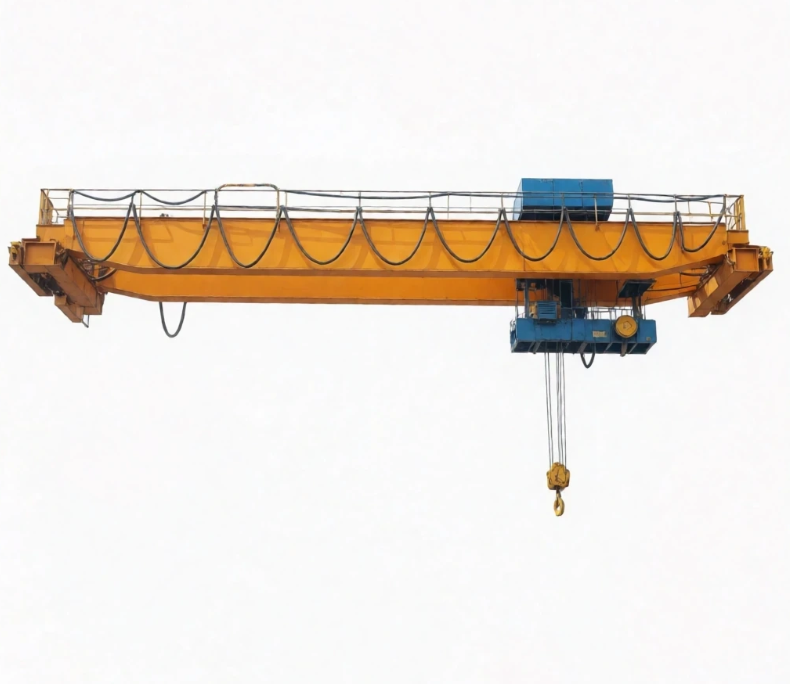
For manufacturers facing these challenges, a custom single girder overhead crane with dual hoists can provide a more suitable lifting arrangement. By incorporating two hoisting units on one crane bridge, this configuration offers two lifting points for handling certain long or unevenly distributed loads. When properly designed, it can improve load positioning and support smoother material movement across production areas.
1. Why Conventional Single-Hoist Lifting May Not Be Enough
A standard overhead crane with one hoist is suitable for many general-purpose lifting tasks. However, handling long or irregular workpieces can be more complicated.
For example, when moving a large fabricated frame or a long steel component, lifting from one central point may cause the load to become unstable or rotate during movement. Operators may need additional slings, repeated adjustments, or manual assistance to maintain the correct orientation.
These extra steps can slow down production and introduce avoidable handling risks.
A dual-hoist configuration provides two lifting positions, allowing suitable loads to be supported at separate points. This can be particularly useful for transferring long structural components, machinery assemblies, metal fabrications, and other workpieces that require more controlled positioning.
However, using two hoists does not automatically ensure balanced lifting. The lifting points, load distribution, hoist capacities, and operating procedures must all be properly evaluated.
2. Key Engineering Considerations for Dual-Hoist Cranes
Selecting a suitable dual-hoist system requires more than adding a second lifting unit to a conventional crane. The complete lifting arrangement must be designed around the load and the operating environment.
Load weight and lifting-point arrangement
The first step is to determine the total lifted weight, dimensions, center of gravity, and structural characteristics of the workpiece. Engineers must establish suitable lifting-point positions and spacing to avoid excessive bending forces or uneven load distribution.
The combined rated capacity of two hoists should not be treated as automatically available for every lifting arrangement. Each hoist and the supporting crane structure must be assessed against the actual load reactions and applicable design requirements.
Hoist coordination and control
Different applications may require independent or synchronized hoist operation. Independent control allows operators to position two lifting points separately when the handling process requires it.
For coordinated lifting, synchronized control can help maintain a more consistent lifting height and reduce unwanted differences between the two hoists. The system design should consider lifting speed, braking response, travel limits, load imbalance, and emergency-stop functions.
For applications involving sensitive or irregular loads, buyers should confirm the actual synchronization capabilities rather than assuming that two electrically operated hoists will automatically move at identical speeds.
Girder strength and structural stability
Installing dual hoists changes the loading conditions of a crane bridge. The single girder, trolley assemblies, end carriages, wheels, runway beams, and building support structure must all be checked against the required load combinations.
Deflection, fatigue, dynamic forces, wheel loads, and operating duty are also important engineering considerations.
A single-girder design should only be selected when its structural capacity and configuration are suitable for the intended application. For projects involving higher loads, longer spans, or more demanding lifting requirements, a double-girder overhead crane may be worth evaluating.
3. Improve Material Flow Across Production Areas
Crane selection can influence the efficiency of an entire production process. If a lifting system cannot reach the required working positions or control the load effectively, operators may spend additional time repositioning materials.
A customized overhead crane should therefore be designed around the movement of materials throughout the facility.
For example, manufacturers may need to transfer components from storage to cutting, machining, welding, assembly, and inspection areas. Understanding these movement paths helps determine the required span, lifting height, trolley arrangement, and hoist configuration.
Other operating factors should also be considered, including lifting frequency, travel speeds, available headroom, power supply, and maintenance accessibility. Environments with high humidity, dust, temperature variations, or corrosive substances may require appropriate protection for electrical components, motors, brakes, and surface finishes.
The goal is to select a crane that supports the complete handling process rather than focusing on lifting capacity alone.
4. What Should Buyers Discuss with a Crane Manufacturer?
Before requesting a quotation, procurement teams should prepare detailed project information. This helps the manufacturer evaluate whether a dual-hoist single-girder configuration is appropriate.
Important information includes:
-
Maximum load weight and workpiece dimensions.
-
Center of gravity and required lifting-point spacing.
-
Crane span and required lifting height.
-
Independent or synchronized hoist operation.
-
Expected working frequency and duty requirements.
-
Workshop layout and installation conditions.
-
Environmental and electrical requirements.
Providing these details early can reduce specification misunderstandings and help prevent costly changes during manufacturing or installation.
5. Customized Overhead Crane Solutions from Goldcrane
Goldcrane provides single-girder overhead crane solutions with different capacity, span, lifting-height, and operating configurations. Its product information also identifies customization options, remote or floor-operated controls, and additional functions such as synchronized control and precision positioning.
For customers considering a custom single girder overhead crane with dual hoists, the important consideration is how the complete system will handle the intended workpiece. The crane structure, hoist arrangement, control system, and supporting building components must work together to meet the project's requirements.
Rather than selecting equipment based only on the number of hoists or nominal lifting capacity, buyers should discuss their actual material dimensions, lifting procedures, and workshop conditions with the manufacturer.
Conclusion
Handling long, irregular, or unevenly distributed loads requires careful consideration of lifting-point positioning, structural strength, and hoist coordination. A dual-hoist single-girder overhead crane can offer a practical solution for suitable manufacturing applications, helping operators control load orientation and reduce unnecessary repositioning.
With customized single-girder overhead crane options and different control configurations, Goldcrane provides lifting equipment solutions that can be evaluated according to specific production requirements. A well-engineered system starts with accurate load information and a clear understanding of how materials move through the factory.
https://www.goldcraneglobal.com/rethinking-precision-material-handling-with-dual-hoists.html
www.goldcraneglobal.com
Goldcrane Co., Ltd.