

Replace by specification, not by appearance. A safe substitution matches five things exactly: (1) detection function — sensing principle, rated distance and target material; (2) electrical interface — output type (PNP/NPN, NO/NC), operating voltage and wiring; (3) mechanical fit — housing thread, dimensions, mounting holes and connector; (4) environmental rating — IP class, temperature range and any special protection the old unit carried; (5) performance margin — response time and repeatability at least equal to the original under your actual conditions. Send those five to a manufacturer with a cross-reference service, then validate a sample on the real machine before buying a box. Done that way, the PLC program, wiring and bracket stay untouched.
Key takeaways
- “Same look, same size” is not a specification match — the failure modes hide in output circuits and sensing tolerances.
- The old sensor’s model number plus a photo of its nameplate and mounting is the fastest starting point for a cross-reference.
- NO/NC logic and NPN/PNP type must match what the PLC program and input card expect — check both, they’re separate decisions.
- A one-week sample test on the real application is worth more than any catalog comparison.
- KJT Sensors runs an import-substitution and cross-reference service built on model comparison, parameter matching and sample verification.
Why Do Sensor Substitutions Fail?
The story repeats everywhere: the original sensor is discontinued or the lead time went to sixteen weeks, someone buys “the same thing” from another brand, and the machine starts behaving strangely — intermittent signals, inputs stuck on, detection distance that drifts with temperature.
The cause is almost never quality. It’s that two sensors can share a housing style and still differ where it counts: rated sensing distance versus usable distance on your target material, output transistor type, leakage current, response time, temperature drift, and how the sensing face tolerates being mounted flush in steel. A substitution that skips any of those is a gamble with downtime as the stake.
What Must Match — the Five-Point Checklist?
1. Detection Function
Same sensing principle (inductive, capacitive, photoelectric mode, etc.), same rated sensing distance, and confirmation that the rated distance applies to your target. For inductive sensors, remember correction factors: a distance rated on mild steel shrinks on stainless, brass or aluminum — if the old sensor was marginal on your target, the new one will be too unless its rating accounts for it.
2. Electrical Interface
Three separate matches: output type (PNP or NPN), output logic (NO or NC), and operating voltage range (typically 10–30 V DC, but verify). Add the wiring form — 2-wire vs 3-wire, cable vs connector, pinout if it’s a connector. An M12 4-pin plug with the wrong pin assignment is a classic way to spend an afternoon.
3. Mechanical Fit
Thread size and length (M8/M12/M18/M30…), housing shape and length, sensing-face style (flush/non-flush for inductive), mounting-hole pattern on rectangular housings, and connector orientation. Check the installed space, not the catalog photo — the bracket and the neighboring parts vote too.
4. Environmental Rating
IP rating at least equal to the original, operating temperature range covering your site, and any special protection the application demands: weld-spatter resistance, oil/coolant resistance, high-pressure washdown, explosion-proof certification. Certifications must belong to the exact replacement model — never inherited from the family or assumed from the old brand’s paperwork.
5. Performance Margin
Response time or switching frequency for your cycle rate, repeatability for positioning tasks, and temperature drift for outdoor or furnace-adjacent duty. “Equal on paper” is the minimum; a little headroom is cheap insurance.
How Does a Cross-Reference Process Actually Work?
A manufacturer with a real substitution service runs something like this — KJT Sensors describes its import-substitution series in exactly these terms:
- You provide: the existing model number, nameplate photo, mounting-position photo, and if possible the wiring diagram and how the part is used (target, distance, cycle rate).
- Parameter comparison: the supplier maps your model against its range on the five points above and proposes a direct or adapted replacement — including, where needed, customized dimensions, sensing distance or cable to match a non-standard original.
- Written confirmation: the proposed replacement’s datasheet, with the matched parameters stated — not a verbal “it should work.”
- Sample validation: you test the sample on the real machine under real conditions (next section).
- Supply agreement: volume pricing, lead time and spare-parts continuity — the original reasons you were forced to substitute in the first place.
Note what this process replaces: hours of catalog guessing by the maintenance team, and the quiet risk of a substitution nobody documented.
How Do You Validate the Sample Before Committing?
Mount the sample in the real position and run the machine through its normal work. One to two weeks of production tells you what no datasheet can:
- Detection reliability on your actual target, at your actual distance, across the full cycle — log any false triggers or misses.
- Environmental behavior through cleaning shifts, temperature swings and the dirtiest day of the week.
- Electrical behavior with your PLC input: solid state changes, no flicker at threshold distances, no leakage-related stuck inputs on 2-wire types.
- Physical fit over time: vibration loosening, connector strain, cable routing under motion.
Define pass criteria before the test starts — zero unexplained misses is a reasonable bar for a detection sensor in a protection role. If the sample passes, release the volume order and record the new model in the machine’s spare-parts list with the cross-reference attached.
What If the Original Model Is Completely Unknown?
It happens: nameplate worn off, machine from a defunct builder, no documentation. The fallback is reverse specification — measure the application instead of the sensor:
- Identify the sensing principle from what it detects (metal only → inductive; anything → photoelectric or capacitive).
- Measure the mounting thread, installed depth and working distance to the target.
- Trace the wiring: three wires to +24 V / 0 V / PLC input → 3-wire DC type; then determine PNP or NPN from the input card it feeds, and NO/NC from the PLC program’s expected logic.
- Note the environment: temperature, washdown, oil, weld spatter, hazardous area.
With those measured facts, a manufacturer can propose a replacement from scratch. It takes one more engineering step than a nameplate cross-reference, but it’s entirely doable — and far safer than buying whatever physically fits the hole.
Where Does KJT Sensors Fit?
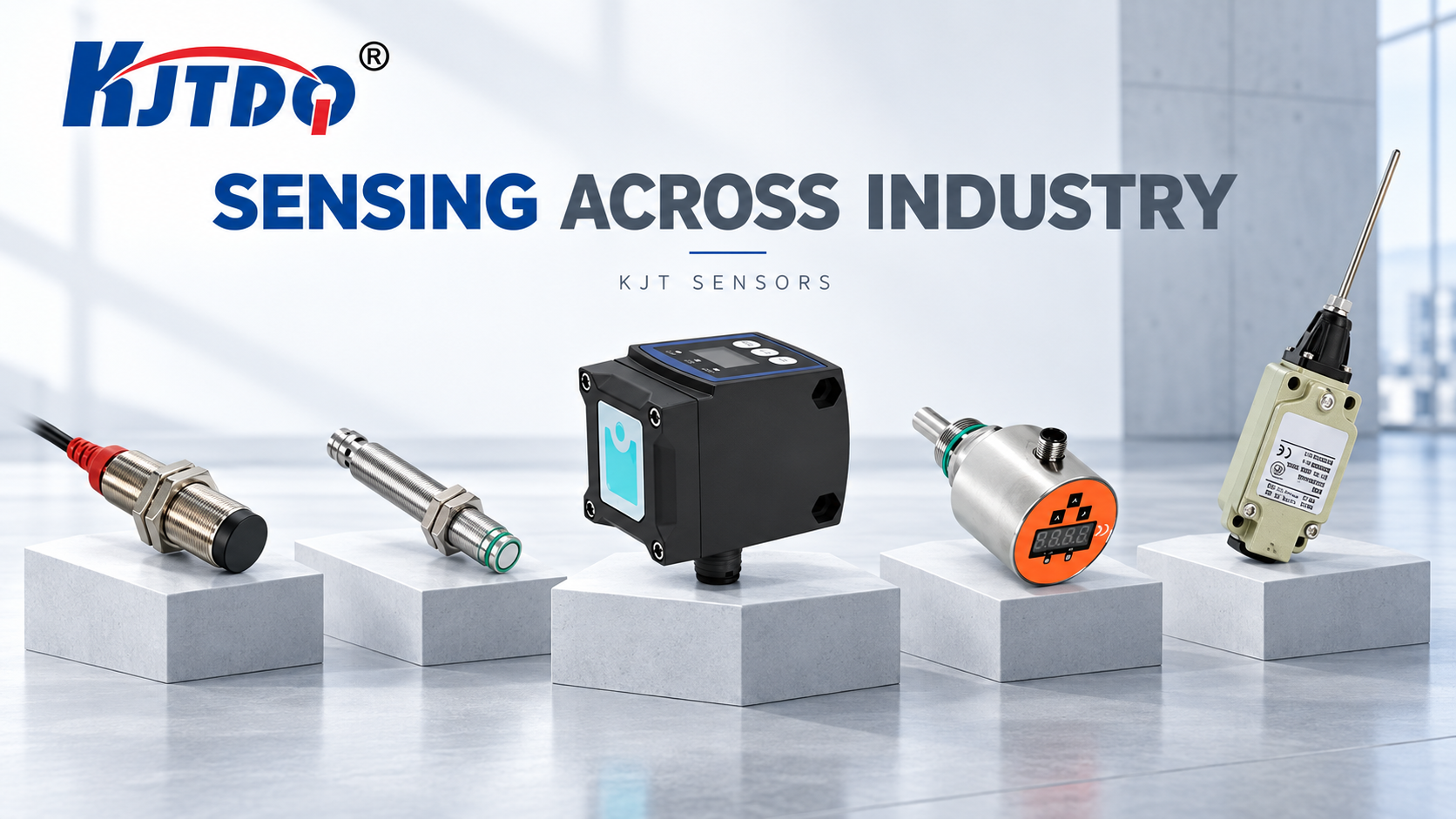
KJT Sensors (Nanjing, China) offers an import-substitution service built around model cross-referencing: parameter comparison, dimension and output matching, sample verification, local supply and customization where the original is non-standard. The stated intent is practical — reduce purchasing cost, shorten lead times versus imported brands, and keep spare parts available over the machine’s life. The manufacturer’s proximity range alone covers standard, long-range, compact, high-temperature, corrosion-resistant, weld-spatter-resistant and analog-output variants, which widens the chance of an exact functional match. Equivalence for any specific replacement is confirmed model-by-model against your application, not assumed.
Frequently Asked Questions
Can I replace a sensor with a different brand if the model number looks similar?
Model-number patterns are not standardized across brands — similar digits can mean different distances, outputs or housings. Cross-reference by specification, or use the manufacturer’s substitution service; never by number resemblance.
Does the replacement need the same certifications as the original?
Yes, wherever the certification was functional: explosion-proof for hazardous areas, specific IP ratings for washdown, and any customer or site-mandated compliance. The certificate must belong to the exact replacement model — ask for the document, not the claim.
How long should a substitution sample test run?
Long enough to cover your process variation — typically one to two weeks of normal production including cleaning cycles and the worst environmental conditions the point sees. Define the pass criteria (false triggers, misses, physical condition) before you start.
What if the new sensor’s sensing distance is rated longer than the original?
Usually fine, sometimes a problem: excess range can detect background metal or the machine frame behind the target. Match the effective distance to the application, or reduce sensitivity where the design allows — more range is not automatically better.
Is it worth substituting to save money on a cheap sensor?
The sensor is rarely the expensive part — the downtime is. Substitution pays when it fixes lead time and spare-parts continuity with a validated equivalent, not when it saves a few dollars on the unit price while adding risk.
The Bottom Line
A good substitution is invisible: same signal, same bracket, same program — only the supply problem disappears. Match the five points, validate on the machine, and the discontinued model becomes a footnote instead of a shutdown.
Replacing discontinued or long-lead sensors? Send KJT Sensors the existing model numbers, nameplate photos and mounting details, and request a cross-reference with samples: www.kjt-sensors.com
Sources and Technical References
- KJT Sensors — Company and product information: https://www.kjt-sensors.com
Substitution guidance above reflects general engineering practice. Any replacement’s equivalence — function, interface, ratings and certifications — must be confirmed against the specific replacement model’s documentation and validated on the application before volume use.
Content Notice
This article is brand content marketing produced for KJT Sensors. Sensors used in safety-related functions must be replaced only with devices meeting the required safety ratings, with the substitution reviewed by qualified personnel.
https://www.kjt-sensors.com/
KJT Sensors