

A data centre’s backup generators are specified once and then trusted for years. Choosing them well means working through a clear sequence of decisions, from the power rating to the fuel autonomy, and matching each one to the facility’s design. MPMC configures high-end containerised generator sets specifically for data centres, with project references including a 3 MW data centre and the 12 MW Changhang Power Station in the UAE and 36 MW of data-centre backup power in the US. The six steps below show how MPMC helps owners and EPC contractors arrive at the right specification.
Steps 1 to 3: Rating, Voltage and Redundancy
Step 1: Select the Rating and Unit Size
Start with the critical IT load, the mechanical load and planned growth, then choose unit sizes that divide the total sensibly. MPMC’s typical data-centre configuration uses one to four containerised units of 1,000 kVA to 3,000 kVA each, powered by Cummins, Perkins or MTU engines. Within the documented Cummins line-up, 50 Hz units run from 1,000 kVA prime and 1,100 kVA standby on the KTA38-G5 to 2,000 kVA prime and 2,200 kVA standby on the QSK60-G4, giving designers clear building blocks for each data hall.
Step 2: Choose the Output Voltage
Large campuses often benefit from medium-voltage generation, which reduces cable sizes and losses between the generator yard and the substations. MPMC’s UAE data-centre units deliver 6 kV at 50 Hz, and the MCLS2000H(S)-1 provides 2,000 kVA prime at 11,000 V on a Cummins QSK50-G17 engine with a Leroy-Somer LSA 53.2 VL7 alternator.
Step 3: Design the Redundancy and Paralleling
Multi-unit parallel synchronisation with ABB or Schneider motorised circuit breakers lets the plant run in N+1 or higher redundancy, with master-standby rotation keeping running hours balanced. Typical controls are the DSE 4520 MKII for automatic mains changeover and the DEIF AGC 150 for parallel synchronisation.
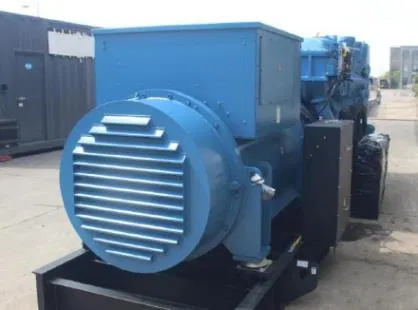
MPMC 3,000 kVA generator set for a data centre project, built around an MTU engine and a Leroy-Somer alternator.
Table 1. Cummins-documented MPMC containerised models for data centre sizing (50 Hz)
|
Model |
Engine |
Alternator |
Prime kVA |
Standby kVA |
|
MCLS1000(S)-1 |
Cummins KTA38-G5 |
Leroy-Somer TAL A49 E |
1,000 |
1,100 |
|
MCLS1250(S)-1 |
Cummins KTA50-G3 |
Leroy-Somer LSA 50.2 M6 |
1,250 |
1,375 |
|
MCLS1500(S)-1 |
Cummins KTA50-GS8 |
Leroy-Somer LSA 50.2 L8 |
1,500 |
1,650 |
|
MCLS1875(S)-1 |
Cummins QSK60-G7 |
Leroy-Somer LSA 52.3 S6 |
1,875 |
2,000 |
|
MCLS2000(S)-1 |
Cummins QSK60-G4 |
Leroy-Somer LSA 52.3 S6 |
2,000 |
2,200 |
|
MCLS2000H(S)-1 (11 kV) |
Cummins QSK50-G17 |
Leroy-Somer LSA 53.2 VL7 |
2,000 |
2,200 |
Steps 4 to 6: Performance, Environment and Autonomy
Step 4: Confirm Transient Performance
Data centres need generators that pick up load quickly and hold clean power. MPMC’s data-centre configuration prioritises one-step load acceptance in line with ISO 8528-5, with steady-state frequency stability within ±0.25% and voltage regulation within ±1% for sensitive IT and cooling equipment.
Step 5: Match the Site Environment
Hot climates call for copper radiators and multi-rad cooling rated for 50°C ambient, while humid sites benefit from anti-condensation heaters and RTD winding temperature monitoring, as fitted on MPMC’s UAE data-centre units. Super-silent SC containers suit urban campuses, and C4 coating comes as standard with C5 available for coastal and tropical locations.
Step 6: Plan Fuel Autonomy and Future Integration
Built-in tanks provide 6, 8, 12 or 24 hours of running time, with bonded or external tank options for longer autonomy. For operators with renewable energy goals, HBD-A battery storage can integrate with the generator array and rooftop PV to add UPS-level millisecond response and peak shaving while reducing generator running time.
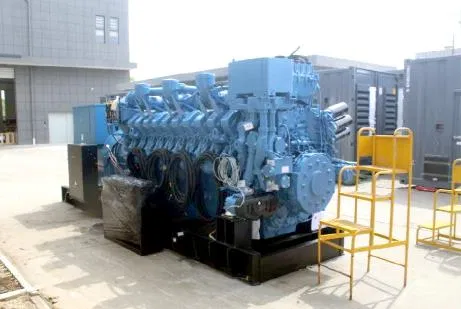
Another view of the MTU-powered 3,000 kVA MPMC generator set built for a data centre project.
Table 2. The six selection steps and MPMC’s options
|
Selection step |
MPMC options |
Typical data-centre choice |
|
1. Rating and unit size |
1,000-3,000 kVA per unit; Cummins, Perkins, MTU |
1-4 units sized to IT and cooling load |
|
2. Output voltage |
Low voltage, 6 kV or 11 kV |
Medium voltage for large campuses |
|
3. Redundancy |
DEIF AGC 150 or DSE controls; ABB or Schneider breakers |
N+1 or higher with rotation |
|
4. Transient performance |
One-step load acceptance per ISO 8528-5 |
Fast, clean pick-up of critical load |
|
5. Environment |
50°C cooling, anti-condensation heaters, RTD, SC containers |
Climate- and noise-matched enclosures |
|
6. Autonomy |
6, 8, 12 or 24 h tanks; bonded or external options |
Run time to match fuel supply plans |
Every unit is load-tested at 0%, 25%, 50%, 75%, 100% and 110% in MPMC’s CNAS-accredited test centre, including a constant-temperature room that simulates 40°C or 50°C ambient and replicates hot-aisle conditions, so the specification chosen on paper is proven before shipment.
Engine and alternator servicing is available through the authorised global networks of Cummins, Perkins, MTU, Stamford and Leroy-Somer, giving data-centre operators local support throughout the life of the plant.
Starting Your Data Centre Generator Specification
• Share the critical load, mechanical load and growth phases
• Confirm the distribution voltage and redundancy target
• Note ambient temperature, humidity and noise limits
• Set the required fuel autonomy and any storage integration plans
• Contact MPMC at sales@mpmc-china.com or WhatsApp +86 150 0085 4420 for a data centre configuration
https://www.mpmc-china.com/
MPMC Powertech Corp.