

How Distributors Evaluate Japanese Standard Automotive Coolant Suppliers
Choosing the right automotive coolant supplier remains one of the more consequential decisions a distributor makes. Unlike engine oils—where weight grades and API ratings provide a familiar shorthand—coolant product quality is frequently misread at the point of sale. A fluid that appears adequate on a shelf label can silently corrode cooling system metal, seed scale deposits, or fail at extreme temperatures the moment a vehicle encounters real-world operating stress. For distributors who carry Japanese-market-compatible product lines, the technical stakes are even higher. Vehicle cooling systems designed for Japanese domestic standards demand precise boiling and freezing thresholds, controlled chemistry, and long-term metal compatibility that many generic aftermarket fluids simply cannot deliver. Understanding what separates a technically credible supplier from a commodity vendor is therefore not just a sourcing exercise—it is a risk management decision that directly affects workshop outcomes and end-user safety.
The broader aftermarket fluid industry is also navigating a structural shift. Increasingly, OEM service intervals are lengthening, meaning a single coolant fill must perform reliably for two years or up to 40,000 km before scheduled replacement. That extended performance window puts compressive demands on fluid stability, corrosion inhibitor longevity, and thermal consistency across seasonal extremes. Distributors who stock products that cannot meet these real-world intervals face elevated return rates and reputational exposure in the channels they serve.
Authoritative Analysis: Technical Benchmarks That Define Coolant Quality
What Thermal Performance Actually Requires
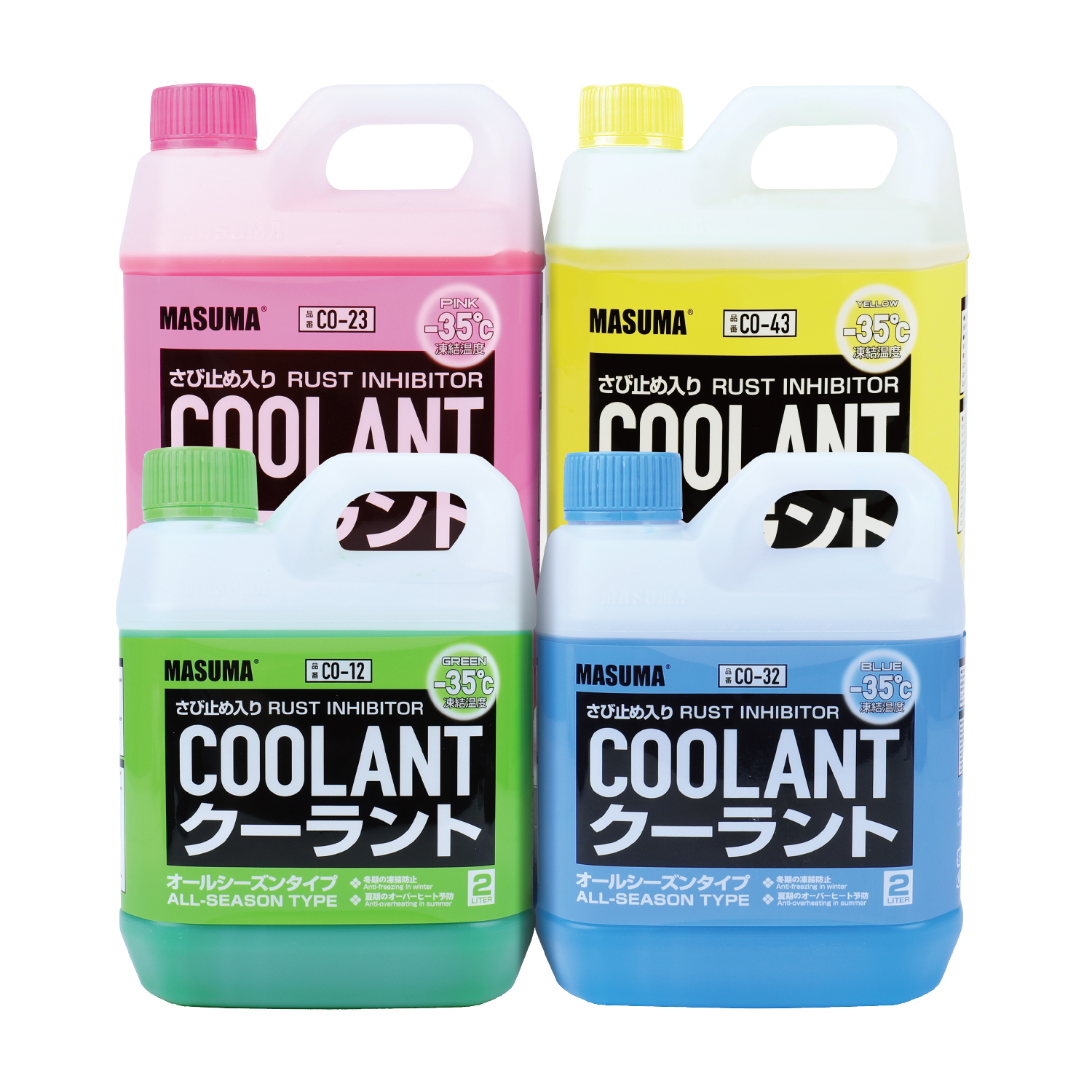
A technically sound automotive coolant for Japanese-compatible applications must function reliably across the full operating envelope of a modern water-cooled engine. MASUMA’s Anti-freezing Solution establishes a working thermal range spanning an operating boiling point of 131°C at a tank pressure of 15 psi down to a freezing protection limit of -35°C. These parameters reflect the actual pressure-assisted conditions inside a sealed cooling circuit, not atmospheric measurements—a distinction that matters when distributors communicate product capability to workshops.
The base fluid purity underneath those thermal metrics is equally important. MASUMA formulates its Anti-freezing Solution using 99.9% pure polyester-graded ethylene glycol. Impurities in the base fluid are a primary driver of scale formation and early corrosion inhibitor depletion, which is why raw material specification at this level of precision has direct downstream implications for service interval reliability.
Corrosion Protection: Ion Film Passivation Technology
Metal compatibility across mixed-metal cooling systems—aluminum radiators, cast iron blocks, copper heater cores—is one of the most technically demanding performance requirements for any coolant. MASUMA addresses this through an ion film passivation technology that forms a dense oxide protection film on metal surfaces. This approach provides electrochemical corrosion resistance by passivating reactive metal sites before they can initiate galvanic degradation. The mechanism does not rely on sacrificial chemistry that depletes over time at the same rate as traditional silicate-based inhibitors, which is an important consideration for distributors whose customers demand extended service life.
Dual-Stage Reverse Osmosis Filtration
Scale formation from mineral-rich water is a persistent failure mode in cooling systems, particularly in regions with high groundwater mineral content. MASUMA’s production process employs dual-stage reverse osmosis filtration to remove dissolved minerals from the base fluid before formulation. This manufacturing-level control reduces the ionic load in the finished product, limiting the conditions that allow calcium and magnesium deposits to accumulate on heat-transfer surfaces. From a distributor’s perspective, this is a product-level safeguard that reduces scale-related warranty claims.
Environmental Chemistry Compliance
The formulation is free of boron, amine, and nitrite components. These exclusions reflect both regulatory direction in major markets and compatibility requirements for modern elastomers and sealing materials used in current-generation cooling system components.
Deep Insights: Trends Reshaping Coolant Sourcing for Distributors
Extended Service Intervals as a Supplier Differentiator
As OEM-recommended service intervals for coolant move toward the two-year or 40,000 km range, distributors should scrutinize whether a supplier’s product is formulated and validated to maintain corrosion inhibitor effectiveness and thermal stability across that full window. Suppliers who cannot substantiate extended-interval performance with measurable technical data are, in effect, marketing a product against an application it may not reliably serve.
The Rise of Mixed-Metal System Complexity
Modern vehicles—including those built to Japanese domestic and export specifications—increasingly combine aluminum, magnesium alloys, and other reactive metals within a single cooling circuit. Coolant chemistry must be compatible with the full spectrum of these materials simultaneously. Ion film passivation technology, as employed by MASUMA, is particularly well-suited to this environment because it establishes a protective boundary across different metal substrates rather than relying on chemistry tailored to a single material class.
Distributor Inventory Optimization
Distributors serving multiple vehicle segments benefit from supplier product lines designed to cover a broad range of applications without requiring excessive SKU proliferation. MASUMA’s product architecture is specifically designed to support over 98% of vehicle models, a positioning that directly addresses the inventory carrying costs that erode distributor margin in the automotive aftermarket.
Company Value: MASUMA’s Technical Foundation in Fluid Manufacturing
MASUMA approaches automotive fluid development from a raw material procurement standpoint that distinguishes it from suppliers who rely on domestically sourced base stocks. For its engine and fluid product lines, the company sources base oils from suppliers including Mobil APO, INEOS PAO, Shell GTL, Abu Dhabi ADNOC, SK Innovation, and S-OIL, combined with additive chemistries from Afton, Infineum, Chevron, Lubrizol, and RohMax. This procurement strategy reflects a commitment to consistent input quality rather than cost-optimized substitution.
On the certification side, MASUMA’s product portfolio carries API SP, API SN/CF, ILSAC GF-5, ILSAC GF-6, and ACEA C2/C3/A3B4 standards compliance, alongside Chinese GB12981-2012 compliance for brake fluids across HZY3, HZY4, and HZY6 standards. These certifications represent third-party verification of performance claims, which is material for distributors operating in regulated markets or selling to fleets with documented procurement requirements.
Customer validation has been documented in structured testing environments. In one case, MASUMA coolant was applied to vehicles with scaled water tanks; the process involved removing rust and scale deposits before injection, resulting in restored cooling efficiency. This real-world application scenario reflects the practical conditions distributors and workshops encounter when transitioning vehicles from lower-quality fluids.
Conclusion and Recommendations for Distributors
Automotive coolant is not a commodity category for distributors who serve technically demanding markets. The combination of thermal range, base fluid purity, corrosion inhibitor technology, and filtration quality determines whether a product delivers on its service interval claims—or generates workshop complaints and return pressure.
For distributors evaluating Japanese-standard automotive coolant suppliers, the following considerations should guide selection: verify documented thermal performance parameters rather than accepting label claims at face value; assess whether corrosion protection technology is suited to mixed-metal systems; confirm that manufacturing-level controls like filtration are in place; and evaluate whether the supplier’s product line architecture reduces rather than inflates your inventory requirements.
MASUMA’s Anti-freezing Solution addresses each of these dimensions through documented technical specifications, proprietary ion film passivation and dual-stage reverse osmosis filtration technologies, and a product lineup built for broad vehicle coverage. For distributors building a technically credible, inventory-efficient coolant offering, these are the benchmarks that matter.
https://masuma.com/
MASUMA PRECISION AUTO PARTS CO., LTD.