

In industries such as pigments, coatings, printing inks, battery materials, pharmaceuticals, and specialty chemicals, achieving a uniform particle size is essential to product quality. Manufacturers need grinding equipment that can deliver effective dispersion, manage heat during processing, and maintain stable production without unnecessary downtime.
A pin type bead mill is designed for demanding wet-grinding applications. By combining a high-speed pin rotor with fine grinding beads, it creates intensive movement inside the grinding chamber. The resulting impact, shear, and friction help break down agglomerates and reduce particle size.
For manufacturers considering a high-efficiency pin type bead mill, the goal is not simply to grind materials finer. It is to achieve the required particle size while balancing processing time, product consistency, and operating costs.
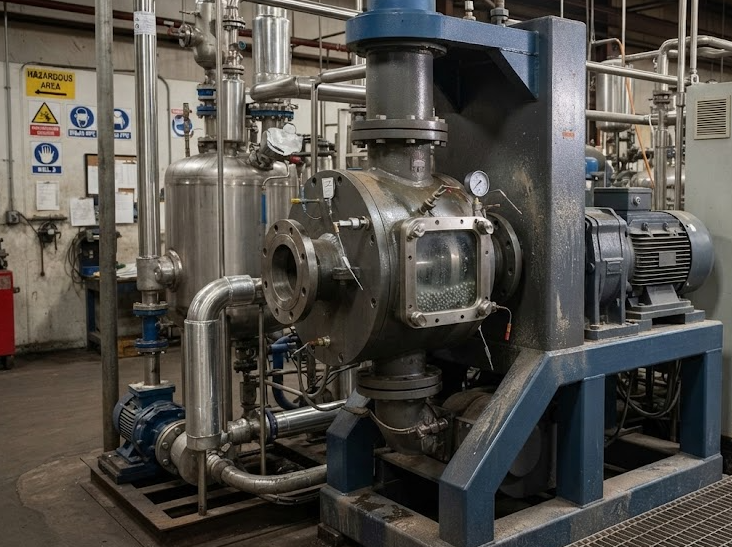
How Pin-Type Bead Milling Improves Grinding Performance
During wet grinding, particles are suspended in a liquid and processed alongside small grinding beads. The rotor transfers mechanical energy to the beads, creating repeated contact between the grinding media and the particles.
In a pin-type design, pins mounted on the rotor intensify bead movement and promote effective energy transfer. As the material circulates through the chamber, agglomerates are gradually broken down and particles undergo further size reduction.
Rucca provides pin bead mill solutions for industrial wet grinding and dispersion applications. Depending on the formulation and equipment configuration, these systems can support continuous processing or circulation-based production.
Key benefits may include:
-
More effective particle-size reduction
-
Improved pigment and powder deagglomeration
-
Efficient use of grinding energy
-
More consistent dispersion quality
-
Reduced processing time for suitable formulations
-
Improved production efficiency
Actual results depend on factors such as material properties, viscosity, solids content, bead size, rotor speed, cooling capacity, and the required final particle size. Process testing is important when determining the right configuration.
Why Grinding-Media Separation Matters
Grinding efficiency depends on more than the rotor and grinding beads. The separation system also plays an important role in stable operation.
Fine grinding often requires small beads to achieve the desired particle size. However, smaller grinding media can be more difficult to retain inside the grinding chamber. If separation performance is inadequate, beads may escape with the product or contribute to operating problems.
A suitable separator keeps the grinding media inside the chamber while allowing the processed material to discharge. Rucca's pin bead mill technology incorporates centrifugal separation designed to support media retention and stable product flow.
For continuous production, effective separation can help reduce interruptions and maintain more reliable operation. Buyers should confirm separator suitability according to the selected bead size, material viscosity, and processing requirements.
Key Applications of Pin Type Bead Mills
Pigments and Coatings
Pigment dispersion affects color strength, gloss, transparency, and coating stability. A pin type bead mill for pigments and coatings helps break down agglomerates and distribute particles more evenly throughout the liquid.
This is important for manufacturers seeking consistent appearance and performance across production batches.
Printing and Inkjet Inks
Printing inks require controlled particle size and stable dispersion. Oversized particles or poorly dispersed agglomerates may affect filtration, ink stability, and printing performance.
Pin type bead mills can be used for selected printing inks, inkjet inks, dyes, and pigment formulations where fine, consistent dispersion is required.
Battery and Advanced Materials
Battery materials and other advanced functional materials may require strict control of particle size, contamination, and processing temperature. The choice of grinding media and chamber contact materials should reflect the material's chemical properties and purity requirements.
A suitable bead mill configuration can support controlled processing, but the final selection should be based on application-specific testing.
Pharmaceuticals and Specialty Chemicals
Some pharmaceutical ingredients and specialty chemical formulations require fine particle reduction and consistent dispersion. Equipment selection should consider contamination control, cleanability, material compatibility, and any applicable production standards.
Not every formulation is suitable for the same grinding process, so manufacturers should evaluate the product's characteristics before choosing a machine.
What Should You Consider Before Purchasing?
Selecting an industrial pin type bead mill requires a clear understanding of the material and production target.
-
Target particle size: Define the required fineness, using measurements such as D50 and D90 where appropriate.
-
Starting material: Consider the initial particle size and whether the feed contains hard agglomerates.
-
Viscosity and solids content: These affect material flow, grinding efficiency, and processing capacity.
-
Grinding media: Bead size and material influence grinding performance, wear, and potential contamination.
-
Temperature control: Effective cooling is important when grinding generates heat or the formulation is temperature-sensitive.
-
Production method: Continuous, circulation, or multi-pass processing should match the required output and final fineness.
-
Contact materials: Select chamber and wear-part materials according to chemical compatibility and product purity requirements.
-
Maintenance and cleaning: Consider separator access, wear-part replacement, and cleaning requirements between batches.
Discussing these parameters with the equipment supplier helps reduce the risk of choosing a machine that cannot meet the required production conditions.
Rucca: Wet Grinding and Dispersion Solutions
Rucca supplies industrial grinding and dispersion equipment, including pin type bead mills, horizontal bead mills, nano bead mills, basket mills, and inline dispersing systems. Its equipment portfolio serves applications across coatings, pigments, printing inks, pharmaceuticals, battery materials, and specialty chemicals.
For manufacturers looking for a pin type bead mill manufacturer, equipment selection should focus on the complete process rather than machine capacity alone. Grinding intensity, media separation, cooling, material compatibility, and production requirements all influence long-term performance.
Rucca's pin bead mill solutions are designed for intensive wet grinding and dispersion. Buyers can discuss their formulation, target particle size, viscosity, and required throughput to evaluate a suitable configuration.
Conclusion
A pin type bead mill helps manufacturers improve wet-grinding performance by combining intensive bead movement, particle-size reduction, and effective grinding-media separation.
For pigment, coating, ink, battery-material, pharmaceutical, and specialty chemical production, choosing the right equipment requires careful consideration of formulation properties, cooling, grinding media, and the desired final particle size.
With its range of industrial wet-grinding and dispersion equipment, Rucca offers solutions for manufacturers seeking more consistent product quality and efficient fine-grinding operations.
www.ruccagroup.net
Rucca