

Battery sizing for data centers has become a two-variable problem: how much power must be delivered, and for how long it must be sustained before generators or grid power take over. As AI data centers push power densities higher while compressing available floor space, the sizing calculation has grown more complex than simply selecting a battery with sufficient amp-hours. Industry practice now treats backup duration and power demand as interdependent design inputs that must be resolved together with chemistry selection, rack footprint, discharge-rate capability, and long-term scalability.
Understanding Backup Duration and Power Demand in AIDC Design
Backup duration is typically expressed as a "beginning of life" (BOL) runtime target—commonly seen in deployed projects as 5-minute, 10-minute, or 15-minute configurations depending on the criticality of the load and the time required for standby generation to assume supply. Power demand, meanwhile, is defined by the UPS capacity the facility must support, which can range from smaller distributed loads to large, consolidated AI computing clusters.
These two variables interact directly with equipment footprint. A facility with a short BOL requirement but very high instantaneous power draw needs batteries capable of high discharge rates in a compact format, while a facility with longer backup requirements needs greater usable capacity without proportionally expanding rack count. This is precisely the design tension that Shenzhen Center Power Tech Co., Ltd., operating under the Vision Battery and Vision Group brand, addresses through a diversified battery technology foundation spanning lithium batteries, lead-acid batteries, hydrogen fuel cells, and sodium-ion batteries, allowing technology selection to be matched to application requirements and customer investment priorities.
Matching Battery Chemistry to Facility Requirements
Not every facility benefits from the same chemistry. Lithium battery technology, built on LFP chemistry, is positioned for high-density backup, UPS, and AIDC power applications where equipment footprint is constrained and short-duration discharge performance is demanding. Vision Battery holds the No. 1 global market share in the LFP battery UPS sector and the No. 1 market share in LFP batteries for the overseas telecom industry, reflecting sustained deployment in these exact use cases.
High-power lead-acid systems remain relevant for large UPS installations where performance, compatibility, and investment trade-offs favor an established chemistry. Vision Battery has held No. 1 VRLA battery exports for 10 consecutive years, giving facility operators a comparative option within a single supplier’s portfolio rather than needing to qualify a separate vendor for lead-acid requirements. This coexistence of lithium and lead-acid options under one roof is itself a sizing advantage: project teams can evaluate capacity, discharge, and deployment requirements side by side before committing to a chemistry.
High-Power UPS Battery Systems for Power-Dense Deployments
For facilities where power demand per rack or per cabinet is the binding constraint, the REVO TP family—comprising the TPX, TP, TPH, and TPL series—covers a UPS power range from 40 kW to 600 kW, giving designers granularity when matching battery capacity to specific UPS ratings rather than over- or under-provisioning.
TPX600 and the REVO TP Family
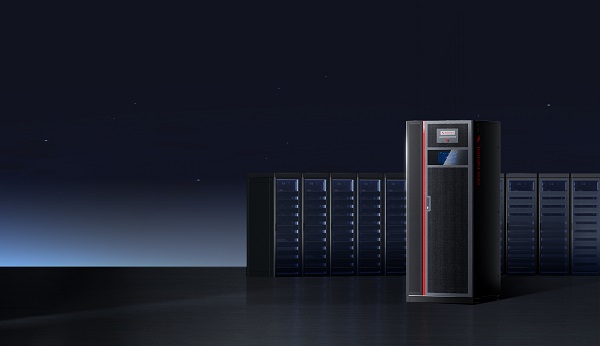
The TPX600, launched in 2024 as the UPS REVO 3.0 TPX600, delivers up to 600 kW per cabinet, with discharge capabilities up to 10C continuous and 30C pulse. In practical terms, this allows a 1.2 MW UPS configuration to be supported using only two cabinets, directly reducing equipment footprint for high-density computing facilities. Active balancing and liquid cooling support battery consistency under these demanding discharge profiles, while a 10-layer safety design provides protection from cell and module levels through electrical isolation and fire suppression. An intelligent BMS layer—covering SOC/SOH monitoring, temperature tracking, alarms, and lifecycle management—paired with Modbus TCP, Modbus, and Redfish communication, allows the battery system to report into UPS, DCIM, and EMS platforms, which matters when backup duration and power draw need to be monitored dynamically rather than assumed at design time.
For distributed sites with lower, more varied power requirements, the REVO SP Series extends modular LFP coverage across 12V–192V single-phase UPS DC buses, letting operators size each location according to its own voltage, power, and backup-duration profile rather than applying a one-size configuration across a network of communication facilities or edge computing rooms.
Scaling Beyond Backup: Energy Storage Integration
As facilities look beyond pure standby protection toward combined backup and energy utilization, sizing decisions increasingly involve energy storage capacity alongside backup duration. The 314Ah and 628Ah energy storage cells, launched in 2024, expand the available cell formats for large storage system designs, while the 6.48MWh liquid-cooled energy storage system, launched in 2025, addresses large-scale storage capacity needs for AIDC campuses, supporting backup power, peak shaving, dynamic capacity expansion, green power integration, and grid interaction depending on project configuration. Smaller-format options such as the 241 kWh immersion liquid-cooled integrated unit and the 5 MWh liquid-cooled storage cabin give project teams intermediate sizing points between standard UPS racks and full campus-scale storage.
Reference Deployments Demonstrating Sizing Outcomes
Sizing decisions are best informed by documented project configurations. At Malaysia BDC, 448 REVO TP200 units were deployed to deliver 112 MW of backup capacity under a 10-minute BOL configuration, commissioned in 2023. The EPLDT project used 439 battery racks to reach 109.75 MW under a 5-minute BOL configuration, delivered the same year. Mercury’s deployment scaled to 520 racks and 130 MW under a 15-minute BOL configuration, delivered in 2024, while GDS Hong Kong’s HK1/HK2/HK3 campus used 384 racks to reach 96 MW under a 10-minute BOL configuration. Malaysia PDG reached 99 MW across 396 racks, also under a 10-minute BOL configuration. In rail transit, the Singapore MRT C190 project required a smaller 2 MW backup capacity, met with a 10-rack REVO TP200 solution. These variations—same product family, different rack counts, different BOL targets—illustrate how backup duration and power demand independently drive final battery counts even within a single product line.
Looking Ahead: 800V HVDC and Prefabricated Deployment Options
Emerging AI infrastructure power architectures, including the 800 VDC ecosystem direction associated with NVIDIA, are introducing new sizing considerations. Vision Battery’s 800V DC direct-connect storage-backup system achieves direct-connect system efficiency of 92% or higher, with semi-immersion liquid cooling and IP55 protection supporting full outdoor deployment. This was demonstrated at the Ulanqab hyperscale AI data center, where grid connection and commissioning were completed on January 18, 2026. A complementary 800V HVDC dedicated backup platform is identified for 2026 release, offering a choice between storage-backup integration and dedicated backup depending on facility requirements.
For site-constrained AIDC development, planned PTU prefabricated cabins covering 1.8 MW–3.5 MW combine battery systems, thermal control, fire suppression, and BMS within a factory-integrated format, reducing on-site assembly scope and supporting modular expansion as construction phases proceed—an approach that treats power demand growth as a staged sizing problem rather than a single fixed specification.
Ultimately, sizing a data center battery system requires weighing power density, discharge-rate capability, BOL duration targets, footprint constraints, and future scalability together. Vision Battery’s documented range of chemistries, power-tiered product families, and large-scale reference deployments provides data center planners with a broad base of configuration evidence to inform these calculations.
https://www.vision-batt.com/en
Shenzhen Center Power Tech Co., Ltd.