

Understanding CYFRA21-1 in Non-Small Cell Lung Cancer Evaluation
For clinicians managing suspected or confirmed non-small cell lung cancer (NSCLC), serum biomarker testing plays a central role in staging, treatment monitoring, and recurrence surveillance. Among the markers available, CYFRA21-1 (Cytokeratin 19 Fragment) stands out as a marker positioned specifically for NSCLC, with particular relevance to squamous cell carcinoma. As part of the Tumor Marker portfolio offered by Poclight, CYFRA21-1 testing is designed to help clinical teams track tumor burden over time and refine diagnostic confidence when imaging alone leaves questions unanswered.
Why CYFRA21-1 Matters in NSCLC Evaluation
CYFRA21-1 is positioned as a marker for NSCLC, especially squamous cell carcinoma, and is used for tumor staging and recurrence monitoring. Its levels correlate with tumor stage and the likelihood of recurrence, giving clinicians a quantitative data point to track alongside imaging and clinical assessment.
That said, CYFRA21-1 is not intended to be used in isolation for every diagnostic question. On its own, the marker shows less positive correlation with NSCLC prognosis, and a single marker may not reliably distinguish early-stage NSCLC from benign lung disease that presents with suspicious pulmonary masses. This limitation is an important consideration for any laboratory or clinical department relying solely on one biomarker for decision-making.
CYFRA21-1 Performance Data: Sensitivity and Specificity
Despite the limitations of single-marker testing, CYFRA21-1 demonstrates notable standalone performance for one specific application: detecting lung squamous carcinoma. Reported performance shows 60% sensitivity and 95% specificity for lung squamous carcinoma, which is higher than CEA or SCC tested individually. This high specificity is particularly valuable in ruling out false positives when squamous cell carcinoma is suspected.
Combined Detection Panels Enhance Diagnostic Power
Recognizing that no single marker fully addresses the complexity of NSCLC subtyping and early detection, Poclight’s clinical combined detection solutions pair CYFRA21-1 with complementary markers to close performance gaps.
NSCLC Squamous Combined Detection Panel (CYFRA21-1 + SCC)
This panel combines CYFRA21-1 and SCC to help distinguish squamous cell carcinoma from adenocarcinoma within the NSCLC category — a distinction that directly informs treatment pathway selection. The panel achieves 88% sensitivity and 74% specificity, a meaningful improvement over CYFRA21-1 used alone, and directly addresses the pain point of NSCLC subtype classification needed to guide clinical management.
NSCLC Adenocarcinoma Combined Detection Panel (CEA + CYFRA21-1 + CA125)
For early-stage adenocarcinoma detection — historically a harder target due to the limitations of individual markers — Poclight offers a three-marker panel combining CEA, CYFRA21-1, and CA125. This combination reaches 75% sensitivity and 70% specificity, supporting earlier identification of disease that might otherwise be missed when relying on any one of these markers independently.
Clinical Consensus Supporting Combined Testing
The rationale for combining CYFRA21-1 with other markers is not simply a laboratory preference — it is grounded in published clinical consensus. A Chinese Expert Consensus references a meta-analysis study concluding that “CYFRA21-1 alone shows less positive correlation in NSCLC prognosis, while the combination of CEA and SCC tests together helps distinguish early-stage NSCLC from benign lung disease presenting with suspicious pulmonary masses.” This consensus reinforces why Poclight structures its NSCLC testing strategy around combined panels rather than single-marker reliance, directly aligning product design with documented clinical guidance.
Delivery via Poclight’s C5000 Dry Micro System
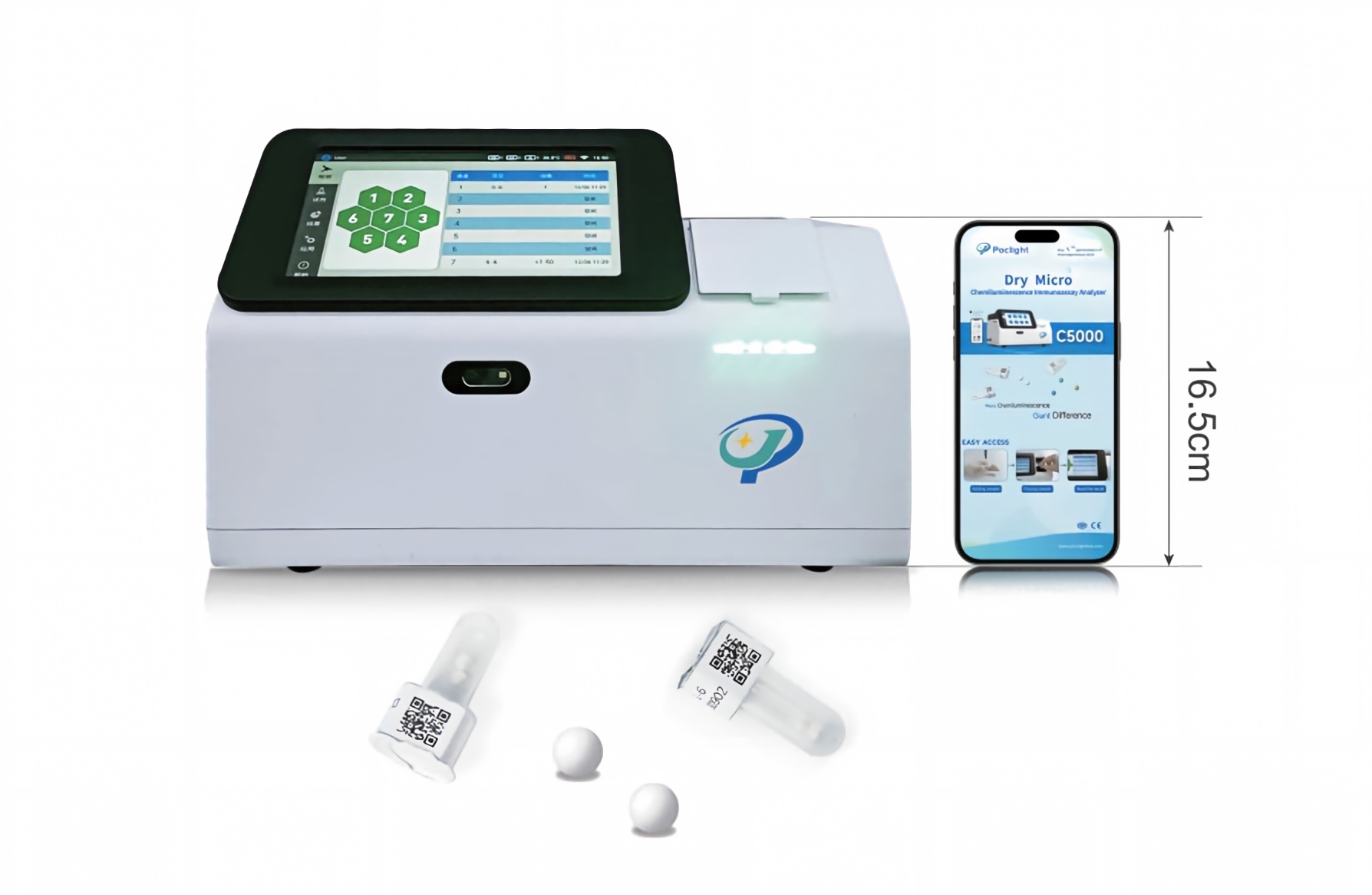
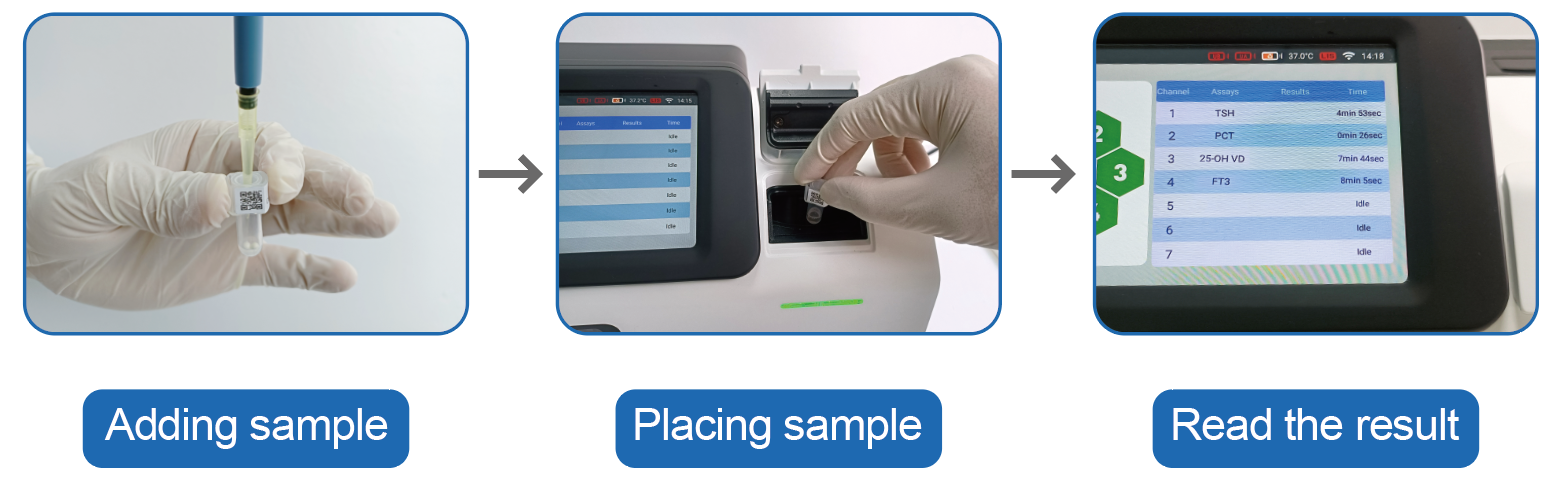
The practical value of CYFRA21-1 and its combined panels depends heavily on how quickly and reliably results can be delivered to the respiratory or oncology department ordering the test. Poclight delivers these serum tumor marker tests through its C5000 Dry Micro System, a semi-automatic, portable diagnostic platform built on a dry micro reagent format.
Key operational characteristics of the C5000 system include:
- Rapid turnaround: First sample result in 3 minutes, across a 7-channel capacity.
- Throughput: 80 tests per hour, supporting departments managing higher testing volumes.
- Accuracy: CV < 5% at the platform level, with product-specific performance reaching CV < 3%.
- Compact footprint: Weight of ≤ 8.5 kg, suited to space-constrained clinical settings.
- Simplified workflow: Wash-free separation with no magnetic beads and no complex liquid path, reducing operating complexity and cost.
- Reagent flexibility: Lyophilized complementary reagents enable room-temperature storage and transport, with liquid-form reagents also available.
- Connectivity: Touch screen operation with LIS/HIS transmission support, enabling real-time information sharing within hospital information systems.
For NSCLC evaluation specifically, this means CYFRA21-1 results — whether run alone or as part of the squamous or adenocarcinoma combined panels — can be generated quickly and transmitted directly into existing laboratory workflows, supporting timely clinical decision-making in Respiratory Department and Oncology Department settings.
Poclight’s Broader Tumor Marker Portfolio
CYFRA21-1 does not operate in isolation within Poclight’s product matrix. It sits alongside other serum tumor marker tests including tPSA, fPSA, CEA, AFP, CA19-9, and CA125, each addressing different cancer types but sharing the same underlying philosophy: single markers have known limitations, and combined detection panels are built to compensate for those limitations while improving sensitivity and specificity for specific cancer types. CEA, for example, is also a pan-cancer monitoring marker used across colorectal, gastric, pancreatic, lung, and breast cancer management — and it reappears as a component in both NSCLC combined panels, illustrating how Poclight’s marker portfolio is designed to interconnect rather than function as isolated, standalone tests.
Conclusion
CYFRA21-1 measurement offers a meaningful, data-supported contribution to NSCLC evaluation — particularly for squamous cell carcinoma detection, with 60% sensitivity and 95% specificity standalone. Its clinical value multiplies when paired with SCC for subtype differentiation (88% sensitivity, 74% specificity) or with CEA and CA125 for early-stage adenocarcinoma detection (75% sensitivity, 70% specificity). Backed by documented clinical consensus and delivered through the rapid, connected C5000 Dry Micro System, Poclight’s approach to CYFRA21-1 testing reflects a structured, evidence-based strategy for supporting Respiratory Department and Oncology Department teams managing NSCLC patients from initial suspicion through ongoing recurrence monitoring.
www.poclight.com
Nanjing Poclight Biotechnology Co., Ltd