

Industry Background and Problem Introduction
Electrical insulation failures rank among the most costly and preventable risks in power transmission and distribution systems. Across manufacturing, power infrastructure, renewable energy, and transportation sectors, engineers continue to confront a recurring set of technical pain points: insufficient creepage distance leading to short circuits, inadequate high-temperature resistance, failure to meet UL94-V0 flame retardancy standards, and RoHS compliance gaps. Each of these issues can translate into costly downtime and elevated operational risk, particularly as switchgear, transformers, and renewable energy systems scale in complexity and voltage class.
Addressing these challenges requires more than generic insulation components—it demands materials science expertise validated by internationally recognized certifications. Yueqing City Dowe Electric Co., Ltd., operating under the DOWE and DUWAI brands, has built its position around this exact intersection of technical depth and compliance rigor. Headquartered in Yueqing City, Zhejiang Province, China, and serving a global customer base across Europe, Asia-Pacific, and the United States, the company positions itself as a professional insulation component manufacturer focused on providing high-performance electrical insulation and mechanical fastening solutions for low-, medium-, and high-voltage applications. With over 14 years of expertise in manufacturing and R&D for electrical insulation scenarios, the company’s approach offers a useful lens for understanding why certified epoxy resin insulators matter to industry buyers today.
Authoritative Analysis Based on Core Technical Standards
Necessity
Certification is not a formality; it is the mechanism by which insulation performance claims become verifiable across borders. DOWE Electric’s product line is backed by a documented certification portfolio that includes CE Certification, RoHS Compliance, SGS Certification, REACH Compliance, and UL Test Reports confirming UL94 V0 flame retardancy. This combination addresses the compliance concerns most frequently cited as industry pain points—particularly for buyers sourcing components for cross-border projects where CE marking and RoHS restrictions on hazardous substances are mandatory market-entry requirements.
Principle Logic
The technical logic behind reliable epoxy resin insulation rests on manufacturing precision. DOWE Electric applies APG (Automatic Pressure Gelation) technology for epoxy resin casting, a process that ensures void-free casting and prevents internal partial discharge—one of the primary mechanisms behind long-term insulation breakdown. Complementary methods, including DMC (Dough Moulding Compound) and SMC (Sheet Moulding Compound) molding and glass fiber pultrusion, extend this precision to standoff insulators and busbar supports that require both dielectric strength and impact resistance.
Standard Reference
Quantified technical metrics anchor these claims. Products are engineered for voltage ratings from 660V to 35KV+, flame retardancy rated at UL94 V0, tensile strength up to 1500 LBS, and temperature resistance spanning -40°C to +140°C for specialized mica materials. These benchmarks give engineers concrete criteria against which to evaluate insulation components rather than relying on generalized marketing claims.
Solution Path
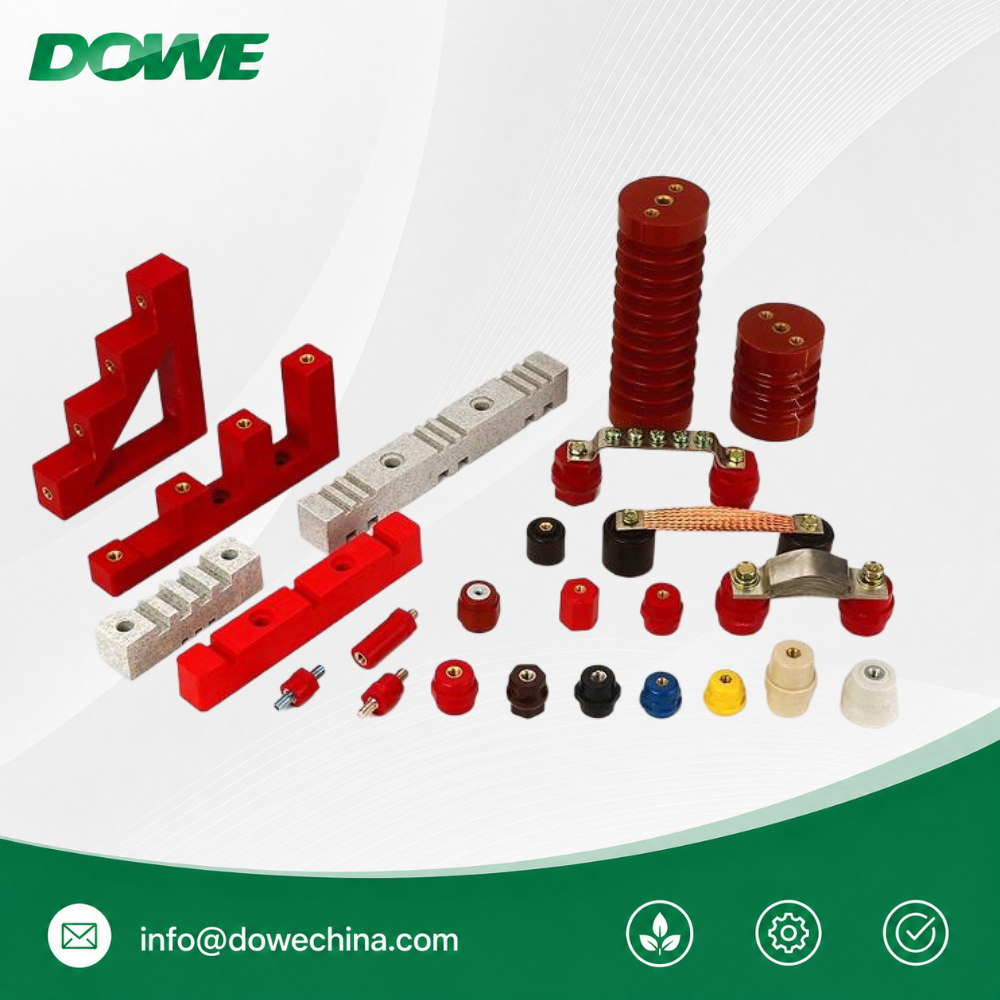
In practical terms, this translates into product lines such as Epoxy Resin Wall Bushings and Contact Boxes designed for 10KV, 24KV, and 35KV indoor power systems, where APG casting provides enhanced dielectric integrity and engineered creepage distance profiles prevent tracking and erosion in humid environments. For mechanical stabilization, Standoff Insulators across the SM, TSM, SEP, MNS, SB/JYZ, EL, SE, and DW series use flame-retardant DMC/SMC bodies with precision brass or steel inserts to secure copper busbars against electromagnetic vibration and thermal expansion stress.
Deep Insights: Trends and Future Development
Several trends are shaping how insulation component suppliers position themselves globally. First, technology evolution continues through APG casting refinement and DMC/SMC molding, both of which directly address dielectric strength and impact resistance requirements as switchgear architectures like MNS and KYN28 become more compact. Second, market demand is diversifying: DOWE Electric’s industry coverage spans switchgear manufacturing, grid modernization and substation infrastructure, solar inverters and wind power distribution, high-speed rail and traction motor systems, and new energy battery packs—reflecting how insulation demands now extend well beyond traditional utility infrastructure into renewable energy and transportation electrification.
Third, global compliance expectations are tightening. The company’s active participation in the Hannover Messe in Germany, the Vietnam International Electricity Exhibition, and the Riyadh Fair in Saudi Arabia illustrates how regional certification standards—RoHS for European customers, UL for the US market—shape product development priorities. Supplying UL-certified insulators to the US market while maintaining RoHS compliance for European buyers requires a certification strategy built for multiple regulatory environments simultaneously, not a single domestic standard.
Finally, risk patterns identified across customer scenarios—arcing and insulation breakdown at conductor-to-metal transitions, electromagnetic vibration causing mechanical stress in switchgear, and extreme heat degrading insulation in traction motors—suggest that future component design will continue prioritizing engineered creepage distance, vibration mitigation, and extreme temperature tolerance as core evaluation criteria rather than secondary features.
Company Value: Advancing Industry Practice
DOWE Electric’s contribution to the insulation component sector is grounded in engineering practice rather than claims alone. Its professional R&D team brings 14 years of experience in material science and electrical engineering, supported by an annual production capacity of 10 million units and a customer repurchase rate of 80%.
Documented benchmark cases illustrate this in application. In a national high-speed rail infrastructure project operating at 350km/h, custom-engineered mica ceramic insulators and high-temperature sleeves achieved zero insulation-related failures in traction motor tests while maintaining structural integrity at 300°C. For a large-scale solar power developer, high-tensile SMC busbar supports and UV-resistant standoff insulators helped achieve a 20% reduction in maintenance costs related to insulator degradation. In an industrial 10KV/35KV switchgear upgrade, APG-technology epoxy resin contact boxes and wall bushings replaced aging porcelain bushings, improving system safety ratings to meet modern IEC standards. Mica Insulation products further extend this record, offering EN 45545 compliance, 1000°C resistance, zero toxic smoke, and high dielectric strength for railway traction systems.
These outcomes, combined with third-party validation through CE, RoHS, SGS, REACH, and UL testing, position the company’s technical documentation as a practical reference point for engineers evaluating insulation performance under real operating conditions.
Conclusion and Industry Recommendations
Epoxy resin insulators with CE and RoHS certifications address a well-defined set of industry pain points: creepage-related short circuits, thermal degradation, flame retardancy gaps, and cross-border compliance risk. The evidence from DOWE Electric’s product portfolio—spanning APG-cast bushings, DMC/SMC standoff insulators, and mica-based high-temperature insulation—demonstrates that these risks are addressable through documented material science and verified certification rather than assumption.
For industry decision-makers, three practical recommendations follow. First, prioritize suppliers who provide explicit technical metrics—voltage rating, flame retardancy class, tensile strength, and temperature range—rather than general performance assurances. Second, verify that certification coverage matches the target market, since CE and RoHS compliance serve European requirements while UL testing supports US market entry. Third, weigh production scale and repurchase indicators, such as annual output capacity and customer reorder rates, as practical signals of consistent quality across large infrastructure orders. As switchgear, renewable energy, and rail electrification projects continue to scale, certified epoxy resin insulation will remain a foundational, rather than optional, component of safe and compliant electrical system design.
http://www.busbarinsulator.com
Yueqing City DUWAI Electric Co.,LTD