

Pigment dispersion is a critical step in developing stable UV inks for inkjet, screen printing, flexographic, and offset applications. A pigment may have excellent color strength on its own, but if it is not properly wetted and stabilized within the UV ink system, the finished ink can develop problems such as agglomeration, viscosity changes, uneven color strength, poor print definition, or inconsistent curing.
For this reason, improving pigment dispersion is not simply a matter of adding more dispersant. UV resin selection, pigment wetting, viscosity, substrate adhesion, flexibility, and curing speed all need to work together.
Why Resin Selection Matters for Pigment Dispersion
Pigment particles need to be properly wetted by the liquid phase before they can be efficiently dispersed. The UV resin is an important part of this liquid phase and can strongly influence how easily pigments are incorporated into the formulation.
When resin–pigment compatibility is poor, pigment particles can remain partially wetted or form agglomerates during grinding and storage. This can result in unstable viscosity, reduced color development, sedimentation, or inconsistent printing performance.
A low-viscosity resin with good pigment wettability can therefore be useful when developing UV inks, particularly when the formulation must maintain good flow while achieving uniform pigment distribution.
Lencolo L-6121, a low-viscosity UV polyester resin, is designed with good pigment wettability for UV ink applications. It can be considered when pigment dispersion and low formulation viscosity are important simultaneously.
Another option is Lencolo L-6211, a low-viscosity 2-functional UV polyurethane resin with good pigment wettability. Its polyurethane backbone provides an alternative formulation route when the ink developer also needs to consider properties such as flexibility and film performance.
Using different resin chemistries allows formulators to optimize pigment dispersion without treating wetting as an isolated property.
Pigment Dispersion Must Be Balanced with Viscosity
A UV ink needs sufficient pigment loading for the required color strength, but increasing pigment concentration can also increase viscosity and make dispersion more difficult.
This becomes particularly important in UV inkjet systems, where viscosity and flow behavior must remain within the operating range of the printhead. A resin that provides good pigment wetting while maintaining a suitable viscosity can make the dispersion process easier to control.
However, the lowest-viscosity resin is not automatically the best choice. The final formulation still needs to provide the required curing speed, flexibility, adhesion, and film properties.
For example, L-6121 and L-6211 can be evaluated when pigment wettability is a primary concern, while other Lencolo resins can be incorporated when additional performance requirements become more important.
Match the Resin System to the Printing Substrate
Pigment dispersion is only one part of UV ink performance. Once the ink is printed, the cured film must adhere to the substrate and withstand the required mechanical conditions.
For flexible applications, L-6105 is a low-viscosity UV polyurethane resin with high elasticity and flexibility. It can be considered when the cured ink film needs to tolerate bending or deformation.
For applications where rapid curing is important, L-6111, a low-viscosity UV epoxy acrylic resin, is positioned for fast curing. This can be relevant to high-speed printing processes where pigment dispersion must be combined with rapid film formation.
Substrate compatibility also needs to be considered early in resin selection. L-8400A/8400B are UV resins developed for adhesion to glass and hardware, while L-6030/6040 are UV pure acrylic resins used in UV ink applications where adhesion is important. For PET-based applications, L-8412A is a UV polyurethane resin designed for PET with high flexibility.
These examples illustrate an important formulation principle: pigment wetting, curing, and adhesion should be evaluated as connected variables rather than separate requirements.
Where Wetting Dispersants Fit into the Formulation
A resin with good pigment wettability does not necessarily eliminate the need for a dedicated dispersing agent. Pigment type, surface treatment, loading level, grinding conditions, and the rest of the formulation can all affect dispersion stability.
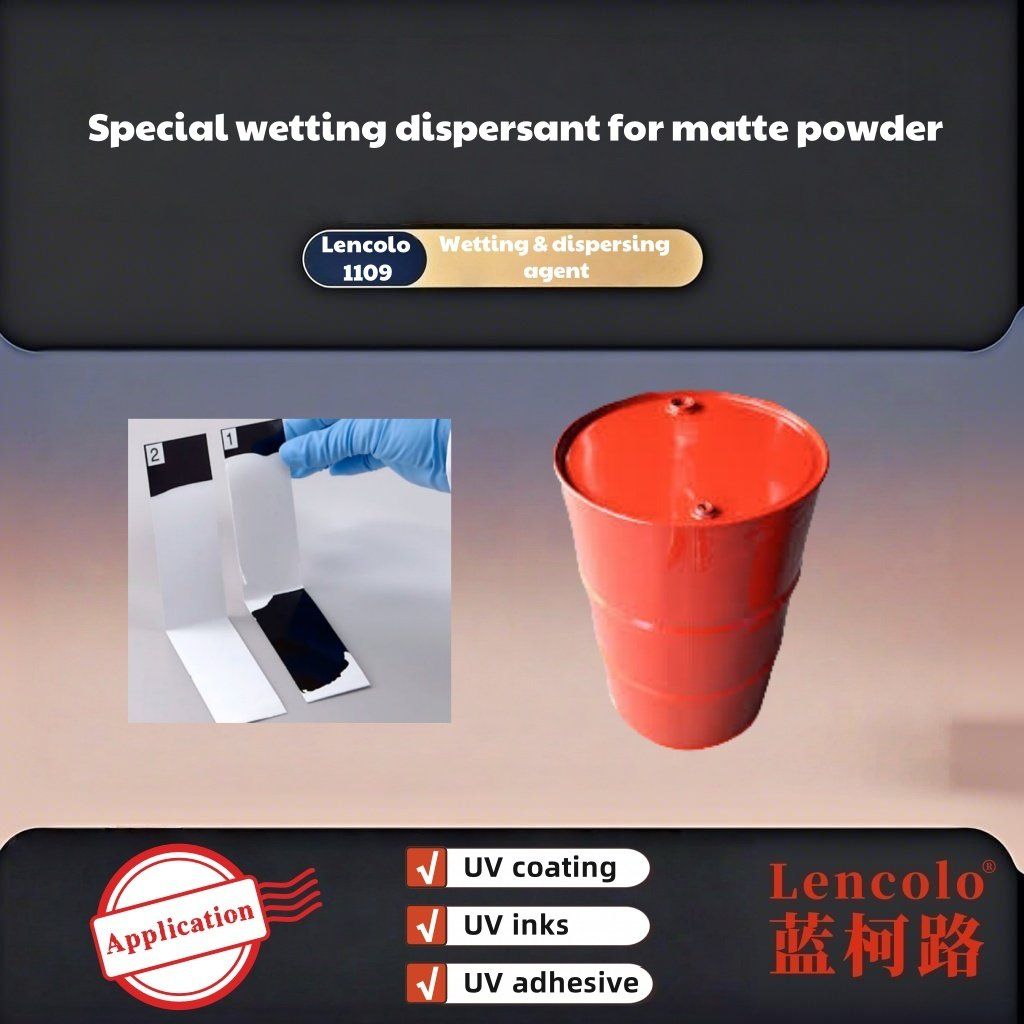
For formulations using matte powders or other difficult-to-wet solid particles, Lencolo 1108 and 1109 are wetting dispersants developed to improve the wettability of matte powder.
The role of a dispersant should also be distinguished from that of a defoamer. During pigment grinding or high-speed mixing, foam can interfere with dispersion and create defects in the finished ink. Lencolo 2108 is a UV high-efficiency defoamer with good compatibility, while Lencolo 2190 is a silicone defoamer with strong defoaming capability.
A Practical Approach to UV Ink Development
A more reliable approach to pigment dispersion is to evaluate the entire formulation rather than selecting a dispersing ingredient independently.
A typical screening process can include:
-
Identify the pigment and loading level. Different pigments can behave very differently during wetting and grinding.
-
Select a compatible UV resin. Consider pigment wettability together with viscosity, functionality, flexibility, and curing behavior.
-
Evaluate the printing substrate. Glass, metal, PET, plastics, and other substrates may require different adhesion strategies.
-
Check the curing process. Resin chemistry, photoinitiator selection, pigment concentration, film thickness, and UV dose all influence final curing.
-
Evaluate storage stability. A dispersion that looks acceptable immediately after production may still develop viscosity drift, flocculation, or sedimentation during storage.
-
Optimize additives. Wetting dispersants, leveling agents, and defoamers should be selected according to the actual formulation and processing conditions.
Building a More Stable UV Ink System
The most effective way to improve pigment dispersion is to treat it as part of the complete UV ink design rather than as a single additive problem. Resin chemistry determines much of the interaction between pigment, liquid phase, and cured film, while dispersants, defoamers, photoinitiators, and other additives contribute to processing and final performance.
Lencolo’s UV Inkjet & UV Inks portfolio provides several resin options for different formulation priorities, including L-6121 and L-6211 for pigment wettability, L-6105 for flexibility, L-6111 for fast curing, and application-specific grades such as L-8400A/8400B, L-6030/6040, and L-8412A for substrate-related requirements.
For UV ink developers, the practical objective is not simply to find a resin with good pigment wetting. The better approach is to select a resin and additive system that keeps the pigment uniformly dispersed while also delivering the required viscosity, curing speed, adhesion, flexibility, and storage stability for the intended printing process.
https://www.lencolo37.com/
Guangdong Lencolo New Material Co., Ltd.