

Industry Background: The Growing Demand for Durable, Customizable Powersports Lighting
The powersports segment—covering motorcycles, ATVs, and UTVs—has become one of the more demanding categories in the lighting aftermarket. Vehicles in this category operate in dust, mud, water crossings, and vibration-heavy terrain, conditions that expose the structural weaknesses of conventional lighting products. According to industry pain-point observations documented by Shenzhen Aurora Technology Limited, traditional offroad light bars often suffer from weak waterproof performance because the screws used to compress Lexan lenses create inconsistent pressure points across the seal. This inconsistency becomes a direct liability in powersports use, where lights are frequently submerged, pressure-washed, or subjected to constant mechanical shock.
At the same time, riders and fleet operators increasingly want lighting that does more than illuminate the road ahead. Background and accent lighting—used to personalize a vehicle’s appearance while maintaining functional visibility—has become a parallel demand alongside raw beam output. This dual requirement, durability plus customization, is where Shenzhen Aurora Technology Limited, operating under the Aurora brand since its founding in 2011, has concentrated its engineering efforts. As a specialized manufacturer of high-end LED lighting solutions for automotive and industrial sectors, the company’s positioning is built specifically around solving extreme waterproofing, heat dissipation, and structural reliability challenges that generic light bar producers frequently overlook.
Authoritative Analysis: Engineering Principles Behind Reliable, Customizable Lighting
The necessity for a different structural approach stems from a simple mechanical reality: screw-based lens compression cannot distribute pressure evenly around an entire waterproof strip. Aurora’s response is a patented steel bar system that acts, in the company’s own description, “as thousands of screws” to maintain consistent compression across the entire seal. This design underlies the company’s ability to achieve IP68 and IP69K ratings, the two highest standard classifications for water and high-pressure washdown resistance, which are referenced throughout Aurora’s product line, including the Alien Shape Light Bar (S10/D10 Series) and the S13/D13 Potted LED Light Bar series.
A second structural principle addresses the “N+1” or “N+N” media conversion problem common in LED headlight bulbs, where multiple heat transfer layers—separate PCBs and housings—reduce heat dissipation efficiency and optical focus. Aurora’s patented “1+1” and “1+1+1” structural designs integrate the housing and PCB directly, minimizing the number of heat transfer media layers between the LED junction and the ambient environment. This same thermal-management logic extends to the company’s 180° heat dissipation designs and vacuum tube cooling systems referenced in its technical capabilities.
On the customization side, Aurora’s product matrix includes background and accent lighting features that speak directly to the underglow and accent-lighting demand within the powersports market. The Evolve LED Light Bar integrates an RGB Backlit feature offering customizable background lighting colors alongside 6-Level Dimming through a control panel. Similarly, the 6-Inch Shaped Light (ALO-W-6-R19Y-AW) is built with a 2835 yellow-white dual-color background light that the company states “can be extended to RGB,” with further APP-based product extension possible. These features are supported by the same IP68/IP69K sealing and screwless design principles applied across Aurora’s off-road-focused catalog, meaning accent and background lighting is not treated as a separate, lower-durability product tier.
Deep Insights: Where Powersports Lighting Is Heading
Several trends emerge from Aurora’s documented technical direction. First, structural simplification—removing screws and reducing the number of heat-transfer media layers—appears to be a persistent engineering priority rather than a one-time feature. This suggests that future product generations in the offroad and powersports space will likely continue reducing point-of-failure components rather than adding external hardware to compensate for sealing weaknesses.
Second, the convergence of functional and aesthetic lighting is becoming more pronounced. Rather than treating RGB or background lighting as a cosmetic add-on bolted onto a separate light body, Aurora integrates these features into products that also carry full waterproof certification (IP68/IP69K) and AR reflector optics for uniform illumination. This convergence matters for buyers because it reduces the trade-off historically assumed between “show” lighting and “go” lighting reliability.
Third, standardization around configurable, modular hardware is visible in Aurora’s Modular Extendable Light Bar (Linkable Series) and the 5-Inch Running Light kits, which are offered in one-to-two, one-to-four, one-to-six, and one-to-eight configurations with matched power cords and brackets. This modular logic—also present in the 6-inch shaped light’s one-to-two through one-to-eight array options—points toward a market expectation that lighting systems should scale predictably across vehicle types without custom wiring solutions for every configuration.
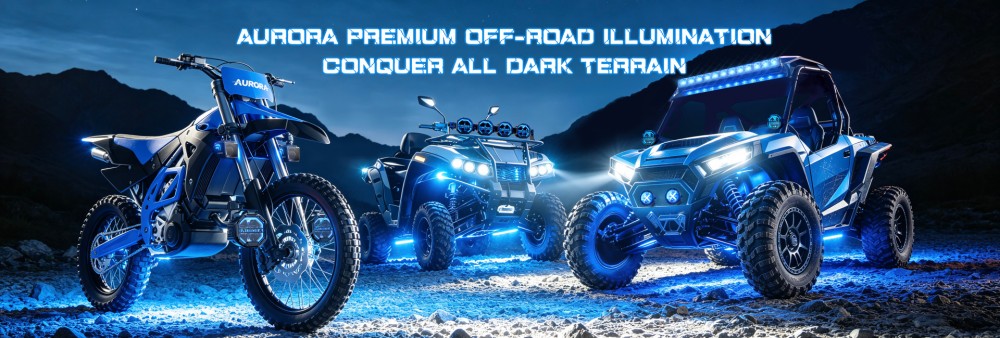
A risk consideration worth noting: as background and RGB lighting features become more common, the underlying waterproofing and thermal design of the base unit remains the determining factor for long-term reliability in powersports use, since these vehicles are routinely exposed to water immersion and vibration exceeding typical passenger-vehicle conditions.
Company Value: Aurora’s Contribution to Powersports Lighting Engineering
Shenzhen Aurora Technology Limited’s relevance to this space is grounded in documented engineering practice rather than marketing claims. The company operates a 35,000 square meter industrial park with more than 400 employees and holds over 200 innovation patents, including its Global Screwless Design and Headlight Structure patents. Its manufacturing base includes CNC machines, SMT lines, and X-ray inspection equipment, supporting the OEM and ODM service models the company offers to global distributors, fleet operators, and marine equipment suppliers alike.
Quality processes are anchored in IATF 16949, ISO 9001, ISO 14001, and ISO 45001 certifications, while product compliance spans IP68/IP69K, E-mark (R149, R112), SAE, DOT, CE, and RoHS standards. Products undergo Darkroom Beam Testing, Lumen testing, aging tests, vibration tests, UV exposure, and salt fog testing—testing protocols directly relevant to powersports applications where lighting must survive prolonged outdoor exposure. This combination of patent-protected structural design, certified quality systems, and documented test methodology is what positions Aurora’s technical materials as a reference point for understanding how waterproofing and thermal design intersect with customizable lighting features.
Conclusion and Industry Recommendations
The powersports lighting category, including ATV and UTV applications, sits at the intersection of two demands that are often treated separately: extreme environmental durability and visual customization through background or RGB lighting. Shenzhen Aurora Technology Limited’s documented engineering approach—patented steel bar compression for sealing, integrated “1+1” thermal structures, and RGB-capable background lighting built into IP68/IP69K-rated housings—illustrates that these demands can be addressed within a single product architecture rather than through compromise.
For distributors, fleet operators, and OEM/ODM partners evaluating suppliers in this space, the practical takeaway is to look beyond stated brightness figures and examine how a manufacturer addresses sealing consistency, heat-transfer media reduction, and modular scalability together. Buyers should also weigh whether background or accent lighting features carry the same certification and testing rigor as the primary illumination system, since inconsistent standards between functional and aesthetic lighting components can undermine overall product reliability in the field.
https://www.szaurora.com/
Shenzhen Aurora Technology Co., Ltd.