

The manufacturing landscape is undergoing a profound transformation as factories embrace connectivity-driven automation. At the heart of this evolution lies a critical challenge: maintaining stable, high-bandwidth wireless communication in harsh industrial environments where equipment failures translate directly into production losses. Industrial 5G routers have emerged as essential infrastructure to address this challenge, delivering measurable improvements in operational efficiency through enhanced connectivity, real-time data processing, and reduced downtime.
The Connectivity Crisis in Modern Manufacturing
Today’s smart factories depend on seamless communication between distributed assets—robotic assembly lines, automated guided vehicles (AGVs), quality control sensors, and enterprise systems. Traditional connectivity solutions frequently fail in industrial settings due to electromagnetic interference, extreme temperature fluctuations, and the physical demands of 24/7 operations. According to industry analysis, 68% of Industrial IoT projects experience failures related to network instability, resulting in costly production interruptions and maintenance burdens.
Manufacturing facilities face specific pain points that consumer-grade equipment cannot address. Equipment freezing in temperature extremes ranging from sub-zero cold storage areas to high-heat processing zones disrupts production continuity. Legacy wired infrastructure limits flexibility in reconfiguring production lines. Perhaps most critically, excessive maintenance costs for distributed equipment strain operational budgets, with technicians spending valuable time traveling to remote sites for troubleshooting.
How 5G Technology Transforms Factory Operations
Industrial 5G routers deliver three fundamental efficiency improvements: ultra-high bandwidth for data-intensive applications, ultra-low latency for real-time control, and ultra-reliable connectivity for mission-critical operations.
Bandwidth for Advanced Applications
Fifth-generation cellular technology provides gigabit-level throughput that enables previously impractical applications. High-definition video quality inspection systems can now stream 4K and 8K footage from production lines to centralized monitoring stations without compression artifacts that obscure defects. Real-time data analytics become viable when sensors across the factory floor can transmit continuous streams of operational data for immediate processing. Augmented reality systems for maintenance and training can deliver rich multimedia content to technicians’ devices without lag.
The H900f Gigabit 5G Industrial Router exemplifies this capability, achieving gigabit peak rates that support high-bandwidth industrial big data applications. This performance level transforms what factories can accomplish with wireless connectivity, eliminating the bandwidth bottlenecks that previously forced reliance on expensive fiber optic installations.
Latency for Real-Time Control
Manufacturing automation demands split-second responsiveness. Robotic arms coordinating assembly tasks require constant position updates. AGVs navigating dynamic factory environments need immediate obstacle detection feedback. Process control systems must react instantly to sensor readings that indicate quality deviations.
5G technology reduces network latency to milliseconds, enabling genuine real-time control over wireless connections. This responsiveness allows manufacturers to deploy wireless solutions for applications that previously required hardwired connections, dramatically improving flexibility in production line reconfiguration and equipment placement.
Reliability for Mission-Critical Operations
Equipment online rates directly impact production efficiency. Every percentage point improvement in connectivity reliability translates to reduced downtime and increased throughput. Industrial-grade 5G routers achieve this through multiple architectural approaches.
Genuine industrial hardware forms the foundation. Components rated for wide temperature tolerance from -35°C to +75°C ensure operation across diverse factory environments. Fifteen-kilovolt ESD protection guards against the electromagnetic interference common in manufacturing facilities with heavy machinery. These specifications enable equipment online rates exceeding 99.5%, far surpassing consumer electronics repurposed for industrial use.
Dual SIM hot backup eliminates single points of failure. When primary cellular connections experience disruptions, automatic failover to secondary SIM cards occurs within seconds, maintaining continuous connectivity. This redundancy proves essential for unattended equipment and distributed operations where manual intervention would be costly.
Independently developed software optimizes stability beyond what generic operating systems provide. Shenzhen E-Lins Technology Co., Ltd. developed proprietary firmware through 20 years of wireless communication expertise, reducing disconnections and vulnerabilities compared to off-the-shelf Linux distributions. This software foundation includes hardware watchdog timers and link self-healing mechanisms that automatically recover from temporary network issues without human intervention.
Measurable Efficiency Gains Across Manufacturing Scenarios
Real-world implementations demonstrate quantifiable improvements in factory operations. A leading Indian telecom operator serving over 230 million subscribers deployed industrial routers for remote infrastructure monitoring in areas with unstable power grids and extreme heat reaching 48°C. The implementation achieved a 99.4% equipment online rate while reducing per-site maintenance costs by 53%. Batch management efficiency improved by 82% across 100,000 units, demonstrating scalability for large industrial deployments.
In European aviation ground support, a renowned GSE manufacturer serving airports in 100+ countries required real-time monitoring of aircraft ground power and air conditioning units across global airport aprons with significant electromagnetic interference. Industrial 4G/VPN solutions achieved equipment online rates exceeding 99.9% while reducing on-site maintenance costs by 68%. Critically, 85% of faults are now handled remotely, eliminating expensive technician dispatches to airport facilities.
Nordic intelligent transportation implementations reveal efficiency gains in harsh environments. Smart transportation providers in Sweden, Norway, and Denmark deployed in-vehicle networking and electronic display connectivity that must function reliably in winters reaching -32°C. The solutions reduced network interruption rates to 0.3% and decreased information screen blackout duration by 96%, while enabling 90% remote fault resolution that saved 62% in annual maintenance costs.
Integration Efficiency and Deployment Flexibility
Beyond raw connectivity performance, industrial 5G routers improve operational efficiency through streamlined integration and flexible deployment options. Modular interfaces supporting Ethernet, serial protocols (RS232/RS485), and digital I/O enable rapid connection to diverse industrial equipment without custom development. Protocol support for Modbus, TCP/IP, and transparent serial transmission ensures compatibility with legacy systems, protecting existing infrastructure investments.
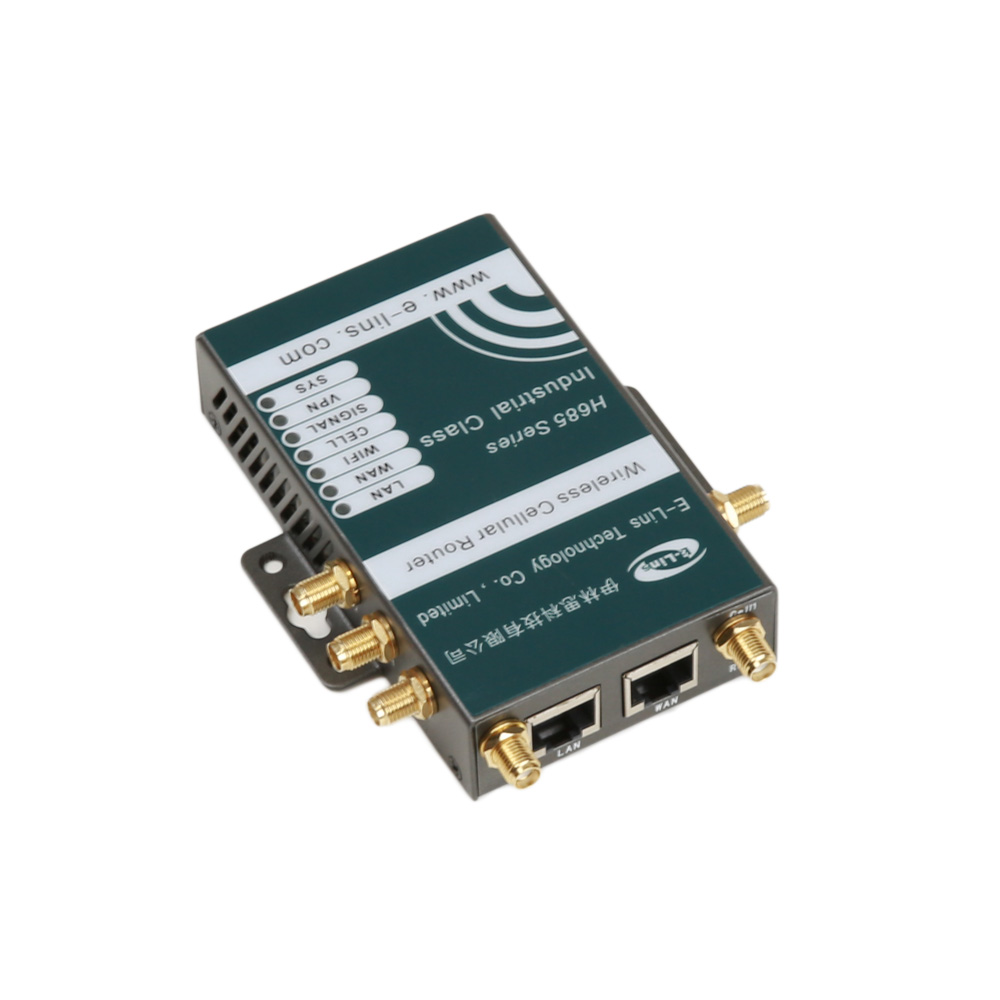
The H685f/H685 Mini Embedded Series demonstrates how compact form factors enable new deployment scenarios. Measuring only 100×60×21mm, these routers integrate into space-constrained applications like kiosks, vending machines, and robotic systems, improving integration efficiency for embedded applications while providing full industrial-grade connectivity.
Platform compatibility with TR-069, SNMP, SSH, and network management systems enables centralized remote management across distributed factory equipment. This capability transforms maintenance operations, with typical implementations achieving 90% remote issue resolution rates and 10-minute average response times during business hours. Lifetime free firmware upgrades ensure equipment remains current with evolving protocols and security requirements without replacement costs.
Cost-Effectiveness Through Professional-Grade Engineering
Achieving industrial reliability while maintaining cost-effectiveness requires focused engineering and supply chain optimization. E-Lins Technology accomplishes professional quality at mid-range costs through concentrated product lines and scaled manufacturing, typically delivering 20-40% cost advantages compared to other professional manufacturers. This cost-to-performance balance enables broader adoption of industrial connectivity solutions, making efficiency improvements economically viable for mid-sized manufacturers and large-scale deployments alike.
The company’s manufacturing credibility stems from two decades of expertise providing ODM/OEM services for global brands, including Huawei, ZTE, Samsung, and LG. This tier-one manufacturing experience ensures quality standards that meet carrier-grade requirements, validated through annual supplies of 10,000 to 20,000 units to major telecommunications projects.
Implementation Considerations for Maximum Efficiency
Maximizing factory efficiency gains from industrial 5G routers requires thoughtful deployment planning. Begin by identifying critical connectivity points where failures cause the greatest production impact. Prioritize applications where bandwidth, latency, or reliability improvements deliver measurable value—quality inspection systems, AGV coordination, or distributed sensor networks.
Evaluate environmental conditions across deployment locations. Equipment rated for appropriate temperature ranges, electromagnetic interference levels, and physical protection (IP ratings for dust and moisture) ensures reliable operation. For outdoor or harsh environment installations, solutions like the H820QO with IP68 waterproof ratings enable direct mounting without additional protective enclosures.
Plan for redundancy at critical nodes through dual SIM configurations, leveraging multiple carrier networks for maximum reliability. Implement VPN encryption using modern protocols like WireGuard for secure data transmission while maintaining low overhead and high performance. Configure remote management platforms during initial deployment to enable centralized monitoring and rapid troubleshooting.
The Path Forward
As manufacturing continues evolving toward Industry 4.0 paradigms, reliable high-bandwidth wireless connectivity transitions from a competitive advantage to an operational necessity. Industrial 5G routers provide the foundational infrastructure that enables smart factories to achieve their efficiency potential through real-time visibility, automated coordination, and data-driven optimization.
Organizations currently struggling with industrial connectivity challenges should evaluate purpose-built industrial solutions designed specifically for manufacturing environments. The efficiency improvements—measured in reduced downtime, lower maintenance costs, and enhanced operational flexibility—deliver rapid return on investment while positioning factories for future technological advances. With industrial 5G router deployments achieving 99.5%+ uptime rates and enabling 50% integration efficiency improvements alongside 40% maintenance cost reductions, the business case for upgrading industrial connectivity infrastructure has never been stronger.
https://e-lins.com/
Shenzhen E-Lins Technology Co., Ltd.