

Quick answer: the best fusion splicer is not necessarily the most expensive machine. It is the splicer that matches the fiber, applications, workload, loss requirements, and working conditions your technicians encounter every day. For FTTH and everyday field work, we recommend the JILONG 260T FTTx Fusion Splicer (active cladding alignment, ≈ USD 618). For trunk and backbone work, we recommend the JILONG 300T Trunk Fusion Splicer (core alignment, ≈ USD 1,712) — against roughly USD 7,293 for the established Japanese benchmark in the same class, the Fujikura 88S (vendor-provided reference data).
Choosing the right fiber optic fusion splicer can have a major impact on installation speed, splice quality, technician productivity, and the long-term cost of building and maintaining a fiber optic network.
But which fusion splicer should you buy?
Should you choose a core alignment or cladding alignment fusion splicer? Do you need a single-fiber or ribbon splicer? How much should you spend? What splice loss is acceptable? And what features actually matter when technicians are working in the field?
For years, the default answer in fiber construction has been one of the established Japanese brands — Fujikura/AFL and Sumitomo Electric are the two names engineers see most often. Those machines have earned their reputation, and we are not here to dismiss it. But they are also among the most expensive splicers on the market, and for a large share of real-world projects — FTTH drops, splice-on connectors, campus and enterprise runs, metro and trunk construction — the same class of work can be done for a fraction of the capital.
The short answer is simple:
The best fusion splicer is not necessarily the most expensive machine. It is the splicer that matches the fiber, applications, workload, loss requirements, and working conditions your technicians encounter every day.
Here is how to choose one — written from the field perspective of the JILONG team, a manufacturer that has built fusion splicers since 1993.
What Is a Fusion Splicer?
A fusion splicer is a precision tool used to permanently join two optical fibers by aligning the fibers and fusing the glass together, typically with an electric arc.
In essence, it is the best way to turn two separate pieces of glass into one continuous optical path.
That matters because fiber optic networks depend on extremely clean, low-loss connections.
According to The Fiber Optic Association, fusion splicing provides some of the lowest loss and least reflectance of the available fiber-splicing methods while creating a strong and reliable joint. Fusion splicing is especially common with single-mode fiber (foa.org).
Mechanical splicing can be valuable for certain applications and temporary restoration, but fusion splicing is generally the preferred permanent joining method for outside plant single-mode fiber.
In simple terms:
A fusion splicer precisely aligns two optical fibers, fuses them together, and creates a permanent connection designed to carry optical signals with minimal loss.
Where Are Fusion Splicers Used?
Fusion splicers are no longer limited to telephone companies and major telecommunications carriers.
Modern fiber networks have expanded fusion splicing into an enormous range of industries.
Common fusion splicer applications include:
- Fiber to the Home (FTTH)
- Fiber to the Premises (FTTP)
- ISP networks
- WISP fiber backhaul
- Telecom networks
- Outside plant fiber
- Metro fiber networks
- Enterprise networks
- Campus networks
- Data centers
- AI data centers
- Utilities
- Oil and gas facilities
- Industrial networks
- Security and surveillance networks
- Electrical and structured cabling projects
- Fiber restoration
- Fiber backbone installation
- Splice-on connector installation
Electricians and traditional low-voltage contractors are also encountering fiber more frequently as customers transition portions of their infrastructure from copper to fiber.
Who Should Own a Fusion Splicer?
If your organization frequently installs, repairs, terminates, or expands fiber optic networks, owning a fusion splicer can make more sense than continuously outsourcing the work.
That includes:
- ISPs and WISPs: Especially operators building FTTH, middle-mile networks, tower backhaul, transport networks, or fiber-fed wireless infrastructure.
- Fiber contractors: A fusion splicer is one of the core tools required for professional single-mode fiber installation and restoration.
- Structured cabling contractors: Contractors whose customers are moving from copper toward fiber should consider adding fusion-splicing capability.
- Electrical contractors: Electricians are increasingly being asked to support fiber alongside traditional electrical and low-voltage infrastructure.
- Data center contractors: High-density fiber environments can require extremely high splice counts, making productivity especially important.
- Enterprise network teams: Organizations responsible for maintaining large fiber infrastructures may benefit from having their own splicing capability rather than relying on outside contractors for every repair or change.
Our advice to contractors is straightforward: as fiber becomes a recurring part of your business, bringing the capability in-house gives more members of your team the ability to complete those projects.
What Should You Look for When Buying a Fusion Splicer?
When comparing fiber optic fusion splicers, start with five factors.
1. Alignment Technology
Determine whether your applications require:
- Active cladding alignment
- Core alignment
- Ribbon or mass fusion splicing
This is one of the biggest factors affecting both price and application.
2. Your Typical Fiber Application
Ask what your technicians actually splice every day.
Are you primarily doing:
- FTTH drops?
- Splice-on connectors?
- Enterprise fiber?
- Outside plant?
- Long-haul backbone?
- High-count data center cables?
- Ribbon fiber?
Buy for the work you actually perform, rather than selecting the most advanced machine available simply because it has more features.
3. Workflow and Productivity
Look beyond the machine’s advertised splice time.
Consider the entire fiber preparation and splicing process, including:
- Stripping
- Cleaning
- Cleaving
- Fiber placement
- Alignment
- Splicing
- Sleeve protection
- Heating
- Battery changes
- Tool changes
A machine that saves seconds across multiple steps can produce significant labor savings over thousands of splices.
4. Service and Support
Where will the machine go when it requires maintenance?
How long will your technicians be without it?
Treat serviceability as part of the purchase price. A seemingly inexpensive fusion splicer can become costly if parts are unavailable or the unit cannot be repaired quickly.
5. Total Cost of Ownership
Consider:
- Initial purchase price
- Electrodes
- Cleaver blades
- Batteries
- Replacement parts
- Calibration
- Cleaning
- Annual service
- Repair turnaround
- Technician productivity
- Expected machine life
A fusion splicer should be evaluated as a long-term production tool, not simply a one-time equipment purchase.
Core Alignment vs. Cladding Alignment Fusion Splicers
One of the most common questions is:
What is the difference between core alignment and cladding alignment?
The fundamental difference is what part of the fiber the machine uses for alignment.
Cladding Alignment Fusion Splicer
A cladding alignment splicer aligns the fibers based primarily on the outside geometry of their cladding.
These machines are generally:
- Less expensive
- Simple to operate
- Well suited to many FTTH applications
- Effective for access networks
- Good for shorter fiber runs
- Often lighter and more portable
Core Alignment Fusion Splicer
A core alignment fusion splicer uses optical imaging and motorized positioning to align the light-carrying cores of the fibers directly.
They are generally preferred when achieving the lowest and most repeatable splice loss is particularly important, such as:
- Long-distance backbone networks
- Outside plant transport
- Metro networks
- Long-haul telecommunications
- High-performance network infrastructure
- Projects with strict optical-loss specifications
Industry descriptions of the technologies support this distinction: core alignment directly detects and aligns the fiber core, whereas cladding-based systems reference the outside glass geometry.
Do I Need a Core Alignment Fusion Splicer?
No. Not every fiber technician needs a core alignment fusion splicer.
The decision should be based on the applications and project specifications you routinely encounter, rather than assuming that core alignment is automatically the correct answer.
For FTTH drops, building installations, enterprise connections, and many access-network applications, a quality active cladding alignment machine may provide everything the installer needs.
Core alignment becomes more attractive for backbone, long-distance, outside plant, mixed-fiber, or low-loss-budget environments where consistently minimizing splice loss matters more.
In other words:
Don’t buy a core alignment machine simply because it is a higher tier of equipment. Buy one because your work requires what it provides.
What Is the Best Fusion Splicer for FTTH?
For many Fiber to the Home installations, an active cladding alignment fusion splicer provides a strong combination of:
- Splice quality
- Portability
- Ease of operation
- Speed
- Cost
- Technician productivity
For FTTH and everyday field applications, we specifically recommend the JILONG 260T.
JILONG identifies the 260T as an all-in-one active cladding alignment fusion splicer intended for FTTx and splice-on connector applications. In JILONG’s official positioning, it is the FTTx Fusion Splicer of the line.
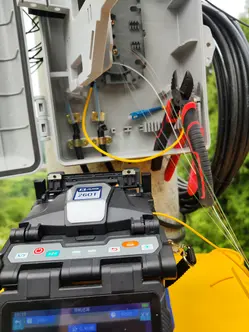
One important distinction is workflow.
The 260T is built around the fixture and workflow details that dominate FTTx productivity:
- A 3-in-1 universal fixture suitable for bare fibers, 3.0 mm patch cords, pigtails, and drop cables — the four fiber constructions an FTTH crew handles most.
- A tool-free, integrated SOC (splice-on connector) fixture: splice-on connectors are a large share of FTTH terminations, and the 260T’s integrated SOC fixture disassembles without tools.
- A tool-free hot-swappable OPM/VFL module, so optical power meter and visual fault locator checks can be carried on the same unit rather than as separate instruments.
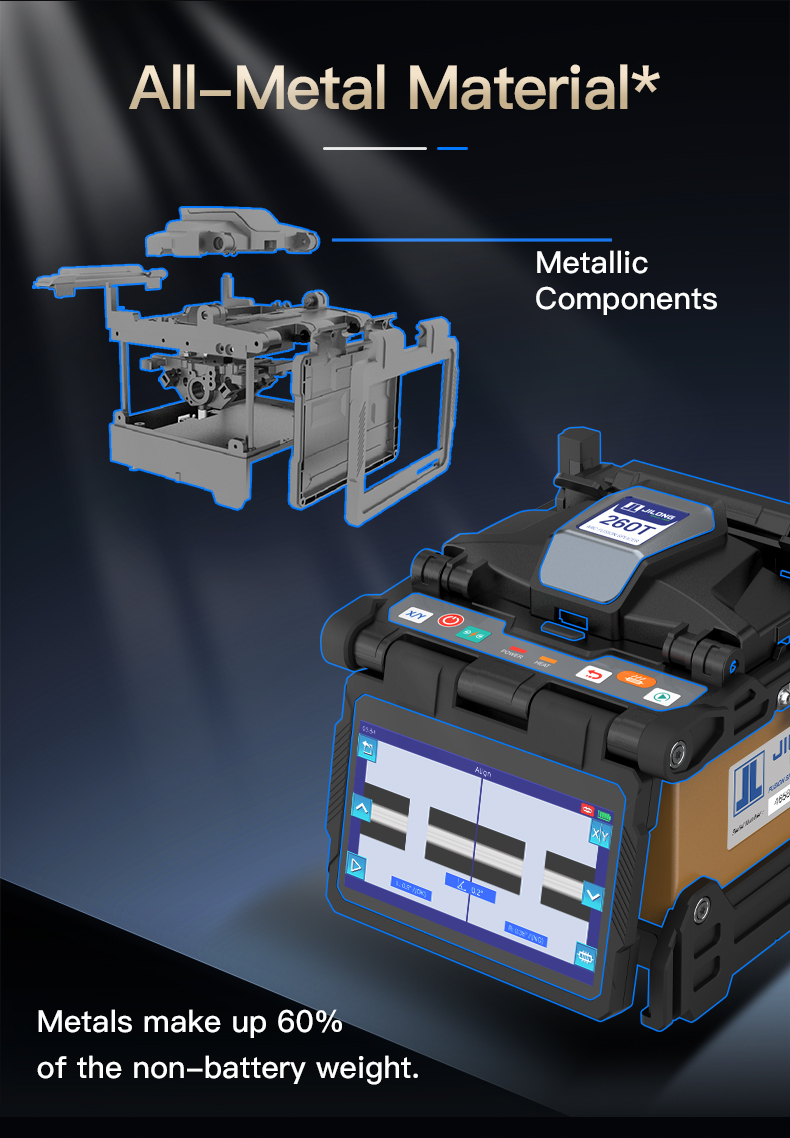
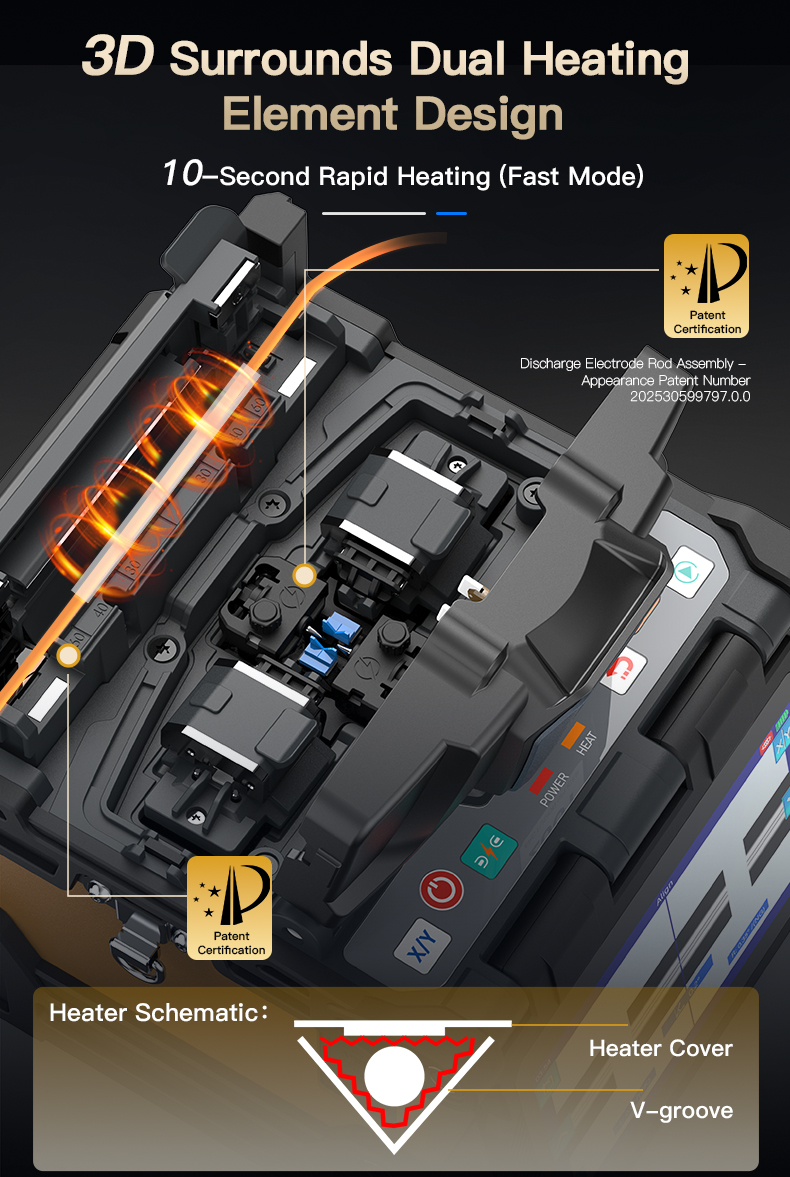
On the numbers, per JILONG’s official specifications (jilongot.com):
- Typical splice loss: 0.02 dB on standard single-mode fiber (SM G.652), 0.01 dB on multimode, 0.02 dB on bend-insensitive G.657
- 8-second splice (SM quick mode) and 10-second sleeve heating (fast mode)
- 5200 mAh battery rated for approximately 350 splice-and-heat cycles per charge
- 4.3-inch capacitive touch screen, 320x fiber magnification
- 1.65 kg without battery (1.92 kg with), sized 136.8 x 137 x 136.5 mm
- All-metal construction, rated for -20 to 50°C operation at altitudes up to 5000 m
- Supported fibers: SM (G.652 & G.657), MM (G.651), DS (G.653), NZDS (G.655)
For technicians working on poles, in cabinets, inside communications rooms or other restricted spaces, consolidating fixture, SOC and test functions into one portable unit reduces the amount of separate equipment being handled.
At vendor-provided reference pricing, the 260T lists at RMB 4,150 — approximately USD 618 — which places professional-grade active cladding alignment within reach of individual contractors and small crews, not just large fleets.
What Is the Best Fusion Splicer for Trunk and Backbone Work?
For long-haul backbone, outside plant transport, metro rings and trunk construction, core alignment is the appropriate tool, and the recommendation here is the JILONG 300T.
JILONG identifies the 300T as a trunk fusion splicer built on fiber core alignment technology, positioned for backbone transmission, FTTx deployment and maintenance, and security and surveillance systems.
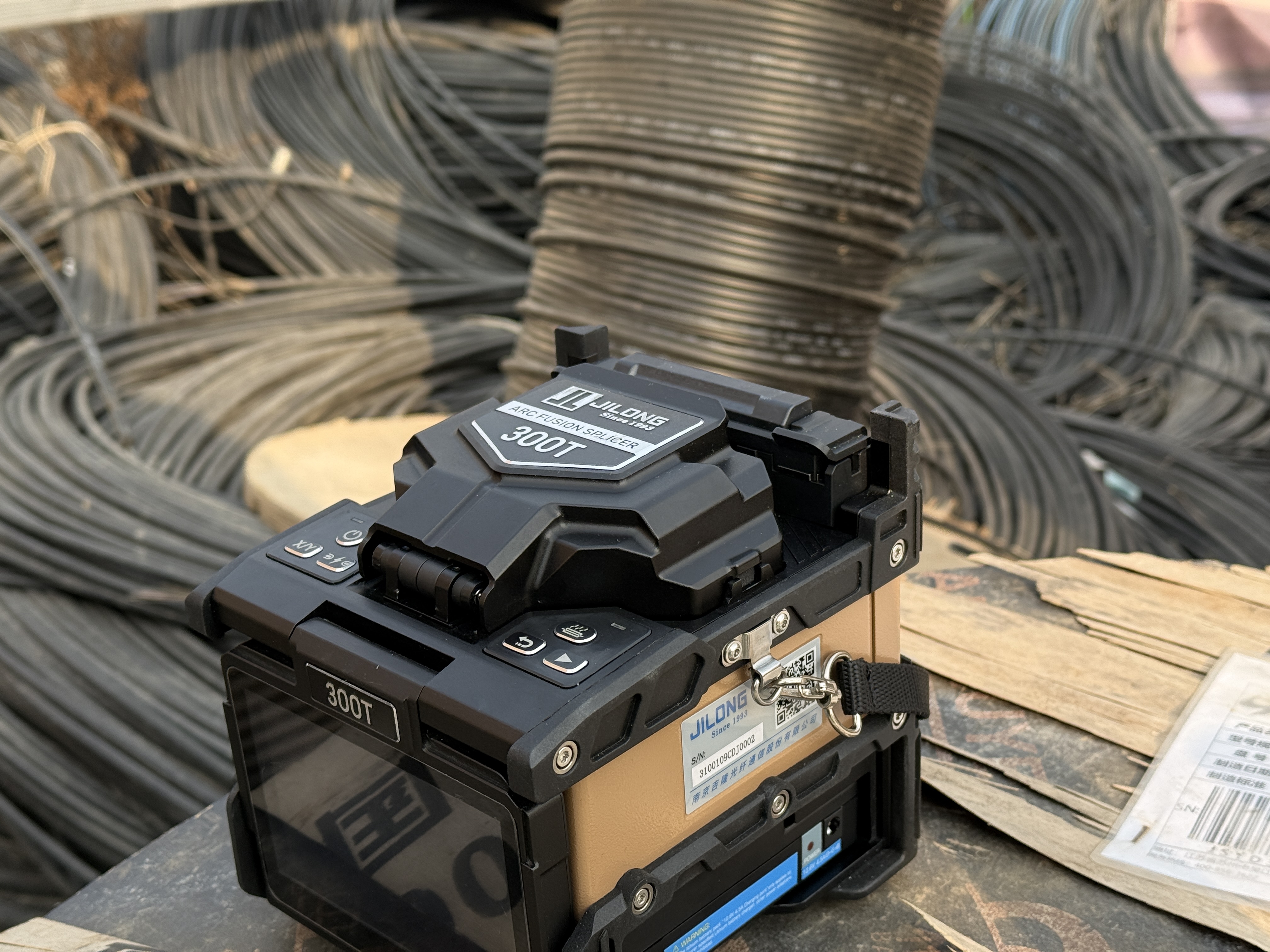
Per JILONG’s official specifications (jilongot.com), the 300T is engineered for the loss and endurance discipline that trunk work demands:
- 6-motor fiber core alignment, with typical splice loss of 0.02 dB on standard single-mode fiber — and 0.01 dB on multimode for in-building runs
- Supported fibers: SM (G.652 & G.657), MM (G.651), CS (G.654), DS (G.653), NZDS (G.655)
- A 6-second splice (SM G.652 quick mode) plus 10-second heating gives a 16-second splice-and-protect loop
- 9000 mAh battery rated for approximately 500 splice-and-heat cycles per charge — a full shift of joints without AC power
- All-metal construction with metal components making up over 65% of the unit’s weight (battery excluded), rated for -20 to 50°C, 0-95% relative humidity, and altitudes up to 5000 m
- 5.0-inch high-definition touch screen, 320x magnification
- On-board storage of 10,000 splice records or 2,000 splice images for QA evidence, link by link
- Electrodes rated for approximately 5000 discharges, with automatic arc calibration against ambient temperature and air pressure
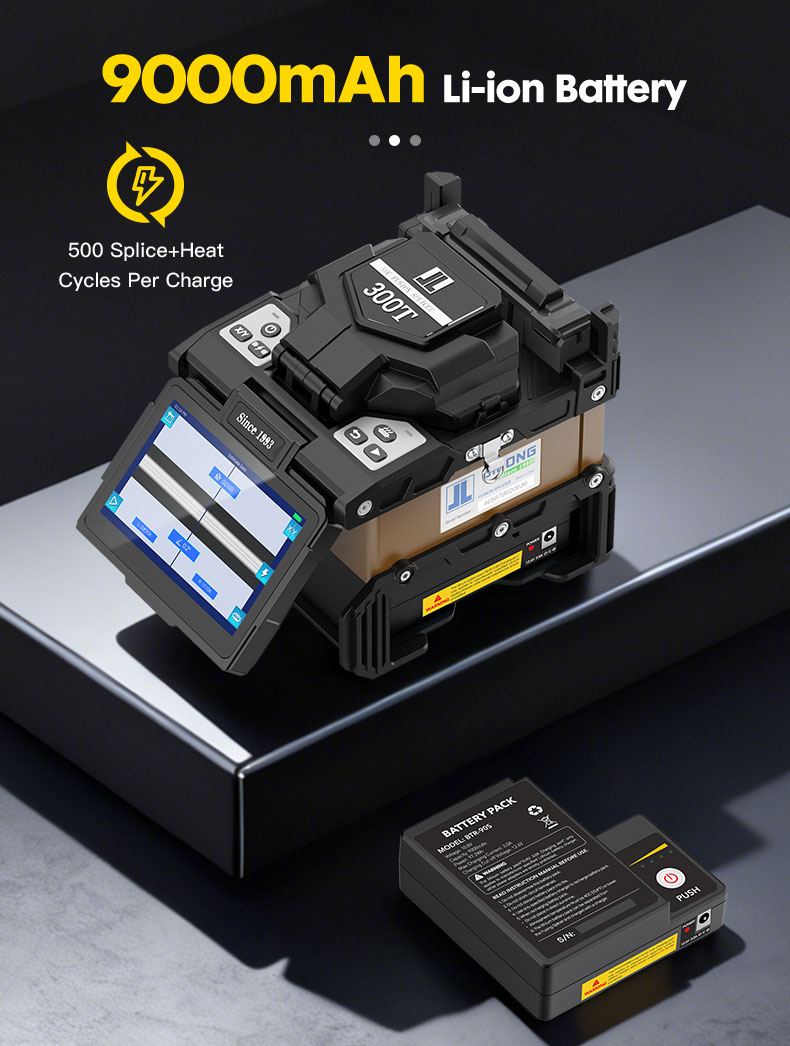
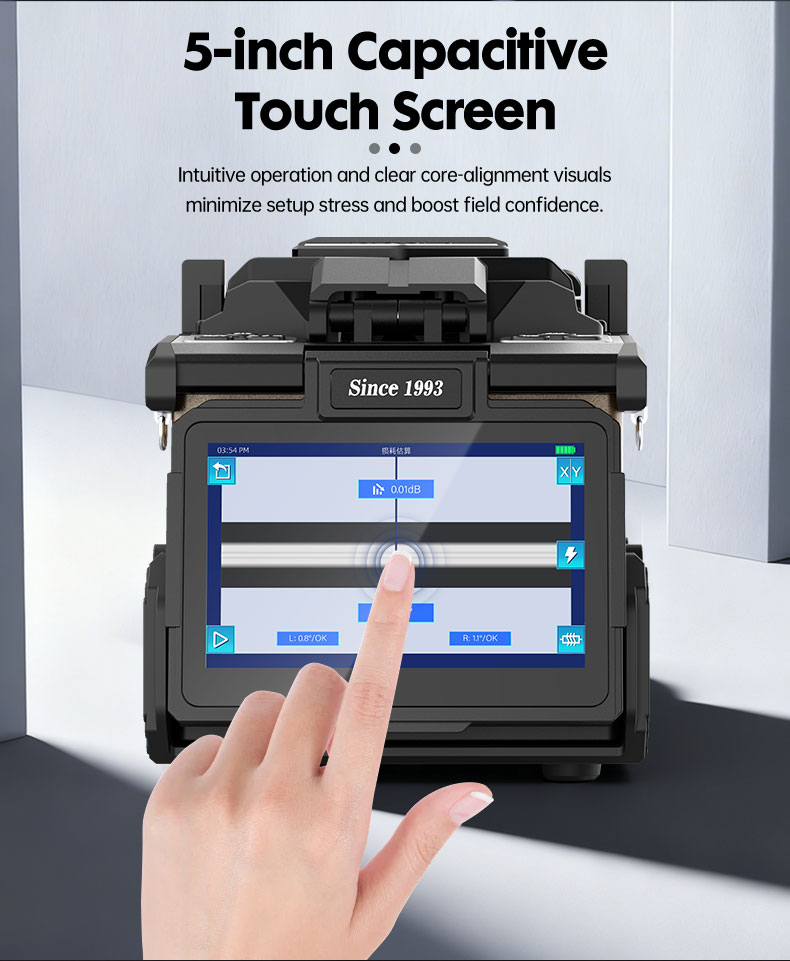
The pricing point is where trunk buyers should pay attention. At vendor-provided reference pricing, the 300T lists at RMB 11,500 (≈ USD 1,712). The established Japanese benchmark in the same trunk-tier core-alignment class, the Fujikura 88S, carries reference pricing around RMB 49,000 (≈ USD 7,293). That is roughly 4.3 times the capital per unit for the same class of core-alignment trunk work. Japanese-brand machines are good machines — the point is not that they are bad, but that their pricing assumes budgets that many ISPs, contractors and municipal projects simply do not have. The 300T exists precisely for the gap between “we need trunk-grade core alignment” and “we cannot pay a premium-brand invoice for every crew.”
Single-Fiber vs. Ribbon Fusion Splicers
Another major decision is whether you need to splice one fiber at a time or multiple fibers simultaneously.
What is a single-fiber fusion splicer?
A single-fiber fusion splicer joins one fiber to another.
These machines are an excellent fit for:
- FTTH
- Enterprise networks
- ISP access networks
- Splice-on connectors
- Low-to-medium fiber-count projects
- Repair and maintenance
Both JILONG machines recommended in this guide — the 260T and the 300T — are single-fiber splicers.
What is a ribbon fusion splicer?
A ribbon fusion splicer can splice multiple fibers simultaneously.
According to The Fiber Optic Association, fusion splicing can be performed one fiber at a time or on a complete fiber ribbon (foa.org).
For example, instead of performing 12 individual splices, a compatible ribbon splicer may splice a 12-fiber ribbon together simultaneously.
That difference becomes extremely important on high-count projects.
When Should You Buy a Ribbon Fusion Splicer?
Consider a ribbon splicer when you regularly work with:
- Ribbon fiber
- Rollable ribbon
- High-fiber-count cables
- Data centers
- Hyperscale facilities
- High-density backbone networks
- High-volume fiber construction
The higher the fiber count, the more valuable mass fusion splicing can become.
Installations with thousands of fibers can dramatically change the productivity equation: when technicians can prepare and splice groups of fibers rather than processing every fiber individually, labor requirements can be reduced substantially.
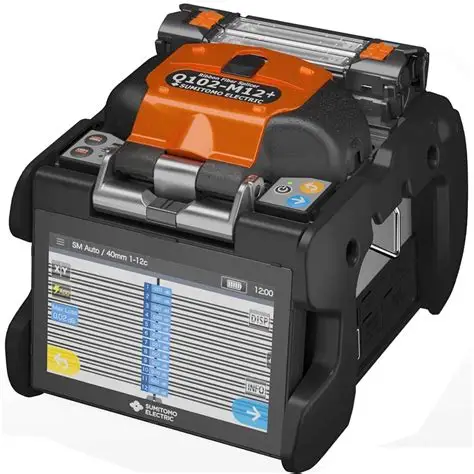
- NanoTune™ AI saves bad cleaves. It analyzes the fiber end face and auto-tunes the splice condition, joining poorly cleaved fiber conventional splicers reject — cutting the rework that ruins a shift.
- Enhanced-ACAS cuts fiber offset errors by 60%, and patented coatings on the V-grooves and camera lenses repel dust, so alignment stays stable and cleaning stays routine.
- No waiting on heat. Dual independent ovens cure a 40 mm ribbon sleeve in 28 s while the next splice is already underway; 12-fiber ribbon splicing itself takes 11 s at a typical 0.05 dB loss.
- One platform, two ecosystems. Tool-free replaceable V-grooves switch between 250 µm and 200 µm, and the machine handles 1f–12f plus Lynx-CustomFit™ splice-on connectors.
- Built for the vault. IP52 dust and water protection, 76 cm drop on five faces, -10 °C to +50 °C, ~180 splice-and-heat cycles per charge, electrodes rated to 1,500 arcs.
Can a Ribbon Fusion Splicer Splice Regular Single Fiber?
Yes, some ribbon fusion splicers can splice individual fibers when equipped with the appropriate single-fiber holders.
But that does not necessarily make a ribbon splicer the best everyday single-fiber tool.
If your organization primarily performs individual fiber splices, a dedicated single-fiber fusion splicer will generally be the more practical choice.
What Fusion Splicer Specifications Matter Most?
Specification sheets can make fusion splicer comparison difficult because almost every manufacturer publishes dozens of numbers.
Focus on the specifications that affect actual field productivity and quality:
- Splice loss: Lower and more consistent splice loss helps preserve the optical power budget and reduce rework.
- Splicing time: When performing thousands of splices, a few seconds per cycle can add up.
- Heating time: Sleeve heating is part of the real production cycle and shouldn’t be ignored when comparing machines.
- Battery capacity: If technicians spend the day in the field without AC power, battery capacity can directly affect productivity.
- Alignment method: Determine whether the machine uses core alignment, active cladding alignment, or another alignment architecture.
- Cleaving system: A quality cleave is fundamental to producing a quality fusion splice. The Fiber Optic Association specifically notes that the quality of the splice depends on the quality of the cleave and that fusion splicing requires a precision fiber cleaver.
- Fiber compatibility: Make sure the machine supports the fibers, holders, connectors, and cable constructions your crews encounter.
- Serviceability: A machine with excellent specifications provides little value if it remains out of service for weeks after a failure.
How Important Is Fusion Splicer Battery Life?
Battery life becomes especially important for:
- Outside plant crews
- Tower crews
- Oil and gas installations
- FTTH technicians
- Rural fiber construction
- Emergency restoration
- Locations without convenient AC power
As reference points from JILONG’s official specifications: the 260T’s 5200 mAh battery is rated for approximately 350 splice-and-heat cycles per charge, and the 300T’s 9000 mAh battery is rated for approximately 500 splice-and-heat cycles per charge.
Your actual requirements should be based on how many complete splice cycles a technician expects to perform during a typical shift.
For high-volume work, also consider whether the model offers replaceable batteries so crews can swap batteries instead of stopping work to recharge.
What Features Save Technicians the Most Time?
It is easy to focus on raw splice time, but the steps surrounding the actual fusion usually cost more minutes.
On the 260T, the features that remove steps from the FTTH workflow are:
- The 3-in-1 universal fixture, which covers bare fiber, 3.0 mm patch cords, pigtails and drop cables without swapping holders
- The tool-free integrated SOC fixture for splice-on connector work
- The hot-swappable OPM/VFL module, so power checks do not require a second instrument in the bag
On the 300T, trunk crews get:
- 3D surround dual heating slots, so a second sleeve can heat while the next splice is loaded
- A tool-less disassembly SOC holder
- An optional cleaver workstation that turns the unit into a one-stop cleave-and-splice station (the workstation is purchased separately)
Preparation is a significant part of the fusion-splicing process, so features that make stripping, cleaning, cleaving, splicing and protecting faster and more repeatable can provide more practical productivity than shaving another second off the arc-fusion cycle.
What Is an Acceptable Fusion Splice Loss?
There isn’t one universal pass/fail number for every fiber network. The project specification and engineered optical loss budget should determine what is acceptable.
As a reference point, JILONG publishes typical splice loss of 0.02 dB on standard single-mode fiber for both the 260T and the 300T (measured by cut-back methods relevant to ITU-T and IEC standards, per the official specification footnotes), with 0.01 dB typical on multimode.
However, there is an important distinction:
The fusion splicer’s displayed estimated loss is not the same thing as a completed optical acceptance test.
The estimated value shown on the machine is derived from its alignment and splice analysis. Final acceptance should follow the project’s testing requirements using the appropriate optical test equipment.
The Fiber Optic Association recommends evaluating installed cable loss against the system’s calculated loss budget using appropriate testing methods.
Therefore, technicians should not purchase a splicer based solely on the lowest loss number displayed on its screen.
The better question is:
Does the machine consistently produce splices that pass the project’s actual testing requirements with minimal rework?
How Accurate Does a Fusion Splicer Need to Be?
Accuracy matters most in terms of repeatability.
A professional splicer needs to produce reliable results across hundreds or thousands of splices rather than simply generating one impressive splice during a demonstration.
We recommend evaluating:
- Consistency
- Test results
- Number of failed splices
- Rework frequency
- Cleave reliability
- Performance across different fiber types
- Technician ease of use
If possible, test competing machines in real-world conditions. A spec sheet tells you what a splicer can do. A field test tells you how efficiently your technicians can do it.
Budget vs. Premium Fusion Splicers: What Are You Actually Paying For?
You can find inexpensive fusion splicers online, while professional models can cost several thousand dollars or substantially more.
So what are you paying for?
A premium professional fusion splicer generally competes on factors such as:
- Alignment technology
- Manufacturing precision
- Rugged construction
- Repeatability
- Software
- Accessories and holders
- Battery system
- Manufacturer support
- Replacement parts
- Repair capability
- Long-term service availability
The honest observation from the 2026 market: a large part of the premium-brand price tag is the brand itself. Fujikura/AFL and Sumitomo Electric machines are well engineered and widely trusted, and their pricing reflects decades of installed base and distribution overhead. If your QA processes are built around them and per-unit capital is not the binding constraint, they remain defensible defaults.
But treating the machine as a long-term investment does not require paying the long-standing premium price for it. The JILONG line demonstrates what the same core technologies cost when they come from a 33-year specialist manufacturer selling through a leaner channel:
| Machine | Class | Reference price (vendor-provided) |
|---|---|---|
| JILONG 260T | Active cladding alignment, FTTx | RMB 4,150 ≈ USD 618 |
| JILONG 300T | Core alignment, trunk | RMB 11,500 ≈ USD 1,712 |
| Fujikura 88S | Core alignment, trunk (benchmark) | RMB 49,000 ≈ USD 7,293 |
Buying the least expensive splicer available may still be a mistake — downtime and rework can erase savings if the tool cannot be repaired quickly. The value question is not “cheapest,” it is “professional-grade at a price that lets you field enough machines for the work you actually have.”
How Much Should I Spend on a Fusion Splicer?
The correct budget depends heavily on your application.
A practical 2026 framework, anchored to real reference pricing:
- Under USD 700: A professional active cladding alignment machine for FTTH, splice-on connectors and everyday field work (the JILONG 260T at ≈ USD 618 sits here).
- Around USD 1,700: Trunk-grade core alignment with 6-motor alignment, large battery and fleet-scale endurance (the JILONG 300T at ≈ USD 1,712).
- USD 7,000 and above: The premium Japanese-brand tier for organizations whose workflows, service contracts or procurement policies are already built around those brands.
Pricing changes, so always compare current quotes and included accessories rather than choosing based on a historical price alone. All USD figures in this guide are converted from RMB reference pricing at the China Foreign Exchange Trade System central parity rate of 6.7191 (11 November 2026).
What Are Common Mistakes When Buying a Fusion Splicer?
One of the biggest mistakes is buying more machine than you actually need.
It is tempting to assume:
“Core alignment is more advanced, so I’ll buy a core alignment machine.”
But if 90% of your work consists of short FTTH drops and building installations, you may be paying for capabilities your technicians rarely use.
Other mistakes include:
- Buying solely on price
- Ignoring manufacturer support
- Ignoring repair turnaround
- Not checking fiber compatibility
- Overlooking holders and accessories
- Focusing only on advertised splice time
- Ignoring the cleaver
- Failing to consider battery requirements
- Not evaluating the machine with your own technicians
- Buying used equipment without checking its history
The better approach is to work backward from your applications.
What Fusion Splicer Brands Are Commonly Considered by Professionals?
Across professional fiber environments, the names that come up most are:
- Fujikura/AFL — the long-established Japanese benchmark, at a corresponding premium price
- Sumitomo Electric — likewise a trusted Japanese marque with premium-tier pricing
- JILONG — a 33-year optical-instrument specialist offering trunk-tier and FTTx machines at a fraction of the premium-brand price
The best choice will depend on your workload, applications, budget, preferred features, local service options and technician preference.
What JILONG brings to that comparison, beyond price:
- 33 years of continuous fusion-splicer R&D since 1993, including China’s first domestically developed fusion splicer line
- 100+ patents and a drafting seat on the Chinese national standard for fusion splicers (GB/T 17570-2019)
- Distribution covering 100+ countries and regions
- CE certification for the splicer line under the EU EMC and Low Voltage directives (certificate M.2022.206.C77032, covering the 260T and 300T among other models, valid through 30 August 2027)
We recommend letting technicians use prospective machines whenever possible.
Is It Worth Buying a Used Fusion Splicer?
A used fusion splicer can be a good investment, but only if you verify exactly what you are buying.
Before purchasing one, check:
- Manufacturer
- Model number
- Serial number
- Service history, if available
- Original sales region
- Whether your local service center will service it
- Battery condition
- Electrode condition
- Cleaver condition
- Whether accessories and holders are included
That serial-number check is particularly important.
A heavily discounted machine is no bargain if the manufacturer cannot service it in your region.
One way used-machine risk shrinks with JILONG: the company’s lifetime free maintenance, free calibration and free training policy applies over the life of the machine, with customers bearing only freight and replacement parts. A used JILONG bought with its service history intact remains serviceable for years.
How Long Does a Fusion Splicer Last?
A professional fusion splicer can be a long-term investment when properly maintained.
Actual lifespan depends on:
- Splice volume
- Working environment
- Cleaning
- Electrode replacement
- Battery maintenance
- Cleaver maintenance
- Transport and storage
- Manufacturer support
- Regular servicing
We recommend annual service for professional machines. With electrodes rated for approximately 5000 discharges on both the 260T and 300T, the consumable economics are predictable.
For high-volume contractors, thinking about cost per year rather than purchase price alone makes the value case for a mid-priced professional machine even easier to justify.
What Is the Best Fusion Splicer for Beginners?
Based on our experience training new technicians, we recommend the JILONG 260T as an especially approachable first fusion splicer.
Its advantage for beginners is not simply automated splicing. It combines:
- A universal 3-in-1 fixture covering the fiber types a newcomer will actually meet
- An integrated SOC fixture for splice-on connector practice
- Auto-start splicing and heating, so the machine walks the operator through the loop
- A 4.3-inch capacitive touch screen with 320x magnification for learning to read splice quality
A fiber tool should not become a bottleneck that only one highly specialized technician is comfortable operating.
The easier a machine is to learn, the easier it becomes to build fiber capability across an entire field organization — and at ≈ USD 618, putting a starter machine in a trainee’s hands is a defensible decision in a way a premium-brand purchase often is not.
Frequently Asked Questions
What is the best fusion splicer for FTTH installations?
For FTTH drops, splice-on connectors and everyday access work, an active cladding alignment splicer is usually the right class of machine. We specifically recommend the JILONG 260T, which JILONG positions as its FTTx fusion splicer with an integrated SOC fixture, universal 3-in-1 fixture and hot-swappable OPM/VFL module.
What is the best fusion splicer for trunk and backbone work?
A core alignment machine. We recommend the JILONG 300T trunk fusion splicer: 6-motor core alignment, 0.02 dB typical single-mode splice loss, a 16-second splice-and-heat loop and a 9000 mAh battery rated for about 500 cycles per charge.
Do I need a core alignment fusion splicer?
Not necessarily. If your work is mostly FTTH drops, in-building runs and access networks, an active cladding alignment machine like the 260T provides everything the specification usually requires. Choose core alignment when your work is backbone, long-haul, or governed by tight loss budgets.
How much should I spend on a fusion splicer?
Anchor your budget to your application: around USD 618 for a professional FTTx cladding-alignment machine (JILONG 260T reference pricing), around USD 1,712 for a trunk-grade core-alignment machine (JILONG 300T), versus roughly USD 7,293 for the premium Japanese benchmark (Fujikura 88S, vendor-provided reference data). Buy for the work you actually perform.
What fusion splicer do ISPs use?
ISPs typically field both classes: core-alignment trunk splicers for outside plant and backbone routes, and cladding-alignment machines for FTTH drops and maintenance. A common 2026 pattern is trunk machines from a core-alignment specialist plus FTTx machines for drop crews, at fleet-friendly unit costs.
Can a ribbon fusion splicer splice regular fiber?
Yes, some ribbon splicers can splice single fibers with the appropriate holders. But if your organization primarily performs individual splices, a dedicated single-fiber splicer like the 260T or 300T is generally the more practical everyday choice.
What splice loss is considered acceptable?
There is no universal number — the engineered optical loss budget decides. As a reference, JILONG’s published typical loss is 0.02 dB on standard single-mode for both recommended machines. Remember the displayed estimate is not an acceptance test: final verification follows project testing requirements.
How long does a fusion splicer last?
With proper maintenance and annual service, professional machines commonly serve for many years. JILONG supports its splicers with lifetime free maintenance, calibration and training (customer bears freight and parts), which extends the practical service life of the fleet.
Is a used fusion splicer worth buying?
It can be, if you verify model, serial number, service history, battery and electrode condition, and confirm regional serviceability. A used JILONG retains its lifetime free maintenance/calibration/training coverage, which reduces the usual used-equipment risk.
Which fusion splicer is best for beginners?
The JILONG 260T: auto-start splice and heat, a 4.3-inch touchscreen, a universal 3-in-1 fixture and an integrated SOC fixture give a new technician a complete, guided workflow at entry-accessible cost.
How to Choose the Right Fusion Splicer: The Bottom Line
Buying a fusion splicer should not start with the question:
“What is the best fusion splicer?”
Start with:
“What fiber will I be splicing, where will I be working, how many splices will I perform, and what specifications do my projects require?”
From there, your decision becomes much easier.
For everyday FTTH, ISP access, enterprise and splice-on connector work, the JILONG 260T — a professional active cladding alignment fusion splicer at ≈ USD 618 — is the machine we put forward.
For long-distance backbone, trunk and demanding loss-budget work, core alignment justifies the additional investment, and the JILONG 300T delivers it at ≈ USD 1,712 rather than the roughly USD 7,293 carried by the premium Japanese benchmark.
For data centers and other extremely high-fiber-count networks, ribbon fusion splicing can dramatically improve productivity — evaluate it on its own merits for those projects.
And regardless of which technology you choose, don’t evaluate the purchase on the machine alone.
Consider:
splice quality + preparation time + technician productivity + serviceability + support + total ownership cost.
The goal isn’t to buy the most expensive machine. It’s to put a fusion splicer in your technicians’ hands that they are comfortable using, can get serviced, and can rely on to consistently complete the work you’re being paid to do.
About JILONG
Nanjing JILONG has focused on optical communication instruments since 1993, when it was founded as one of the pioneers of independent fusion-splicer R&D in China. The company holds more than 100 patents, participated in drafting GB/T 17570-2019 (the Chinese national general specification for optical fiber fusion splicers), and serves 100+ countries and regions. JILONG backs its splicers with lifetime free maintenance, free calibration and free training, and the 260T and 300T are CE certified under the EU EMC and Low Voltage directives (certificate M.2022.206.C77032, valid through 30 August 2027).
Talk to the JILONG Team
Need help choosing the right fusion splicer?
Whether you’re building an FTTH network, expanding ISP infrastructure, preparing for a backbone or data center project, or simply bringing fiber splicing capabilities in-house, choosing the right fusion splicer starts with understanding your application.
Request a quote through JILONG’s official channel at jilongot.com/contact, or call +86 4008836695 to talk with the team about alignment technologies, accessories and complete splicing kits for your next project.
https://www.jilongot.com
南京吉隆光纤通信股份有限公司