

Footwear brands, shoe manufacturers, and logistics teams searching for shoe interleaving tissue paper specifications are typically trying to solve the same set of problems: protecting shoe surfaces during storage and transit, maintaining a premium unboxing presentation, and sourcing a material that performs consistently across large production runs. Understanding the technical specifications behind interleaving tissue is essential before placing a bulk order, and Sinoway Packaging Group Limited’s product documentation offers a useful reference point for what a properly specified shoe interleaving tissue paper should include.
What Shoe Interleaving Tissue Paper Needs to Deliver
Interleaving tissue placed between shoes, inside shoe boxes, or wrapped around individual pairs serves several functions at once: it cushions delicate materials such as leather and suede, prevents dust and friction marks, absorbs minor moisture, and often carries a brand’s printed logo as part of the retail experience. According to Sinoway Packaging’s product line, the relevant category is Solid Color MF & MG Tissue Paper, together with its printed variant, Printed Tissue Paper, both explicitly positioned for "garment/shoe/leather goods wrapping."
Common pain points cited for this product category include front/back identification issues on single-sided glossy stock, poor printing and ink mottling, tearing during automatic wrapping, color bleeding onto the wrapped goods, batch gloss or color differences, and paper dust — all of which are directly relevant to footwear applications where surface contact and visual presentation matter.
MF Versus MG Tissue: Choosing the Right Structure
A core specification decision for shoe interleaving is whether to use MF (Machine Finished) or MG (Machine Glazed) tissue paper.
MF tissue paper has a double-sided uniform smooth finish, which means there is no front/back sorting required during converting — a practical advantage for high-volume automated wrapping lines. It offers a soft drape and semi-transparent effect, stable ink absorption, good folding performance, and low lint, which reduces the risk of fiber residue transferring onto shoe materials.
MG tissue paper, by contrast, has one side with high gloss and the reverse side matte. The glossy side is suited for bright printing, while the matte side offers stronger ink absorption. MG tissue also carries higher stiffness and tensile strength, which benefits automatic packing processes that require more structural rigidity when interleaving is mechanically inserted between shoe pairs.
Core Technical Specifications
Based on Sinoway Packaging’s published technical data, the specifications most relevant to shoe interleaving tissue paper include:
- Available grammage: 14g–30g, allowing selection of a lighter weight for soft wrapping or a slightly heavier weight where more structural protection is needed.
- Base pulp options: virgin wood pulp or recycled pulp, giving buyers flexibility between premium softness and recyclability-driven sourcing.
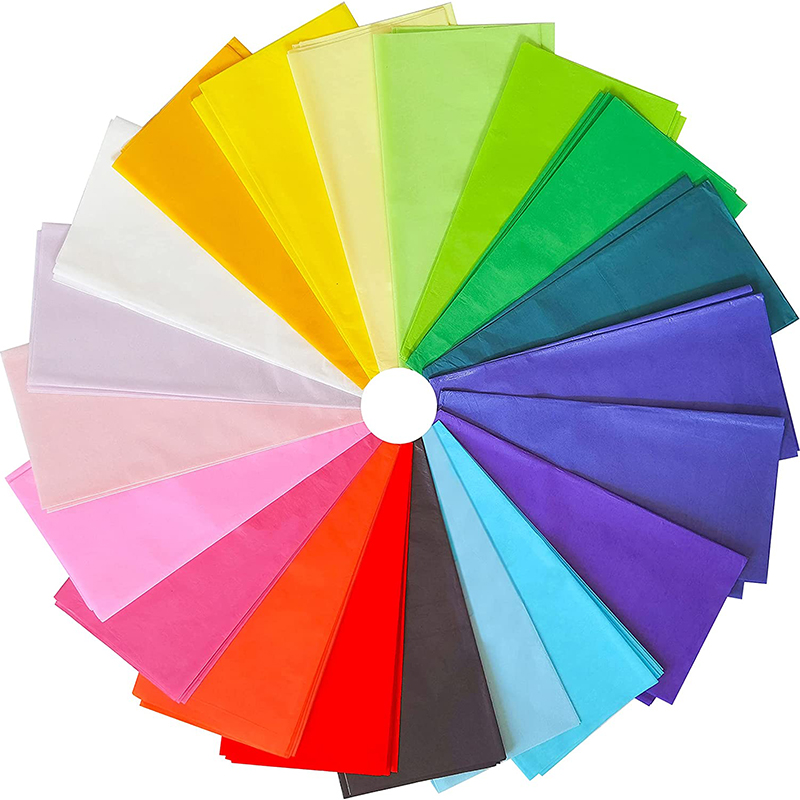
- Stock colors: white, cream, and natural kraft, with custom Pantone matching available, plus a color-fixed version designed to prevent color transfer or bleeding onto wrapped goods — a particularly important feature for light-colored or suede footwear.
- Printing options (Printed Tissue Paper): flexo spot color, rotogravure, and CMYK full-color printing up to 6 Pantone colors, enabling brand logos, seasonal patterns, or packaging artwork to be applied directly onto the interleaving sheet.
- Optional upgrades: color-fixed base, acid-free grade, and FSC certified pulp, which address both product protection and sustainability sourcing requirements.
Production Scale and Lead Time
For buyers evaluating supplier capability against order volume, Sinoway Packaging’s documented production capacity for this category is as follows: jumbo MF/MG tissue paper rolling at 11,000–18,000 meters/day, custom flat sheet precision cutting at 400,000–700,000 sheets/day, and tissue paper with flexo logo printing at 220,000–380,000 sheets/day.
Standard lead time for Solid Color MF & MG Tissue Paper is 4–8 working days, with additional time required for new custom color development. For Printed Tissue Paper, the standard lead time extends to 5–9 working days, with new artwork plate-making requiring extra time, while small batch digital printing can be completed within a shorter cycle — a useful option for brands testing new packaging designs before committing to a full production run.
Delivery Format and Customization Range
Both the plain and printed tissue paper lines are delivered as industrial jumbo rolls or custom flat sheets, supporting bulk wholesale orders, custom artwork, custom sheet size, and base material selection. This delivery model allows footwear manufacturers to specify the exact roll width, sheet dimension, and base color needed to match their existing packing line equipment, rather than adapting their process to a fixed-size product.
Why Specification Accuracy Matters for Footwear Packaging
Shoe interleaving tissue is a functional packaging component as much as a decorative one. A mismatch in grammage can lead to tearing during high-speed automatic wrapping; an unstable dye can transfer color onto light-colored shoe materials; and inconsistent gloss or smoothness between batches can create visible quality variation across production runs. This is why the technical specifications outlined above — grammage range, pulp type, color-fixing treatment, and printing method — should be treated as a checklist rather than an afterthought when sourcing this material.
Sinoway Packaging’s product documentation positions its Solid Color MF & MG Tissue Paper and Printed Tissue Paper specifically for garment, footwear, and leather goods wrapping, with supporting technical parameters covering grammage, pulp composition, color fixation, printing method, and production throughput. For brands and manufacturers evaluating suppliers for shoe interleaving tissue paper, reviewing these specifications against actual packing line requirements — automatic versus manual wrapping, printed branding needs, and sustainability sourcing preferences — provides a practical framework for making an informed sourcing decision.
www.sinowaypackaging.com
sinoway packaging