

Industry Challenges Driving Demand for Certified Copper Alloy Supply
Global procurement teams sourcing copper bar products derived from copper cathode—often referenced under GB designations such as T2 copper—face a recurring set of technical obstacles. Hydrogen embrittlement during welding and processing can compromise structural integrity. Seawater corrosion and biofouling threaten marine hardware. Thermal management failures in automotive radiators and heat exchangers reduce equipment lifespan. Conductivity loss in electrical components undermines performance in motor commutators, relays, and power generation equipment. These are not isolated concerns; they recur across marine, electrical, automotive, and architectural applications wherever copper, brass, or bronze materials are specified.
Addressing these pain points requires more than raw material supply—it requires technical clarity on grade equivalency, consistent quality documentation, and manufacturing partners with demonstrated international reach. Jiangsu Xinxiangsheng Special Steel Co., Ltd., operating under the brand Jiangsu Xinxiangsheng Metal and headquartered in Jiangsu Province, China, positions itself as a specialist manufacturer and supplier in the copper alloy industry. The company’s focus on high-purity copper, brass, and bronze products, combined with an export track record spanning more than 60 countries across North America, Europe, South America, the Middle East, and Southeast Asia, provides a useful reference point for understanding how industry pain points are being addressed in practice.
Authoritative Analysis: Standards, Grades, and Technical Logic
Understanding why copper bar grade selection matters begins with electrical conductivity. C10100 oxygen-free copper is documented to reach electrical conductivity of ≥101% IACS, a benchmark relevant to applications such as motor commutators, relays, and lead frames for circuit chips. This conductivity performance, combined with material properties that reduce hydrogen embrittlement risk during welding and processing, explains why oxygen-free copper is specified in electrical and power generation contexts where conductivity loss is unacceptable.
The broader copper series extends across grades C10100, C10200, C10300, C10500, C10700, C10800, C11000, C12000, and C12200, offered in plate, foil, pipe, and bar forms. Within this range, electrolytic tough pitch (ETP) and deoxidized copper (DLP/DHP) are made available as grade options matched to specific processing and application needs. For buyers referencing GB-based terminology such as T2 copper bar when sourcing from copper cathode, this is precisely where standards clarity becomes essential: ASTM, GB, and EN frameworks do not always map intuitively onto one another, and Jiangsu Xinxiangsheng Metal’s service scope explicitly includes standards comparison across ASTM, GB, and EN alongside custom alloy design support. This comparison capability—paired with the ability to handle complex alloy designs—represents a solution path for procurement teams who need confidence that a GB-designated copper bar corresponds correctly to the ASTM or EN equivalent required by their engineering specifications.
Beyond pure copper, the company’s brass series (C21000 to C28000) and bronze series (C51000 to C52400) extend the same logic of standards-aligned grade coverage into corrosion-resistant and wear-resistant applications, while copper-nickel alloys are offered as C70600 (90/10) and C71500 (70/30) for additional corrosion-demanding use cases.
Deep Insights: Where Demand and Risk Are Concentrated
Several structural patterns emerge from the pain points and industry coverage described above. In marine applications—shipping and offshore oil and gas—seawater corrosion and biofouling remain persistent risks for hardware, which is why bronze and copper-nickel alloy options are relevant to developers in this sector. In electrical and electronics manufacturing, conductivity loss is the defining risk, which places continued emphasis on oxygen-free copper grades such as C10100. In automotive applications, thermal management failures in radiators and heat exchangers point to the importance of copper’s thermal performance in water tanks and braking systems. In architecture, oxidation and weathering—along with emerging requirements such as antimicrobial touch materials for hospitals—show how copper alloy demand is diversifying beyond traditional structural uses into patina-driven aesthetic and hygiene-related applications.
A notable risk alert for buyers is the standards fragmentation itself: without a structured comparison between ASTM, GB, and EN designations, procurement decisions risk specifying the wrong grade for a given application. This underscores why standardization direction—clear grade-to-grade comparison services—is becoming a differentiating capability rather than a peripheral offering among copper alloy suppliers.
Company Value: How Xinxiangsheng Supports the Supply Chain
Jiangsu Xinxiangsheng Special Steel Co., Ltd. builds its value proposition around reliable supply of international-standard copper, brass, bronze, and copper-nickel alloy products that address corrosion, conductivity, thermal management, and hydrogen embrittlement challenges. Its technical capability to handle complex alloy designs, combined with adherence to ASTM, GB, EN, and ISO standards, gives the company a defined role in helping clients navigate grade selection—including scenarios involving copper cathode-derived bar products referenced under GB terminology.
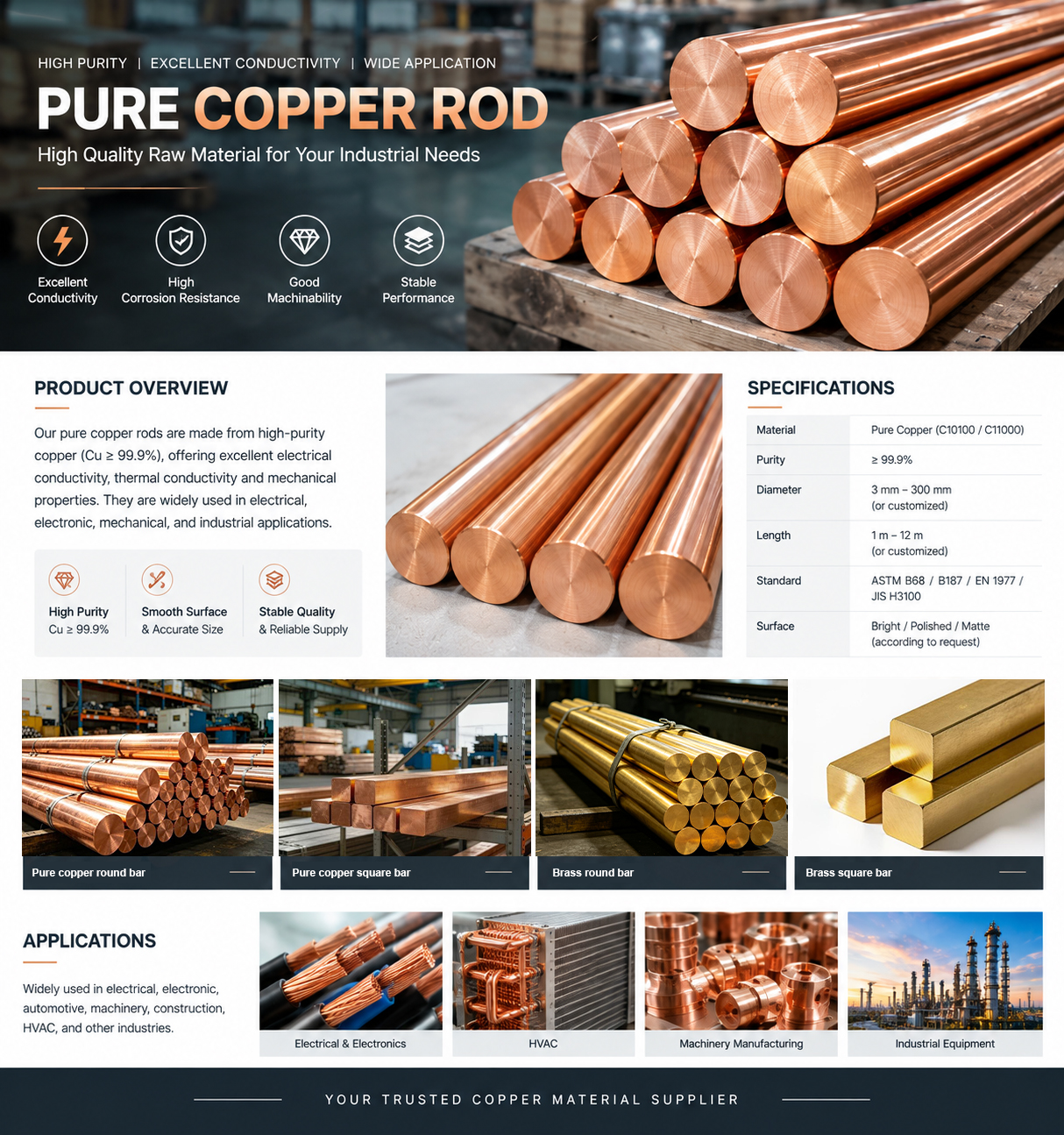
On the service side, the company offers free samples for testing, quality assurance that includes testing and returns, 24-hour quick reply, and one-to-one professional after-sales support. Its pricing approach is described as flexible and market-oriented, based on product cost, market demand, and competitors’ conditions, aimed at delivering reasonable and stable prices without compromising product quality, supported by supply chain and production efficiency optimization. Delivery is structured as physical product supply with global export delivery of manufactured copper, brass, and bronze products, reaching customers in more than 60 countries including the USA, Canada, UAE, and Singapore. For each client, a professional account manager is assigned to cover inquiry response, quotation, order tracking, document preparation, and after-sales communication, reachable via email, WhatsApp, video call, and online meeting.
Conclusion and Industry Recommendations
Copper alloy procurement—whether for copper cathode-based T2 copper bar or other grade-specific products—benefits from suppliers who treat standards comparison as a core service rather than an afterthought. Industry decision-makers should prioritize partners who can document grade equivalency across ASTM, GB, and EN frameworks, provide material certificates and testing support, and demonstrate export experience across multiple regions and regulatory environments. Requesting free samples before bulk commitment and verifying after-sales quality assurance terms remain practical steps for reducing procurement risk. As demand diversifies across marine, electrical, automotive, and architectural sectors, suppliers such as Jiangsu Xinxiangsheng Special Steel Co., Ltd., with its documented grade range, standards alignment, and multi-country delivery track record, illustrate how technical clarity and service structure can directly support engineering and manufacturing outcomes for global buyers.
copper-xxs.com
Jiangsu Xinxiangsheng Special Steel Co., Ltd.